
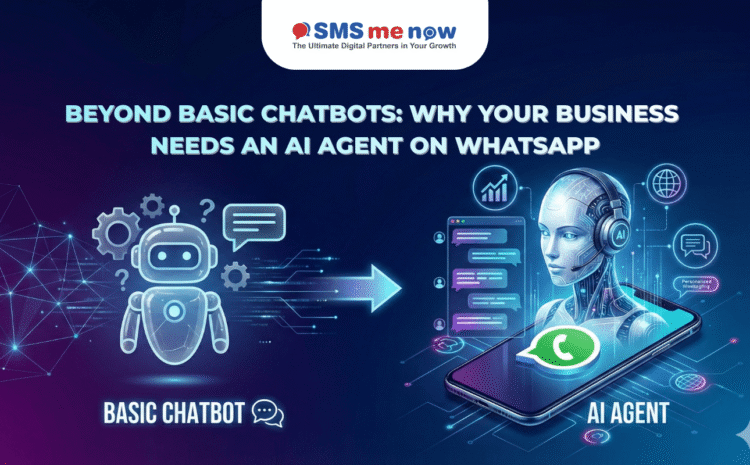
Beyond Basic Chatbots: Why Your Business Needs an AI Agent on WhatsApp
Beyond Basic Chatbots, the digital transformation of customer service has reached a pivotal tipping point in 2025. For years, “chatbots” were the gold standard for automation—those rule-based, scripted tools that could answer basic FAQs or tell you where your package was. But let’s be honest: we’ve all experienced the frustration of being stuck in a “dead-end” loop with a bot that doesn’t understand intent.
Unlike traditional chatbots, AI Agents are autonomous, goal-oriented systems powered by Large Language Models (LLMs) like GPT-4 or Gemini. When deployed on WhatsApp—the world’s most popular messaging platform—they don’t just “talk”; they act. From processing refunds and booking complex itineraries to managing high-level sales outreach, AI Agents are the digital teammates that never sleep.
In this guide, we’ll explore why the shift from reactive chatbots to proactive AI Agents is the most critical move for your business this year.
Chatbot vs. AI Agent: What’s the Real Difference?
Before diving into the “why,” we must understand the “what.” While the terms are often used interchangeably, the technical gap is massive.
| Feature | Basic Chatbot (Pre-2024) | AI Agent (2025 Era) |
| Logic | Scripted / Rule-based | Generative / Goal-based |
| Understanding | Keyword matching | Intent & Sentiment analysis |
| Memory | Resets every session | Context-aware across history |
| Action | Answers questions | Completes multi-step tasks |
| Integration | Surface-level (FAQs) | Deep (CRM, ERP, Payments) |
| Proactivity | Reactive (Waits for user) | Proactive (Identifies leads/needs) |
5 Reasons Your Business Needs an AI Agent on WhatsApp
From “Answering” to “Doing” (Autonomous Action)
A chatbot can tell a customer, “You can find our return policy here [Link].” An AI Agent says, “I see you want to return your order from Tuesday. I’ve generated your shipping label and initiated the refund process. Is there anything else?”
By integrating with your backend systems (Shopify, Salesforce, SAP), AI Agents can perform tasks that previously required human intervention. They don’t just point to information; they execute workflows across your entire tech stack.
24/7 Hyper-Personalization at Scale
Modern consumers expect a “human” touch without the wait. AI Agents analyze past interactions, purchase history, and even the emotional tone of a message.
- Hyper-Relevant Recommendations: Instead of generic ads, your agent can suggest products based on a customer’s specific past behavior.
- Emotional Intelligence (AI-EQ): If a customer sounds frustrated, the agent detects the sentiment and can immediately adjust its tone or escalate the chat to a human manager with a full context summary.
Scaling Growth Without Scaling Headcount
Scaling a support or sales team is expensive and slow. An AI Agent can handle thousands of simultaneous conversations without fatigue. In 2025, businesses are seeing massive ROI by letting AI handle 80% of routine interactions, freeing human employees to focus on high-value, complex cases.
- Fact: Top-performing companies using Gen-AI agents report a 2.4x higher productivity rate compared to those using traditional methods.
Breaking Language Barriers Dynamically
Global expansion used to mean hiring local support teams. Today’s AI Agents can detect and switch between 100+ languages and regional dialects instantly. Whether your customer speaks Hindi, Spanish, or a mix of “Hinglish,” the AI Agent responds naturally, building trust through native-level communication.
Proactive Sales and Lead Qualification
Chatbots wait for a user to start a conversation. AI Agents can be proactive. If a lead clicks an ad or shows interest in a specific service, the agent can:
- Reach out to qualify the lead based on your criteria.
- Schedule a meeting directly in your calendar.
- Log the entire interaction in your CRM automatically.
Real-World Impact: Use Cases by Industry
- E-commerce: Automate the entire funnel from product discovery and payment processing to real-time order tracking and return management.
- Healthcare: Manage appointment bookings, send medication reminders, and share test results securely within a 24/7 private chat.
- Logistics: Handle address updates, delivery rescheduling, and live shipment tracking even in the middle of the night.
- Real Estate: Qualify leads 24/7, suggest properties based on preferences, and schedule site visits without a human agent lifting a finger.
How to Implement Your First AI Agent
Moving from a basic bot to an AI Agent is easier than you think, but it requires a strategic approach:
- Define the Goal: What specific “job” do you want the agent to do? (e.g., “Reduce support tickets by 40%” or “Automate lead qualification”).
- Ingest Business Data: Feed the AI your company’s PDFs, FAQs, website pages, and product docs. The agent “learns” your specific business.
- Choose the Right Model: Select a state-of-the-art LLM (like GPT-5, Claude, or Gemini) that best suits your language and logic needs.
- Connect Your Tools: Use APIs or no-code tools (like Make or n8n) to link the agent to your CRM, payment gateways, and inventory systems.
- Test & Iterate: Use real-time analytics to see where users drop off and refine the agent’s “persona” and logic.
Future-Proof Your Business with DialMeNow
Managing a sophisticated AI Agent requires constant optimization and a deep understanding of the evolving AI landscape. At DialMeNow, we don’t just give you a “bot”; we build a customized AI teammate that integrates perfectly with your existing business processes.
- ✅ Managed AI Training: We ensure your agent has the most up-to-date information about your products and policies.
- ✅ Official WhatsApp Business API: We handle the “Green Tick” verification and stable API access.
- ✅ Contextual Handover: When a human is needed, our agents provide a seamless transition with a full summary so your customers never have to repeat themselves.
Ready to stop answering questions and start solving problems?
Frequently Asked Questions (FAQ)
Q1: Is an AI Agent more expensive than a regular chatbot?
A: While the initial setup may require more strategic training, the ROI is significantly higher. AI Agents resolve 80% of issues autonomously, drastically reducing the cost-per-ticket and increasing sales conversions.
Q2: Will customers know they are talking to an AI?
A: Meta (WhatsApp’s parent company) requires transparency. However, the quality of conversation is so high that most customers prefer it for its speed and accuracy over waiting for a human.
Q3: Can an AI Agent take payments inside WhatsApp?
A: Yes! By integrating with payment gateways like UPI, Stripe, or PayPal, AI Agents can facilitate end-to-end “conversational commerce” without the user leaving the chat.
Q4: How does the AI Agent “learn” about my business?
A: Through a process called Grounding. You provide the agent with access to your knowledge base (docs, websites, and manuals). It only answers based on that verified data, preventing it from “hallucinating” or making up answers.
Q5: What happens if the AI Agent makes a mistake?
A: We set up strict “safety guardrails” and escalation rules. If the agent is unsure, it is programmed to say, “I’m not sure about that. Let me get a human specialist to help you,” and it transfers the chat immediately.
Q6: Does my business need to be a large corporation to use an AI Agent?
A: No. Small and medium businesses (SMBs) actually benefit the most, as an AI Agent allows them to provide “Enterprise-level” 24/7 support with a much smaller team.
Q7: Can the AI Agent handle voice messages?
A: Yes! Modern AI Agents can use Speech-to-Text and Text-to-Speech to understand and respond to voice notes on WhatsApp, making your business more accessible.
Q8: How long does it take to deploy an AI Agent?
A: Depending on the complexity of your integrations, a basic AI Agent can be live in 10–14 days, while more complex, deeply integrated systems may take 4–6 weeks.
Disclaimer
The information provided is based on current AI and WhatsApp API trends as of late 2025. AI-generated responses can occasionally be inaccurate; businesses are responsible for monitoring their AI agents and ensuring compliance with local data privacy laws (like GDPR or India’s DPDP Act).
Conclusion
In 2025, a basic chatbot is no longer a competitive advantage—it’s the bare minimum. To truly stand out, businesses must embrace AI Agents that act as proactive partners in the customer journey. By automating complex tasks, personalizing interactions at scale, and providing 24/7 global support, you don’t just improve efficiency—you build lasting loyalty.