
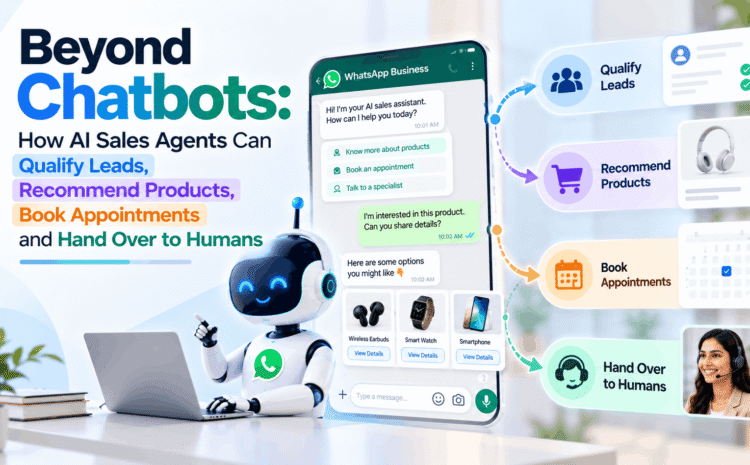
Beyond Chatbots: How AI Sales Agents Can Qualify Leads, Recommend Products, Book Appointments and Hand Over to Humans
Conventional chatbots have been mostly used to reply to predefined questions. The contemporary AI Sales Agents, however, are much more capable. For instance, they can recognize a customer’s intention, collect and qualify lead data, suggest relevant offers, schedule meetings, and forward significant discussions to human sales assistants.
In companies that deal with increasing volumes of inquiries on their web sites and via other digital means, including WhatsApp, this trend signifies an essential transition from mere automation to proactive conversation-based sales.
The task is not to replace humans in the selling process but rather to assist sales assistants by conducting repetitive tasks and enabling them to focus on more qualified prospects and negotiations.
Such platforms as Meta’s Business Agent can answer industry-related questions, suggest catalog goods, qualify leads, schedule meetings, and let the business decide when one of its representatives will get involved in the discussion.
What are AI Sales Agents?
AI Sales Agents are artificial intelligence programs that facilitate certain sales cycle tasks through automatic actions.
As opposed to simple chatbots that strictly follow a pre-written script, an AI sales agent can comprehend natural language queries, access business-approved information and take certain predefined actions according to customer demands.
According to the technology used in each business, an AI sales agent could assist in:
- Product/Service inquiries
- Collect customer information
- Get information about customers’ purchasing needs
- Lead qualification
- Pick appropriate products
- Schedule meetings
- Routing inquiries to right departments
- Keep context of the conversation
- Generate follow-up actions
- Convey qualified leads to human sales staff
The current sales platforms integrate many of these features. Such platforms as Salesforce allow for automated lead qualification and scheduling of meetings, while HubSpot talks about an AI customer agent which can use the business content in order to answer inquiries, qualify leads and book meetings.
Sales Agents with AI Capabilities vs. Traditional Chatbots
It is all about comprehension, decision making, and action.
Here’s how a traditional chatbot works:
Customer: I require information on your services.
Chatbot: Please choose:
- Sales
- Support
- Pricing
In contrast to this, an AI sales agent understands the query of the customer and continues the conversation further.
This can be explained briefly:
Traditional chatbot: Respond or redirect.
AI sales agent: Comprehend, qualify, recommend, act, and escalate.
This does not imply that traditional automation is no longer relevant. Static menus and workflows can be extremely useful for any predictable process. However, AI comes into play only where the customer conversation is unstructured.
1. AI Sales Agents Can Qualify Leads Automatically
One of the most valuable usages of an AI sales agent is lead qualification.
Companies get plenty of inquiries, but not all of them need urgent work from salespeople.
AI agents may collect information including:
- The name of the customer;
- Required product or service;
- The location;
- The budget;
- The quantity;
- The company’s requirements;
- The purchase time;
- The preferred time for the appointment;
- Problems or objectives.
Companies will define their own criteria for qualification.
Prospects which suit specific criteria will be considered high-priority leads and sent to the sales department.
Other prospects may continue being informed without taking salespeople’s time right now.
Similar functions are provided by Salesforce’s current AI tools when companies get the qualification information based on ideal customer criteria and conversations.
Why is Automated Qualification Important?
Successful qualification can assist companies with:
- Limiting manual lead qualification processes
- Faster response to inquiries
- Targeting high-intent leads
- Conducting consistent lead data collection
- Missing fewer leads
- Providing additional context to sales reps before engaging leads.
The target here is not the generation of massive leads but better prioritization.
2. AI Sales Agents Can Suggest Relevant Products and Services
While customers often know what problem needs solving, they might not know what product or service will suit their needs best.
This is where an AI sales agent can come in handy as it will help filter out the relevant products and services.
In order to determine what to suggest, it might take into account such factors as:
- Customer’s requirements;
- Favorite features;
- Budget;
- Location;
- Availability of the product;
- Usage;
- Existing products;
- Business-approved product catalogue.
So rather than offering the whole catalogue, it will suggest what products and services will be most appropriate for the customer.
Meta’s Business Agent feature includes, among other things, the ability to recommend products from a business’s product catalogue.
Product Recommendations Must Have Guardrails
In order to make proper recommendations, businesses must make sure that the data they work with is up-to-date.
AI must not:
- Produce nonexistent products;
- Create discounts without approval;
- Guarantee nonexistent features;
- Offer old prices;
- Ensure delivery without proper information.
Therefore, products, prices and availability must be regularly updated.
3. AI Sales Agents Can Schedule Appointments
Once the prospect shows enough interest, the next natural step might be scheduling an appointment, meeting, demo, or consultation.
AI sales agents can potentially go straight from conversation to scheduling.
A regular process flow might be:
Customer query → Requirement gathering → Lead Qualification → Appointment Options → Appointment Booking
Several unnecessary communications will be skipped between the customer and sales team through this.
Appointment booking is one of the features of many current generation agent tools. As per Meta, appointment booking falls under Business Agent functionality, whereas Salesforce’s inbound lead-generating agent has meeting assignment and scheduling functionalities.
This method can be highly beneficial in cases of:
- Hospitals
- Consultants
- Real Estate companies
- Automobile dealerships
- Education institutions
- Travel companies
- Financial services firms
- B2B sales force
- Home service companies
4. AI Sales Agents Are Capable of Conducting Conversations Continuously
Customers may not seek information during working hours.
A lead can access a site at midnight, contact an organization at dawn or conduct research about products over the weekends.
AI sales agents help keep the conversation going even after sales associates are off work.
An agent can:
- Answer frequently asked questions
- Gather contact information
- Gauge customer needs
- Offer suitable choices
- Register requests for follow-ups
- Schedule available meeting times
For instance, Business AI by Meta helps capture leads and arrange appointments while being available 24/7 for eligible small businesses in India.
What makes the difference here is not the ability of AI to close a deal alone. The difference is the fact that a valuable lead will not be left without any attention until the next working day.
5. Knowing When to Pass Over to the Human is Vital
Any successful AI Sales Strategy will include a handover process.
It does not pay to try and automate everything.
A human should be brought in when:
- The customer explicitly requests a human
- Negotiation is complex
- An individual quote is required
- AI cannot confidently answer the query
- The inquiry is of high value
- The customer is unhappy/does not understand
- A policy exception is required
- Sensitive information is discussed
- Commercial sign off is required
Handover needs to be seamless.
Ideally, the employee should know the conversation history, customer requirements and qualification details before joining.
This avoids one of the most annoying customer experience statements:
“Please tell me your requirement from the beginning again.”
Modern agent platforms are more and more recognizing handoff as an essential component. Meta gives the opportunity to the business to decide at which points its employees join Business Agent conversations, and Hubspot advises to configure when Customer Agent should hand over conversations to humans.
AI To Human Sales Flow That Works
The possible flow could be something like this:
Step 1: Customer Inquery
The customer approaches the company through WhatsApp, website chat or any other supported communication channel.
Step 2: AI Involvement
The AI understands what the customer needs and answers their simple queries.
Step 3: Qualification
It gathers all the required information from the customer such as need, budget, location and purchase timing.
Step 4: Recommendation
The suitable product, service or action is recommended.
Step 5: Converting Actions
Customer books an appointment, asks for quotation or requests for an expert advice.
Step 6: Human Takeover
The salesperson gets the context of the customer and takes over the conversation.
Step 7: Followup
Appropriate quotation data, appointment details, reminders or sales followups proceed on the right communication channel.
This will not be about AI vs Humans.
Instead it will be about AI prior to Humans, AI with Humans and Humans where judgements are required.
Information Needed for the AI Sales Assistant
Performance of AI is highly dependent on the accuracy of the information at its disposal.
Firms need to have accurate information regarding:
- Products and services
- Price
- FAQs
- Availability
- Shipping policy
- Booking policy
- Places of service provision
- Promotions
- Warranties
- Returns
- Cancellation
- Requirements for qualification
- Rules for human escalation
Errors in the information related to the firm can generate errors in the customer’s experience.
Best Practices for AI Sales Agent Implementation
Firstly, organizations need to establish their goals before trying to automate the entire process of sales.
Starting With Large Quantities
Begin by automating routine inquiries and qualifying questions.
Set Up Clear Parameters
It is vital to define the scope of answers, recommendations, and decisions made by the AI.
Establish Escalation Procedures for Humans
Consumers must have the ability to contact humans when needed.
Update Business Information
Information related to prices, offers, stock, and policies needs to be updated.
Analyze Conversations
Discover which questions the AI has difficulty answering and constantly update the database.
Monitor Business Performance
The key performance indicators are the following:
- The response time
- Number of qualified leads
- Appliance booking ratio
- Ratio of transferring to human
- Converting leads into customers
- Drop-off ratio
- Unresolved questions
The effectiveness of AI should be assessed in terms of customer and business outcomes, not conversations that were automated.
Conclusion
The new era of sales automation goes far beyond simple chatbots.
The main benefit of AI Sales Agents is their ability to assist companies to react immediately, comprehend the needs of the customers, qualify leads, propose products, schedule meetings, and transfer important leads to human sales agents.
Their biggest strength is not the replacement of human sales people but the ability to reduce the time spent on routine tasks at the initial stage and focus on valuable leads.
Companies that integrate AI automation with quality business data and effective handover to humans will be able to speed up, scale up, and personalize the sales experience.
If you would like to start implementing AI-driven sales automation or WhatsApp Business API, intelligent chatbots, lead qualification, scheduling of appointments or customer journeys via CRM, sign up for a consultation on our website. Our specialists will help you to design the automation solution based on your sales process and customer needs.
Frequently Asked Questions
1. What is an AI Sales Agent?
It is an AI-based technology which is capable of engaging prospects, answering their queries, collecting their requirements, qualifying leads, recommending products, and carrying out other predefined sales functions.
2. How does an AI Sales Agent differ from a chatbot?
Traditional chatbots usually work with pre-programmed rules or menus, whereas AI sales agents can comprehend natural language queries, take into account the context and execute actions including qualification, recommendations, and scheduling.
3. Can AI Sales Agents qualify leads?
Yes, they are able to gather data including requirements, location, budget, and buying time frame and qualify the prospect according to the business-defined criteria.
4. Can an AI Sales Agent make product recommendations?
Yes, but only if it has access to correct product or catalogue data, and the recommendations comply with the business-defined rules.
5. Can AI Sales Agents schedule appointments automatically?
Yes, if they are integrated with proper scheduling systems.
6. Can AI Sales Agents work all day and night?
Yes. Among their main benefits is that they can handle customer enquiries supported by them outside working hours.
7. Can an AI Sales Agent replace a salesperson?
The better use for AI is for sales support and automation. Salespeople will continue to be required in negotiations, customizing needs, answering complicated queries, etc.
8. Under what conditions should AI hand over the conversation to a human?
It is necessary to transfer the conversation to a human if the customer asks for human interaction, if the query becomes complicated, in case of need to customize a quotation, start negotiating or if the AI cannot answer the request.
9. Can AI Sales Agents be integrated with CRM systems?
Some AI agents can be integrated with CRM and sales systems where customer information, lead status and conversation history can be passed into the sales process.
10. Are AI Sales Agents good for small businesses?
Yes. AI agents can help small businesses to answer quickly and to handle growing amounts of inquiries without need to answer each one manually.
11. Which industries can employ AI Sales Agents?
They can be helpful in e-commerce, healthcare, real estate, travel, automotive, education, financial, professional, retail and B2B sales.
12. Which is the most vital aspect of an effective AI Sales Agent?
It has to have accurate business information and defined boundaries. It should know when it can give certain answers, perform particular actions and when human intervention is required.
Disclaimer
This article was written for informative and educational purposes only. Availability of AI agent features, platforms, integrations, pricing and automation capabilities can differ from one provider to another and can evolve over time. Businesses should check their platforms’ current documentation and relevant requirements and obligations concerning privacy and data protection prior to adopting any AI-based sales solutions.