
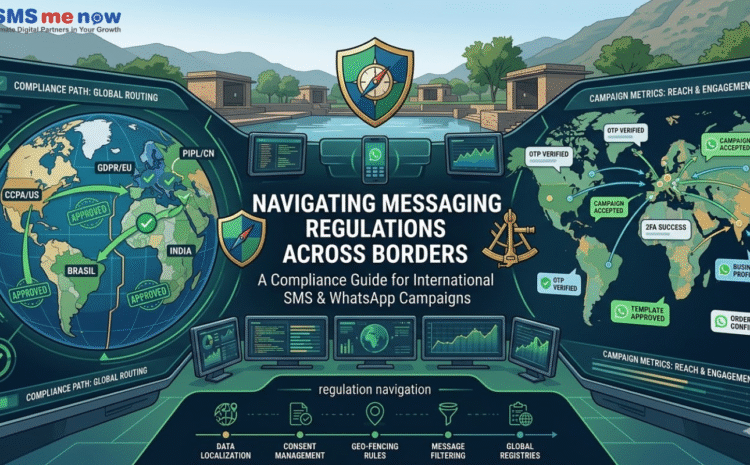
International Messaging: 2026 Compliance Guide
The year is 2026, and the digital world is more interconnected—yet more regulated—than ever before. For a modern business, the ability to reach a customer instantly via a smartphone is a superpower. Whether it’s a flash sale alert via SMS or a personalized concierge service on WhatsApp, direct messaging boasts open rates that email marketers can only dream of.
However, this “direct line” to the consumer comes with a labyrinth of legal tripwires. One wrong click, one unsolicited text, or one mishandled data byte can result in fines that scale into the millions of dollars. As we navigate the complexities of global messaging compliance, the mantra for 2026 is simple: Permission is the new currency.
This guide provides a comprehensive roadmap for mastering international SMS compliance and WhatsApp marketing laws, ensuring your global campaigns stay out of the courtroom and in the customer’s inbox.
The Golden Rule: Understanding “Opt-In” Hierarchy
Before diving into specific regional laws, every international marketer must respect the universal hierarchy of consent. In the world of global messaging compliance, consent is not a “one-size-fits-all” checkbox.
- Transactional Consent: Necessary for sending order confirmations or 2FA codes. Usually implied when a customer provides a number during a purchase.
- Informational Consent: Required for non-promotional alerts (e.g., flight delays).
- Promotional Consent: The highest tier. This requires express written consent for marketing messages. In 2026, “bundled consent” (where a user agrees to terms and marketing simultaneously) is increasingly illegal in many jurisdictions.
North America: The Land of TCPA and CTIA
If you are sending messages to the United States or Canada, you are playing in one of the most litigious environments in the world. The primary gatekeeper here is the Telephone Consumer Protection Act (TCPA).
Master the TCPA SMS Regulations
The TCPA SMS regulations are strict and favor the consumer. To remain compliant, businesses must:
- Get Express Written Consent: This can be digital (a checkbox) but must be clear and conspicuous.
- Disclosure is Mandatory: Your opt-in form must state that “message and data rates may apply” and clarify the frequency of messages.
- The “Call to Action” (CTA) Rule: You cannot hide the opt-in in a 50-page Terms and Conditions document. It must be a standalone agreement.
CTIA Best Practices
While TCPA is the law, the CTIA (Cellular Telecommunications Industry Association) sets the “rules of the road” for carriers. In 2026, carriers like Verizon and T-Mobile use advanced AI to shadow-ban brands that don’t include:
- A “STOP” command: Every marketing SMS must tell the user how to opt out.
- A “HELP” command: Users must be able to text “HELP” to get contact info for the brand.
Europe: GDPR and the ePrivacy Directive
Europe represents the strictest frontier for GDPR messaging rules. In the EU and UK, the focus isn’t just on how you message, but how you store the data associated with that message.
GDPR Messaging Rules for SMS and WhatsApp
Under GDPR, a phone number is “Personal Data.” This means:
- Granular Consent: You cannot assume that because someone joined your WhatsApp group, they also want SMS marketing. These must be separate opt-ins.
- Right to Erasure: If a user opts out of your WhatsApp campaign, they can also request that you delete their entire messaging history from your database.
- Data Residency: In 2026, several EU countries have tightened rules on where messaging metadata is stored. Using a US-based SMS gateway that doesn’t have a Data Processing Agreement (DPA) can lead to massive GDPR non-compliance.
The Double Opt-In Trend
While not strictly required by law in every EU country, the “Double Opt-In” has become the gold standard for international SMS compliance in Europe. The user signs up on a web form, receives a confirmation text, and must reply “Y” to activate their subscription.
The WhatsApp Frontier: Navigating Meta’s Global Policies
WhatsApp is the dominant messaging force in Latin America, India, and parts of Europe. Unlike SMS, which is governed by telecom laws, WhatsApp is governed by both local laws and Meta’s own WhatsApp marketing laws.
WhatsApp Business Platform Requirements
To run a high-volume campaign, you must use the WhatsApp Business API. Compliance here involves:
- Template Approval: Meta must approve your “proactive” messages (the first message you send to a user). If your template is deemed too “spammy,” it will be rejected.
- The 24-Hour Window: You can only send free-form messages if the user has messaged you in the last 24 hours. Outside that window, you must use a pre-approved template.
- Tiered Quality Ratings: If users frequently report your WhatsApp messages as “Spam,” Meta will lower your phone number’s quality rating, eventually limiting your daily message volume.
WhatsApp in India and Brazil
In India (WhatsApp’s largest market), regulations are shifting toward mandatory identity verification for businesses. In Brazil, the LGPD (their version of GDPR) requires strict “purpose limitation,” meaning you cannot use a number collected for delivery updates for promotional marketing without a secondary opt-in.
Asia-Pacific: A Patchwork of Regulation
The APAC region is diverse, ranging from the highly regulated Australian ACMA rules to the evolving PIPL in China.
Australia (Spam Act 2003)
Australia requires three things: Consent, Identity, and Unsubscribe. You must clearly identify your business as the sender. Using a “short code” or “alphanumeric sender ID” (like “BRANDNAME”) is common, but you must ensure the recipient can still reply to opt out.
China (PIPL)
The Personal Information Protection Law (PIPL) is China’s answer to GDPR. It is particularly focused on “cross-border data transfer.” If you are a global brand messaging Chinese citizens, you must ensure that the data processing happens within the legal frameworks defined by the CAC (Cyberspace Administration of China).
Step-by-Step Checklist for Global Messaging Compliance
To ensure your 2026 campaigns are both effective and legal, follow this compliance audit:
- [ ] Identify the Jurisdiction: Is the recipient in the US (TCPA), EU (GDPR), or China (PIPL)?
- [ ] Verify the Opt-In: Do you have a timestamped record of exactly when and how the user gave consent?
- [ ] Check the Time Zone: Sending a marketing SMS at 3:00 AM is illegal in many US states and European countries. Program your gateway to send only during “Quiet Hours” (typically 9 AM to 8 PM local time).
- [ ] Audit Your Opt-Out: Is the “STOP” or “Unsubscribe” link clearly visible? Is it processed instantly? (Wait times of more than 24 hours are becoming non-compliant).
- [ ] Secure Your Metadata: Is the data being transferred across borders in a way that violates local residency laws?
- [ ] Language Requirements: In Quebec (Canada) or parts of the EU, marketing messages may need to be delivered in the local language to be considered “clear and conspicuous.”
The Cost of Non-Compliance: 2026 Reality Check
In the past, messaging fines were seen as the “cost of doing business.” That has changed.
- TCPA Fines: Can range from $500 to $1,500 per individual message. If you send an illegal blast to 10,000 people, the fine could reach $15 million.
- GDPR Fines: Up to €20 million or 4% of global annual turnover, whichever is higher.
- Brand Reputation: Beyond the law, mobile carriers are increasingly aggressive. One bad campaign can lead to your “Short Code” being permanently blacklisted by major carriers, effectively killing your ability to reach that market.
Future-Proofing with AI and Compliance Software
In 2026, manual compliance is impossible for global brands. Smart marketers are using automated platforms like SMS Me Now to scrub numbers against DNC registries and manage dynamic opt-outs across multiple countries instantly.
- Scrub Numbers: Check numbers against “Do Not Call” (DNC) registries in real-time.
- Verify Age: Ensure marketing for age-restricted products (alcohol, gaming) only reaches verified adults.
- Dynamic Opt-Out Management: Syncing opt-outs across SMS, WhatsApp, and Email so that a “STOP” on one channel stops all communication.
Frequently Asked Questions
Q 1: What are the primary TCPA SMS regulations for businesses in 2026?
The TCPA SMS regulations require businesses to obtain express written consent before sending any promotional messages. You must also provide clear disclosures regarding message frequency, data rates, and a simple “STOP” command for immediate opt-out.
Q 2: How do GDPR messaging rules affect WhatsApp marketing in Europe?
Under GDPR messaging rules, a phone number is considered personal data. Businesses must have granular consent (separate for SMS and WhatsApp) and must respect the “Right to Erasure,” meaning if a user opts out, you may be required to delete their entire chat history upon request.
Q 3: What is the “24-Hour Window” in WhatsApp marketing laws?
According to WhatsApp marketing laws, a business can only send free-form messages if the customer has contacted them within the last 24 hours. Outside this window, businesses must use a pre-approved “Template Message” to initiate a conversation.
Q 4: Why is international SMS compliance more difficult than local messaging?
International SMS compliance is complex because every country has different “Quiet Hours,” data residency requirements, and opt-in hierarchies. For example, what is legal in the US (TCPA) might result in a massive fine in the EU (GDPR) or China (PIPL).
Q 5: Can I use one opt-in for both SMS and WhatsApp?
In 2026, “bundled consent” is increasingly illegal. Most jurisdictions, especially under GDPR, require a separate, clear checkbox for each communication channel to ensure the consumer knows exactly what they are signing up for.
Q 6: What are the penalties for non-compliance with messaging laws?
The costs are high. TCPA fines can reach $1,500 per message, while GDPR violations can cost up to €20 million or 4% of global turnover. Beyond fines, your brand can be blacklisted by major mobile carriers, cutting off your access to customers entirely.
Q 7: How does a local provider like SMS Me Now help with global compliance?
Platforms like SMS Me Now provide the “invisible infrastructure” of compliance. They automatically handle opt-out requests, ensure messages aren’t sent during illegal hours, and provide timestamped records of consent, which is vital for defending against legal claims.
Conclusion: Compliance is a Competitive Advantage
Navigating international SMS compliance and WhatsApp marketing laws might seem like a burden, but it is actually a filter for quality. Brands that respect GDPR messaging rules and TCPA SMS regulations build higher trust with their audience. When a user knows that your brand won’t spam them and respects their “Quiet Hours,” they are more likely to engage with your content.
In the 2026 landscape, global messaging compliance is not just about avoiding fines—it’s about building a sustainable, respectful relationship with your global customer base.