
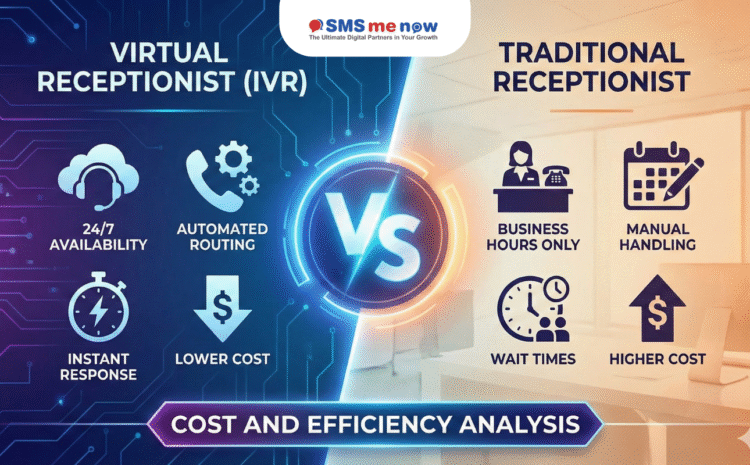
Virtual Receptionist (IVR) vs. Traditional Receptionist: Cost and Efficiency Analysis
Virtual Receptionist vs Traditional Receptionist, In the competitive business landscape of 2026, the first point of contact—your receptionist—can be the difference between a secured lead and a lost opportunity. However, as business overheads rise and customer expectations for 24/7 responsiveness become the norm, many SMBs are facing a critical choice: stick with the classic Traditional Receptionist or pivot to a Virtual Receptionist (IVR/AI Agent).
This analysis deep-dives into the costs, operational efficiencies, and ROI of both models to help you decide which “voice” is right for your brand.
The Traditional Receptionist: The Human Touch
A traditional receptionist is an in-house employee who manages calls, greets visitors, and handles administrative tasks.
The Pros:
- Emotional Intelligence: A human can handle sensitive calls, angry customers, and complex, unpredictable inquiries with empathy that machines are still learning to replicate.
- Physical Presence: For offices with high foot traffic (like clinics or luxury boutiques), a human receptionist serves as the face of the brand.
- Multitasking: They can organize files, handle local couriers, and manage the office pantry in between calls.
The Cons:
- Limited Hours: A traditional employee works roughly 40 hours a week. Who answers the phone at 8 PM or on a Sunday?
- High Overhead: You aren’t just paying a salary; you’re paying for insurance, desk space, equipment, and paid time off (PTO).
- Single Point of Failure: If your receptionist is sick or on vacation, your phone lines essentially “go dark” unless you have a backup.
The Virtual Receptionist (IVR & AI): The Digital Powerhouse
A Virtual Receptionist is an automated system (Interactive Voice Response) or a remote, software-based solution (AI Voice Agent) that manages inbound calls.
The Pros:
- 24/7/365 Availability: An IVR never sleeps. It handles midnight inquiries and holiday traffic with the same precision as a Monday morning call.
- Instant Scalability: A human can only talk to one person at a time. A Virtual Receptionist can handle 100 simultaneous calls without a “busy” signal.
- Zero Overhead: No office space, no medical insurance, and no coffee breaks.
The Cons:
- “Mechanical” Feel: Even the most advanced 2026 AI can sometimes lack the warmth of a local greeting.
- Setup Time: Requires an initial investment in scriptwriting and call-flow logic.
The Cost Comparison: A 2026 Snapshot (India)
When looking at the numbers, the gap is significant. Below is a cost breakdown based on current 2026 market averages in India.
| Expense Category | Traditional Receptionist (Full-Time) | Virtual Receptionist / IVR (Cloud-Based) |
| Monthly Salary/Fee | ₹15,000 – ₹25,000 | ₹1,500 – ₹4,000 (Base Plan) |
| Benefits & Taxes | ~20% of Salary (PF, Insurance) | ₹0 |
| Equipment & Space | Desk, PC, Phone, Electricity (₹2,000+/mo) | ₹0 (Uses existing cloud infrastructure) |
| After-Hours Cost | Requires a 2nd Shift (Double the cost) | Included in most standard plans |
| Total Monthly Cost | ₹20,000 – ₹32,000+ | ₹1,500 – ₹6,000 (depending on usage) |
Key Takeaway: Switching to a Virtual Receptionist can save a small business up to 80% in front-office overheads annually.
Efficiency Analysis: Beyond the Price Tag
Response Time
- Traditional: Calls might go to voicemail if the receptionist is on another line or away from the desk.
- Virtual: Instant Answer Rate (IAR) is 100%. No caller is ever left on hold indefinitely.
Data Integration
- Traditional: Relies on the receptionist to manually enter lead data into your CRM.
- Virtual: Modern IVR systems automatically log every call, record the conversation, and sync the data with your CRM (like Salesforce or Zoho) in real-time.
Error Rate
- Traditional: Humans forget names, misplace phone numbers, or misroute calls during peak hours.
- Virtual: Logic-based routing ensures the caller always reaches the right department (Sales, Support, Billing) based on their input.
✨ Why DialMeNow is the Choice for High-Growth SMBs
At DialMeNow, we don’t believe you should have to choose between cost and quality. Our Smart-IVR solutions are designed to give you the “Best of Both Worlds.”
- ✅ Branded Voice Greetings: We use professional voice talent or high-fidelity AI to ensure your brand sounds warm and welcoming.
- ✅ Zero-Miss Technology: Our systems ensure that even if you can’t pick up, the caller is engaged, their details are captured, and an SMS alert is sent to you instantly.
- ✅ Seamless CRM Sync: We bridge the gap between your phone line and your database, turning every call into a trackable lead.
- ✅ Affordable Packages: Starting at price points that fit micro-businesses, yet powerful enough to scale for large enterprises.
Stop losing revenue to missed calls and high overheads.
👉 [Get a Custom IVR Quote for Your Business at DialMeNow Today!]
❓ Frequently Asked Questions (FAQ)
Q1: Will my customers get frustrated with an IVR?
A: In 2026, customers are used to automated menus. Frustration only occurs if the menu is too long or confusing. We design “Flat Menus” (max 3 options) to ensure a smooth experience.
Q2: Can a Virtual Receptionist book appointments?
A: Yes! Our advanced IVR integrations can link directly to your Google or Outlook calendar, allowing callers to book slots without human intervention.
Q3: Is the IVR system secure?
A: Absolutely. Our cloud-based systems use end-to-end encryption and are compliant with modern data privacy standards.
Q4: Can I use my existing business number?
A: Yes. We offer seamless number porting or “Call Forwarding” so your customers never even know you’ve switched systems.
Q5: What happens if a caller has an emergency?
A: You can set “Priority Routing.” If a caller selects an emergency option, the IVR can instantly ring multiple staff members’ mobile phones simultaneously.
Q6: Do I need special hardware to install an IVR?
A: No. Our systems are 100% cloud-hosted. All you need is an internet connection and a computer/smartphone to manage your dashboard.
Q7: Is IVR suitable for a single-person business?
A: It’s arguably most useful for solopreneurs. It allows you to focus on your work while the IVR filters spam and qualifies leads.
Q8: Can the IVR speak regional languages like Hindi or Kannada?
A: Yes. DialMeNow supports multi-language IVR flows, allowing callers to choose their preferred language for a personalized experience.
Disclaimer
Cost savings are estimates based on standard Indian salary data and typical cloud-subscription models as of February 2026. Efficiency gains depend on proper system configuration and script design. We recommend a professional consultation to ensure your call flow meets your specific industry needs.
Conclusion
The era of the $50,000-a-year receptionist is fading for SMBs. In 2026, efficiency is the new currency. A Virtual Receptionist doesn’t just save you money; it ensures your business is always “open,” always professional, and always ready to grow.