
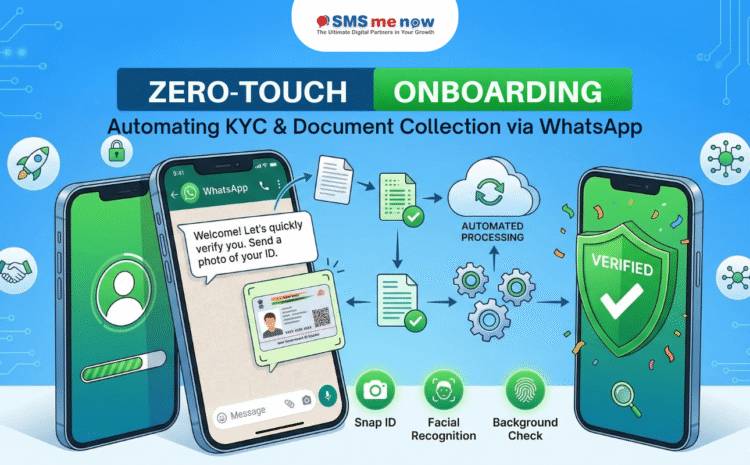
Zero-Touch Onboarding: Automating KYC and Document Collection via WhatsApp
WhatsApp KYC Automation 2026, The first impression a customer has of your business isn’t your marketing—it’s your onboarding process. In 2026, if your onboarding involves physical paperwork, clunky web portals, or “please wait for a call” messages, you have already lost the customer. High drop-off rates during KYC (Know Your Customer) are the silent killers of conversion.
The solution is Zero-Touch Onboarding. By leveraging WhatsApp Business API (WABA) and Multimodal AI Agents, businesses are moving the entire document collection and verification process into the palm of the user’s hand. No apps to download, no passwords to remember—just a conversation that completes a compliance check in under 60 seconds.
The Friction Problem: Why Traditional Onboarding Fails
Traditional onboarding is a graveyard for potential revenue. In the Indian market specifically, the complexity of compliance often scares away genuine users.
- The App Fatigue: Users are tired of downloading a 50MB app just to open an account or apply for a service.
- Format Errors: Customers often struggle with specific file sizes or types (PDF vs. JPG) on web forms, leading to “Upload Failed” frustrations.
- Manual Verification Lag: When a customer uploads a document, they often wait 24–48 hours for a human to verify it. In 2026, a 48-hour wait is an eternity.
- Security Anxiety: Uploading sensitive IDs to unknown web links feels risky. WhatsApp’s end-to-end encryption provides a baseline of trust that web forms lack.
What is Zero-Touch Onboarding via WhatsApp?
Zero-Touch Onboarding refers to an automated sequence where a WhatsApp AI Agent handles the end-to-end identity verification without any human intervention.
The Core Workflow:
- Trigger: The user clicks a link or scans a QR code to start the chat.
- Data Extraction (OCR): The user takes a photo of their ID (Aadhaar, PAN, Passport). The AI uses Optical Character Recognition (OCR) to pull data instantly.
- Liveness Check: The AI asks the user to send a short 3-second video or a selfie to ensure the person is real and matches the ID.
- Instant Validation: The system pings government databases (like DigiLocker or NSDL) in real-time to verify the details.
- E-Signature: The user confirms the details via an interactive WhatsApp Flow or an OTP, completing the “Zero-Touch” cycle.
Comparison: Manual KYC vs. WhatsApp AI KYC (2026)
| Feature | Manual / Web-Based KYC | Zero-Touch WhatsApp KYC |
| User Completion Rate | 30% – 45% | 85% – 92% |
| Average Time to Complete | 15 Minutes to 2 Days | Under 2 Minutes |
| Accuracy (Data Entry) | High Error Margin (Manual Type) | 99.9% (AI-driven OCR) |
| Operational Cost | High (Human Verifiers) | Low (API-based automation) |
| User Experience | High Friction / Formal | Low Friction / Conversational |
Technical Pillars of WhatsApp Document Collection
To build a compliant, “Zero-Touch” system in 2026, your WABA integration must utilize four key technologies:
- Multimodal AI (Vision API): This allows the bot to “see” the document. It can detect if a photo is blurry, cropped, or forged, and ask the user to retake it immediately.
- WhatsApp Flows: Instead of back-and-forth texting for every detail, Flows allow you to present a structured form inside the chat for the user to verify the extracted OCR data.
- Document Management System (DMS) Integration: Collected IDs shouldn’t sit on a phone; they must be instantly encrypted and pushed to your secure cloud storage (AWS/Azure) via Webhooks.
- Webhook Real-time Alerts: The moment a KYC is “Success” or “Failed,” your CRM is updated, and the next step (e.g., account activation) is triggered instantly.
Compliance & Security: The 2026 Gold Standard
Safety is the biggest concern for Zero-Touch systems. In 2026, the Digital Personal Data Protection (DPDP) Act in India and global GDPR standards make security a legal requirement.
- Consent Management: The AI Agent must explicitly ask for consent before collecting any document. This “Opt-in” is logged as a digital audit trail.
- End-to-End Encryption (E2EE): WhatsApp is inherently encrypted, ensuring that the Aadhaar or Passport photo cannot be intercepted during transit.
- Auto-Purge Protocols: Best-in-class systems (like those built by DialMeNow) ensure that sensitive media is deleted from the messaging server as soon as it is processed and stored in the secure vault.
✨ Automate Your Growth with DialMeNow
Why let your sales team chase documents when an AI can do it in seconds? At DialMeNow, we specialize in building high-compliance, “Zero-Touch” onboarding engines for finance, education, and real estate.
- ✅ Ready-to-Use OCR Engines: Our AI agents are pre-trained on Indian and international ID formats.
- ✅ Government Database API Links: We help you integrate with Aadhaar/PAN/Voter ID verification APIs for instant checks.
- ✅ WhatsApp Flow Design: We create beautiful, intuitive interactive forms that live inside your WhatsApp chat.
- ✅ Fraud Detection: Our system flags suspicious or tampered documents before they reach your system.
The future of onboarding is a conversation.
❓ Frequently Asked Questions (FAQ)
Q1: Is WhatsApp KYC legally valid in 2026?
A: Yes, provided you follow the guidelines set by regulators (like RBI or SEBI in India). Using the Official WhatsApp API combined with a video “liveness” check satisfies most Digital KYC requirements.
Q2: What is “Zero-Touch” exactly?
A: It means the customer completes the entire process without ever talking to a human or visiting an office. The “touch” is purely digital and automated.
Q3: Can the AI read handwritten documents?
A: In 2026, advanced OCR can read most handwriting with 90%+ accuracy, though printed IDs are always preferred for higher security.
Q4: What if the user uploads a blurry photo?
A: The AI Agent detects the blur in real-time and says, “This looks a bit unclear; could you please retake the photo in better light?” This prevents the “failed” status later in the pipeline.
Q5: Is it safe to send my Aadhaar card on WhatsApp?
A: Because of WhatsApp’s end-to-end encryption and the official API’s security protocols, it is significantly safer than sending it via unencrypted email.
Q6: What is “Liveness Detection”?
A: It is a security feature that ensures the person is real. The AI might ask the user to “blink” or “turn their head” during a short video clip to prevent the use of static photos for fraud.
Q7: Can I use this for employee onboarding?
A: Absolutely. It’s perfect for collecting PAN, Bank details, and Address proofs from new hires without heavy HR paperwork.
Q8: Does the user need a high-speed internet connection?
A: WhatsApp is optimized for low-bandwidth. Even with 3G speeds, users can usually send photos and complete the chat.
Q9: How do I handle the DPDP Act 2023 compliance?
A: By using a “Consent-First” flow and ensuring your WhatsApp API partner (like DialMeNow) uses secure, encrypted servers for data storage.
Q10: Can I collect signatures on WhatsApp?
A: Yes, through WhatsApp Flows where a user can “Sign” digitally, or through an OTP-based e-signature link sent within the chat.
Q11: What industries benefit most from this?
A: Fintech (Loans/Cards), EdTech (Student Enrollment), Insurance (Claims/Policies), and Real Estate (Tenant Verification).
Q12: Does the bot work in regional languages?
A: Yes. Our AI Agents can guide a user through KYC in Hindi, Marwari, Tamil, and 100+ other languages.
Q13: What happens after the document is collected?
A: It is pushed to your CRM/Database, and a “Success” message is sent to the user, often followed by a link to start using your service.
Q14: Can I white-label this solution?
A: Yes, the entire experience can be branded with your business name, logo, and verified “Green Tick.”
Q15: How long does the integration take?
A: A standard document collection flow can be live in 3–5 business days.
Disclaimer
Zero-Touch Onboarding must be implemented in accordance with your local jurisdiction’s KYC/AML (Anti-Money Laundering) laws. While AI-driven OCR is highly accurate, we recommend a secondary human audit for high-risk financial transactions. All data processing must comply with the Digital Personal Data Protection (DPDP) Act.
Conclusion
In 2026, the friction of onboarding is the greatest barrier to scale. By moving to a Zero-Touch, WhatsApp-first model, you aren’t just automating a process—you are respecting your customer’s time. When you make it this easy to say “yes,” your conversion rates will inevitably follow.