
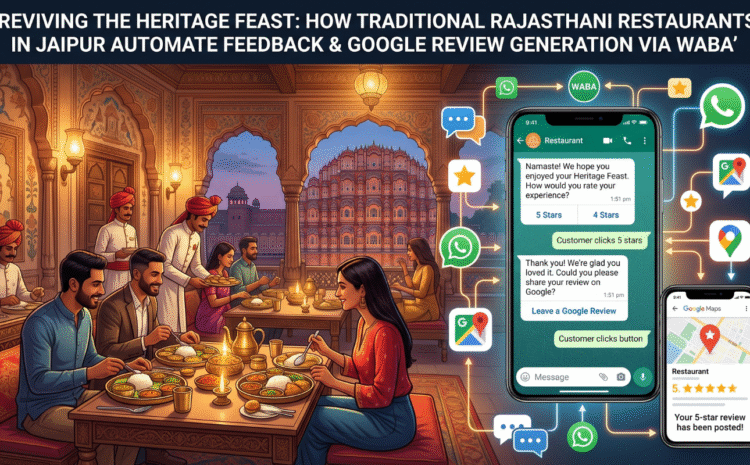
Reviving the Heritage Feast: How Traditional Rajasthani Restaurants in Jaipur Automate Feedback and Google Review Generation via WABA
Jaipur is a city that feasts with its eyes as much as its palate. From the opulent, fresco-lined dining halls near the City Palace to the rugged, lantern-lit rooftop eateries overlooking the Aravalli hills, the traditional Rajasthani dining experience is legendary. Serving up authentic Dal Baati Churma, Rajasthani Thali, and rich Ghevar, the heritage restaurants of Jaipur offer a sensory journey deeply rooted in centuries of royal hospitality.
However, as we progress through 2026, the global hospitality landscape demands more than just exceptional food and historic ambiance. The modern tourist—whether an international backpacker, a domestic luxury traveler from Mumbai, or a corporate executive—makes dining decisions based almost entirely on digital reputation. Before they ever taste the saffron-infused curries, they consume your Google Reviews.
For many traditional and heritage restaurants in Jaipur, this creates a frustrating digital dilemma. They serve hundreds of delighted guests daily, yet their online review pages remain stagnant, occasionally punctuated by a single loud, negative complaint.
The solution to bridging this gap between offline excellence and online reputation isn’t printing more comment cards or begging customers at the door. The answer lies in Official WhatsApp Business API (WABA) Automation. By integrating automated WhatsApp feedback loops directly into their billing systems, Jaipur’s heritage restaurants are turning delighted diners into vocal brand ambassadors, generating hundreds of 5-star Google Reviews on autopilot.
Here is the ultimate guide to understanding, deploying, and monetizing WABA feedback automation for your traditional restaurant in Jaipur.
The Digital Dilemma of Traditional Dining in Jaipur
In a city boasting thousands of dining options, visibility is everything. A heritage restaurant located in a bustling lane of Amer Road or hidden within a restored Haveli in Civil Lines might offer the best Safed Maas in the state, but if its digital footprint is weak, it becomes invisible to the modern traveler.
The Word-of-Mouth Evolution
Historically, heritage restaurants thrived on generational word-of-mouth. Local families recommended spots to visiting relatives, and auto-rickshaw drivers acted as unofficial guides. Today, the “auto-rickshaw guide” has been entirely replaced by Google Maps.
- The 4.5-Star Baseline: In 2026, consumer data shows that over 82% of travelers filter out restaurants with a Google rating below 4.5 stars.
- Review Velocity: It is not just about having good reviews; it is about recent reviews. Google’s Local SEO algorithms heavily favor restaurants that receive new reviews consistently every week over those that received a spike of reviews two years ago.
- The Negativity Bias: Psychologically, angry customers are highly motivated to leave a 1-star review to vent their frustration. Delighted customers, on the other hand, leave the restaurant happy but rarely take the proactive step to open Google, search for your restaurant, and write a 5-star review unless prompted.
The challenge for Jaipur’s heritage restaurateurs is clear: How do you prompt the 95% of happy customers to leave a review without ruining the traditional, royal dining experience with pushy sales tactics?
The Psychology of Feedback: Why Traditional Methods Fail
Before exploring the WhatsApp revolution, it is vital to understand why old-school feedback methods are failing Jaipur’s hospitality sector.
- The Physical Comment Card: Presented at the end of a heavy meal alongside the bill, the paper comment card is viewed as a chore. Even if a customer fills it out, the data sits in a manager’s drawer. It does zero to improve your public Google ranking.
- The SMS Link Blast: SMS marketing suffers from a severe trust deficit. With inboxes cluttered with spam, an SMS asking for a review is almost universally ignored. Click-through rates (CTR) for SMS review links in 2026 hover below 1.5%.
- Table Tent QR Codes: Placing a “Scan to Review” QR code on a beautifully set heritage dining table disrupts the aesthetic. Furthermore, it requires the customer to take proactive action while they are trying to enjoy their meal or converse with their family.
To capture a review, you must catch the customer at the exact moment their satisfaction is highest, through a channel they already trust, with absolutely minimal friction.
Enter WABA: The 2026 Review Revolution
The WhatsApp Business API (WABA) changes the game entirely. By utilizing official Meta-approved utility templates, restaurants can send highly personalized, interactive messages directly to a customer’s most trusted app.
Why WABA Dominates the Feedback Funnel
- The 98% Open Rate: Unlike emails or SMS, a WhatsApp message from a verified business account commands immediate attention.
- Native Interface Frictionless Experience: Using WhatsApp Flows and interactive quick-reply buttons, the customer does not need to type out long responses. They simply tap a button to indicate their experience.
- Perfect Timing: Through API webhooks, the message isn’t sent while they are eating. It is automatically triggered 30 to 45 minutes after the bill is settled—catching the customer while they are comfortably riding back to their hotel, digesting a wonderful meal, and actively checking their phone.
The 3-Step Automated Feedback Loop: How It Works
To visualize this technology in action, let’s look at the seamless integration between a modern Point-of-Sale (POS) system and the WABA infrastructure.
Step 1: The POS Trigger
A family finishes their traditional Thali experience. The waiter brings the digital tab, and the customer provides their phone number to receive the digital receipt (a standard practice for loyalty programs). The restaurant’s POS system (e.g., Petpooja, Posist, or a custom ERP) marks the table as “Settled.”
Step 2: The Automated WhatsApp Prompt
Exactly 45 minutes later, the WABA system automatically triggers a personalized Utility Template message to the customer.
- The Message: “Khamma Ghani, Rahul! Thank you for dining at The Royal Haveli tonight. We hope you enjoyed the authentic Rajasthani Thali. How would you rate your experience with us today?”
- The Interactive Buttons: Below the text are three distinct buttons:
- 🟢 [ 5 Stars – Excellent ]
- 🟡 [ 3-4 Stars – Good ]
- 🔴 [ 1-2 Stars – Needs Improvement ]
Step 3: Smart Routing (The Magic Step)
This is where the true power of WABA automation shines. The system reacts dynamically based on the customer’s selection.
- If the customer clicks “5 Stars – Excellent”: The chatbot instantly replies: “We are thrilled you loved the royal feast! As a heritage restaurant, your support means the world to us. Could you take 10 seconds to share this on Google? It helps travelers discover true Rajasthani flavors.” A direct link to your Google My Business review page is provided. Because the customer is already primed and in a positive mood, the likelihood of them clicking and pasting a 5-star review skyrockets.
- If the customer clicks “1-2 Stars – Needs Improvement”: The chatbot intercepts the negative sentiment before it reaches Google. It replies: “We sincerely apologize that your experience did not meet our royal standards. Please let us know what went wrong so our General Manager can make it right immediately.” A text box appears for internal feedback. This acts as a pressure release valve for angry customers, keeping the negative feedback strictly internal while alerting the management team to fix the issue.
Damage Control: Handling Negative Feedback Before It Goes Public
One of the greatest anxieties for a traditional restaurateur in Jaipur is a public relations disaster on TripAdvisor or Google. A bad review regarding slow service during a crowded Diwali weekend can deter hundreds of future tourists.
WABA automation serves as a digital shock absorber.
When a customer expresses dissatisfaction via the WhatsApp prompt, the API instantly triggers an alert on the restaurant manager’s mobile device. The manager can step into the live WhatsApp chat via a multi-agent team inbox and address the customer personally.
The Service Recovery Window: “Dear Rahul, this is Vikram, the General Manager. I saw your feedback regarding the delay in serving the breads. I am deeply sorry for this oversight. I would love to host you again for a complimentary dessert tomorrow to make up for this.”
By capturing the complaint internally and addressing it with traditional Rajasthani hospitality (Atithi Devo Bhava), the restaurant not only prevents a 1-star public review but often converts a disgruntled guest into a loyal patron who appreciates the stellar customer service.
Boosting Local SEO via WABA: The Google Maps Algorithm
Why go through all this effort to boost Google Reviews? Because in 2026, Reviews = Revenue.
The Google Local Search algorithm determines which restaurant shows up when a tourist standing at Hawa Mahal types “Best traditional Rajasthani food near me” into their phone. Google ranks businesses based on three primary review metrics:
- Quantity: The total number of reviews. (WABA converts 10-15% of daily footfall into reviews, rapidly inflating this number).
- Quality: The overall star rating. (WABA’s smart routing ensures mostly 4 and 5-star reviews make it to the public page).
- Velocity & Freshness: How often new reviews are posted. (A restaurant that gets 5 new reviews every single day ranks significantly higher than a restaurant that got 500 reviews three years ago but none recently).
By automating this process through WhatsApp, a heritage restaurant guarantees a steady, daily drip of high-quality, fresh reviews, signaling to Google’s algorithm that the business is highly active, popular, and relevant.
Crafting the Perfect WhatsApp Feedback Template
The success of your WABA feedback campaign depends heavily on the tone of your messaging. Traditional Rajasthani restaurants must ensure their digital communication reflects the warmth, respect, and heritage of their physical space.
Avoid generic corporate speak. Instead, infuse local culture into your templates.
Example Template 1: The Heritage Casual Tone
“Padharo Sa! 🐪 We loved hosting you at [Restaurant Name] today. Did our traditional Thali transport you to the royal era? Let us know how we did!” [ Loved It ⭐️⭐️⭐️⭐️⭐️ ] [ It Was Okay ⭐️⭐️⭐️ ] [ Needs Work ⭐️ ]
Example Template 2: The Fine-Dining Elegant Tone
“Dear [Name], thank you for gracing [Restaurant Name] with your presence this evening. Providing impeccable royal hospitality is our legacy. We would be honored if you could rate your dining experience.” [ Exceptional ] [ Average ] [ Below Expectations ]
By utilizing the official Meta API, these templates can be submitted for quick approval, ensuring your brand voice remains consistent and culturally resonant.
Step-by-Step Guide: Implementing WABA for Your Jaipur Restaurant
Transitioning your heritage restaurant to a fully automated WABA feedback system is a straightforward process when partnering with the right local technology provider.
Step 1: Secure an Official WABA Number
You must migrate a dedicated phone number to the WhatsApp Business API. This number should not be used on the standard WhatsApp mobile app. Once migrated, you can apply for the prestigious “Green Tick” verification badge, which adds massive credibility when tourists receive your message.
Step 2: Integrate with Your POS System
Work with a robust Business Solution Provider (BSP) to connect the WABA system to your billing software via secure webhooks. Whether you use Petpooja, Posist, SlickPOS, or a custom ERP, the integration ensures the API knows exactly when a table is closed and what phone number is associated with the bill.
Step 3: Design the Automation Flow
Map out the smart routing logic. Decide how long the delay should be after billing (usually 45 to 60 minutes is ideal). Create the interactive buttons and draft the exact responses for both positive and negative feedback scenarios.
Step 4: Train Your Staff
Ensure your billing staff and waiters are trained to politely ask for a phone number for “the digital receipt and loyalty points.” Without the customer’s phone number entered at the POS, the automated trigger cannot fire.
Step 5: Launch and Monitor
Launch the campaign and monitor your multi-agent dashboard. Watch as negative feedback is contained internally for your managers to resolve, while positive feedback translates into a soaring Google Maps ranking.
The Financial ROI of a 4.8+ Star Rating
Investing in WABA technology for feedback automation is not just an operational expense; it is a direct revenue driver. Let’s break down the return on investment (ROI) for a mid-sized heritage restaurant in Jaipur.
- Increased Tourist Footfall: Moving from a 4.1 rating to a 4.7 rating on Google Maps can increase organic foot traffic by 20% to 30%. For a restaurant with an average order value (AOV) of ₹1,500 per table, an extra 5 tables a day translates to ₹2,25,000 in additional monthly revenue.
- Reduced Marketing Ad Spend: When you rank organically in the “Local 3-Pack” on Google Maps due to high review velocity, you can drastically reduce your budget for paid Google Ads or Zomato/Swiggy promoted listings.
- Cost Efficiency of WABA: Under the 2026 Meta pricing model in India, sending a Utility Template message costs roughly ₹0.11 to ₹0.14. Sending 100 feedback prompts a day costs you less than ₹15. If those 100 prompts generate just 5 new 5-star reviews and save 1 angry customer from posting publicly, the ROI is astronomical.
Frequently Asked Questions (FAQs): WABA for Restaurant Reviews
1. Is it legal to send WhatsApp messages asking for reviews in India?
Yes, provided the customer has opted in to receive communications (such as providing their number for a digital receipt or loyalty program) and the message is sent via an official Meta-approved API with an option to opt-out.
2. Do we need the customer’s explicit consent?
Yes. Best practice involves the waiter stating, “May I have your number for the digital bill and occasional feedback updates?” This satisfies initial consent protocols.
3. Can we completely block bad reviews from reaching Google?
While you cannot force a customer not to visit Google independently, the smart routing system acts as a psychological buffer. By offering them an internal text box to vent their frustration, 90% of angry customers feel heard and choose not to pursue a public negative review.
4. How much does it cost to send a feedback request via WABA?
Feedback prompts fall under Meta’s Utility category, which in India costs roughly ₹0.11 to ₹0.14 per delivered message as of 2026.
5. What Point-of-Sale (POS) systems support this WhatsApp integration?
Modern WABA providers can integrate via REST APIs and Webhooks with almost all major cloud-based POS systems used in India, including Petpooja, Posist, UrbanPiper, and SlickPOS.
6. Does this strategy violate Google’s review policies?
Google policies discourage “review gating” (only allowing happy customers to leave a review). However, the WABA method simply asks for internal feedback first. If the customer rates poorly, you are resolving a customer service issue. If they rate highly, you are kindly requesting they share that sentiment on Google.
7. Can we offer a free dessert or discount in exchange for a 5-star review?
No. Explicitly bribing customers for a positive review violates Google’s terms of service and can get your listing penalized. You should ask for honest feedback based purely on their experience.
8. What if the customer pays in cash? How do we get their WhatsApp number?
Many restaurants use a digital tablet at the table for feedback, or the waiter asks for the phone number to enroll them in the restaurant’s “Royal Loyalty Club” to earn points, regardless of payment method.
9. How long does the technical setup and POS integration take?
If you have your business documents ready, number verification and API setup take 24-48 hours. POS integration and template approval usually take an additional 3 to 5 business days.
10. Can we send the feedback prompts in Hindi or local Rajasthani dialects?
Absolutely. WABA supports full Unicode text, allowing you to craft culturally resonant messages in Hindi, English, or conversational regional dialects to charm your local audience.
11. Do I need the “Green Tick” verification to ask for reviews?
A Green Tick is highly recommended as it displays your restaurant’s name instead of a random number, building instant trust. However, you can operate the WABA feedback loop even while your Green Tick application is pending.
12. What happens if a customer replies with a complex complaint on the WhatsApp thread?
The automated chatbot can instantly route the message to a “Live Agent” dashboard. Your restaurant manager receives a notification on their phone/desktop and can take over the chat to apologize and resolve the issue in real-time.
13. Does this system work for cloud kitchens serving traditional food?
Yes, immensely. Since cloud kitchens lack a physical ambiance, their entire survival depends on digital reviews and aggregator ratings. WABA feedback loops are crucial for their growth.
14. What is a “WhatsApp Flow,” and is it used here?
WhatsApp Flows allow for interactive, native forms inside the chat window. Instead of external links, you can build a beautiful survey form right inside the WhatsApp chat for customers to select their star ratings smoothly.
15. Can we automate replies if someone leaves a 5-star Google review?
While WABA handles the WhatsApp side, you will need to reply to the actual Google Review on your Google My Business dashboard separately to thank the customer publicly.
16. Are there any hidden platform charges?
Most WABA providers charge a fixed monthly SaaS/platform fee for dashboard access and integrations, plus the variable per-message delivery costs paid to Meta.
17. How does this system handle international tourists with foreign WhatsApp numbers?
The API can seamlessly deliver messages to international country codes (+1, +44, etc.), ensuring you capture reviews from lucrative foreign tourists visiting Jaipur.
18. What official documents are required to start the WABA onboarding?
You need a legal business document (GST Certificate, FSSAI License, or MSME Registration) that matches your restaurant’s legal name on Facebook Business Manager, plus a fresh phone number.
Conclusion: Protecting the Legacy with Modern Technology
Preserving the rich culinary heritage of Rajasthan does not mean you must rely on outdated business practices. In an era where a single digital search dictates where hundreds of tourists will eat dinner tonight, your online reputation is as crucial as the spices in your kitchen.
By implementing WhatsApp Automation for Restaurant Reviews, Jaipur’s traditional and heritage restaurants can effortlessly capture the delight of their patrons, shield themselves from public PR disasters, and organically dominate local Google Maps search results. It is the perfect marriage of 18th-century royal hospitality and 21st-century digital intelligence.
Disclaimer & Action Guide
All Meta API pricing, platform delivery rules, and Google Local SEO algorithm behaviors reflect industry standards for the 2026 calendar year. Actual increases in Google ratings, footfall, and revenue depend heavily on your restaurant’s baseline food quality, physical hospitality, and consistent POS data entry