
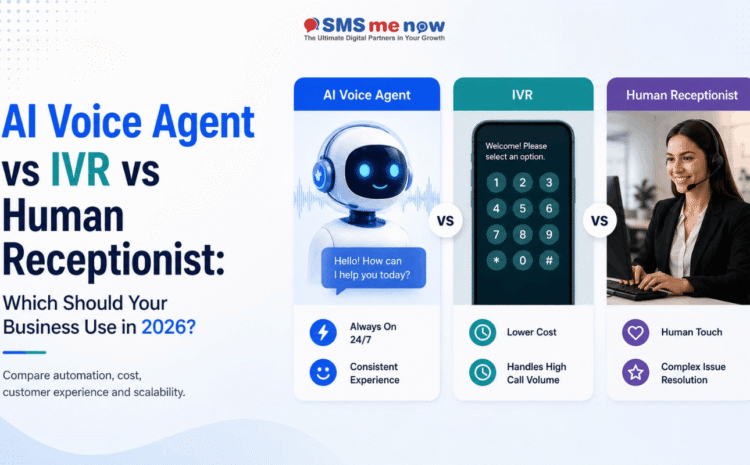
AI Voice Agent vs IVR vs Human Receptionist: Which Should Your Business Use in 2026?
Quick Answer
Traditional IVR is best for predictable menu-based routing, human receptionists are strongest at judgement and empathy, and AI voice agents can add conversational automation for repetitive spoken tasks. Most businesses do not need to choose only one: a hybrid design can use automation for triage and simple requests while giving callers a fast path to a person.
AI Voice Agent vs IVR vs Human Receptionist: Which Should Your Business Use in 2026? is an important business topic because communication and marketing systems now sit directly inside the customer journey. Businesses are no longer choosing tools only for sending messages or receiving calls; they are deciding how leads are captured, how quickly teams respond, how customer consent is respected and how outcomes are measured.
This guide focuses on AI voice agent vs IVR from a practical 2026 perspective. It explains where the approach creates value, where businesses commonly make mistakes, how to implement it in stages and what to measure after launch. The goal is not to overload the discussion with code or platform jargon, but to give owners and marketing or operations teams a clear framework they can use when planning the service.
Why This Topic Matters for Businesses in 2026
- IVR remains reliable for simple “press 1, press 2” routing where options are stable and easy to explain.
- AI voice agents can understand spoken intent and handle more flexible dialogue, but they need careful testing for accents, noisy calls, ambiguous requests and business-rule exceptions.
- Human receptionists provide empathy, discretion and judgement that are difficult to automate completely.
- A solution that saves staffing cost but frustrates high-value callers can reduce revenue, so caller experience must remain the primary design criterion.
- Businesses should not claim that AI is a person or hide escalation when a caller clearly needs human help.
Principles for Customer-Friendly Call Automation
- Phone automation should reduce effort for callers, not prove how many menu options the system can support. Design around the customer’s top reasons for calling.
- Every transfer should preserve context. When callers repeat the same information to three agents, the routing technology is creating work rather than removing it.
- Missed calls need an owner and a response target. A sophisticated IVR is not useful if unhandled calls still disappear into a report nobody reviews.
- Measure the entire outcome—from call arrival through routing, human answer, CRM disposition and final conversion—rather than only total call minutes.
A Practical Workflow
- List the top reasons customers call.
- Mark which reasons are simple routing, structured transactions or judgement-heavy conversations.
- Use IVR for predictable routing and AI only where natural-language automation adds value.
- Set immediate human-transfer rules for complaints, repeated misunderstanding and high-value opportunities.
- Give human agents a summary of the automated interaction.
- Review recordings or transcripts according to policy and improve failed paths.
Business Use Cases
- A hotel can use IVR for reservations versus events, while an AI agent answers basic availability questions before transferring complex group bookings.
- A service company can let AI capture address and problem type, then transfer urgent technical issues to a human dispatcher.
- A small office can use a virtual receptionist after hours but route VIP or complaint keywords to an on-call person.
What to Measure
- Track containment/resolution rate. Define exactly how the metric is calculated and who reviews it so reporting remains consistent across campaigns and teams.
- Track caller abandonment. Define exactly how the metric is calculated and who reviews it so reporting remains consistent across campaigns and teams.
- Track transfer rate. Define exactly how the metric is calculated and who reviews it so reporting remains consistent across campaigns and teams.
- Track repeat-call rate. Define exactly how the metric is calculated and who reviews it so reporting remains consistent across campaigns and teams.
- Track average handling time. Define exactly how the metric is calculated and who reviews it so reporting remains consistent across campaigns and teams.
- Track customer satisfaction. Define exactly how the metric is calculated and who reviews it so reporting remains consistent across campaigns and teams.
Common Mistakes to Avoid
- Avoid forcing AI into every call reason. This usually creates either unnecessary cost, weak customer experience, poor reporting or compliance risk.
- Avoid making the caller repeat information after transfer. This usually creates either unnecessary cost, weak customer experience, poor reporting or compliance risk.
- Avoid using voice automation without noise/accent testing. This usually creates either unnecessary cost, weak customer experience, poor reporting or compliance risk.
- Avoid hiding the human option. This usually creates either unnecessary cost, weak customer experience, poor reporting or compliance risk.
- Avoid optimising only for cost per call. This usually creates either unnecessary cost, weak customer experience, poor reporting or compliance risk.
Implementation Checklist
- Collect at least two weeks of call reasons and missed-call data before designing the menu. Real caller behaviour is more reliable than internal assumptions.
- Draft the shortest routing tree that handles the majority of calls and provides a clear path to a human or callback option.
- Connect call events to CRM or a lead queue with explicit ownership, duplicate matching and disposition fields.
- Pilot during business hours, monitor abandonment and transfers, then add after-hours and overflow rules once the main path is stable.
- Review menus whenever teams, branches, offers or working hours change. An outdated IVR silently sends good leads to the wrong place.
A 30-Day Action Plan
- Week 1 – Observe: review call logs, missed calls and common caller reasons. Speak with reception and sales teams to identify the transfers and repeated questions that waste the most caller and employee time.
- Week 2 – Prototype: create the shortest practical routing tree, define business hours, overflow and callback ownership, and map how a caller is matched to an existing CRM record or new lead.
- Week 3 – Pilot: route a controlled share of calls through the new flow and monitor abandonment, wrong transfers, repeat calls and missed-call follow-up. Keep a manual fallback available while the logic is still being validated.
- Week 4 – Refine: simplify menu wording, change timeouts, improve branch or department routing and make sure every unhandled call appears in an owned callback queue with a measurable response target.
- After the first month, expand only the flows that demonstrably reduce caller effort or improve lead recovery. The objective is a shorter path to resolution, not a more elaborate phone tree.
Frequently Asked Questions (FAQs)
1. What is the main difference between IVR and AI voice?
IVR usually follows predefined menus, while AI voice can interpret spoken language and handle more flexible dialogue.
2. Is an AI voice agent a replacement for reception staff?
It can automate repetitive calls, but businesses still benefit from humans for judgement, exceptions and relationship-sensitive situations.
3. Which option is cheapest?
Cost depends on call volume, platform, staffing and workflow complexity. The lowest direct cost is not always the best customer outcome.
4. Does IVR still make sense in 2026?
Yes. Simple routing and high-volume predictable menus are still strong IVR use cases.
5. What calls should go straight to humans?
Complaints, emergencies, complex sales negotiation and repeated automation failures should have fast human escalation.
6. Can AI voice integrate with CRM?
Yes, when the platform supports APIs and the workflow is designed to create or update customer records.
7. How do we handle accents and languages?
Test with real callers, supported languages and noisy environments before relying on voice automation at scale.
8. Should callers know they are speaking to AI?
Transparency generally supports trust and reduces confusion, especially when the interaction is conversational.
9.Can we use a hybrid system?
Yes. Hybrid routing is often the best approach: automation for triage and routine tasks, humans for exceptions.
10. How should we evaluate a pilot?
Measure resolution, abandonment, transfer quality, repeat calls and customer feedback, not just minutes saved.
Conclusion
AI voice agent vs IVR can create meaningful business value when it is designed around a real customer journey, clear ownership and measurable outcomes. The strongest implementations start with a focused problem, use the right channel for the right task and improve through actual performance data rather than adding automation for its own sake. For a practical discussion about your use case, visit SMSNow.in or use the SMS Me Now contact page to share your requirement. The team provides bulk SMS, voice, WhatsApp Business API, web and digital-marketing services that can be combined according to the business need.
| Plan your business communication or marketing workflow with SMS Me Now. Visit SMSNow.in or contact the team to discuss the most suitable setup for your business. |
Suggested Internal Links
- IVR + CRM Integration: How Businesses Can Automatically Capture, Route and Follow Up Every Incoming Lead
- IVR for Multi-Branch Businesses: Route Calls by Location, Department, Language and Working Hours
- WhatsApp Business Calling API in 2026: How Businesses Can Combine Chat, Voice Calls & Human Support
Editorial References
Official/current references reviewed for facts that can change over time. Re-check platform rate cards and regulatory guidance before publication if scheduling far in advance.
- SMS Me Now – Official Website: https://smsnow.in/
- SMS Me Now – Contact: https://smsnow.in/contact/
Disclaimer
This article is for general informational and marketing-planning purposes. Platform features, pricing, regulatory requirements, availability and technical capabilities can change. Verify current official documentation and obtain appropriate professional advice for compliance, privacy, security or regulated-sector requirements before implementation.