
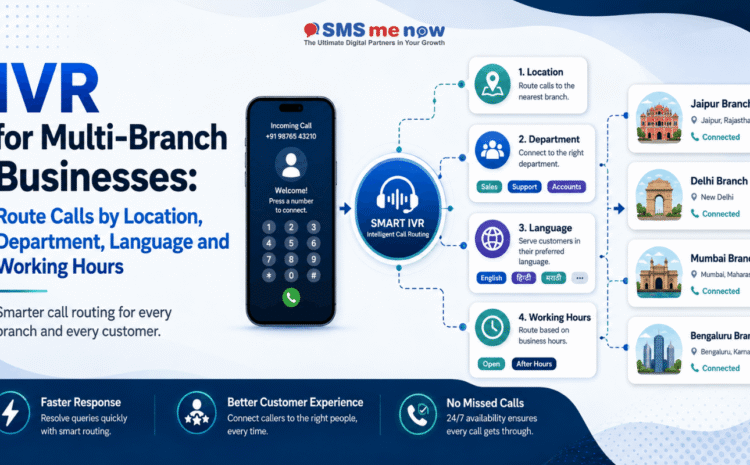
IVR for Multi-Branch Businesses: Route Calls by Location, Department, Language and Working Hours
| Quick Answer A multi-branch IVR should help callers reach the correct team with the fewest decisions possible. Routing can consider location, department, language, working hours and agent availability, while central reporting shows missed calls and demand across branches. The design should remain simple enough that callers do not feel trapped in menus. |
IVR for Multi-Branch Businesses: Route Calls by Location, Department, Language and Working Hours is an important business topic because communication and marketing systems now sit directly inside the customer journey. Businesses are no longer choosing tools only for sending messages or receiving calls; they are deciding how leads are captured, how quickly teams respond, how customer consent is respected and how outcomes are measured.
This guide focuses on IVR for multi branch business from a practical 2026 perspective. It explains where the approach creates value, where businesses commonly make mistakes, how to implement it in stages and what to measure after launch. The goal is not to overload the discussion with code or platform jargon, but to give owners and marketing or operations teams a clear framework they can use when planning the service.
Why This Topic Matters for Businesses in 2026
- Businesses with several locations often publish multiple mobile numbers, which fragments marketing and makes central reporting difficult.
- A common business number can preserve one public identity while routing internally to the appropriate branch or department.
- Location can be selected by the caller or inferred from the number used, campaign, CRM record or other available context.
- Time-based rules allow calls to move to another branch, a central desk, voicemail or callback queue after local working hours.
- Language options should be used only where the business can actually support the selected language after transfer.
Principles for Customer-Friendly Call Automation
- Phone automation should reduce effort for callers, not prove how many menu options the system can support. Design around the customer’s top reasons for calling.
- Every transfer should preserve context. When callers repeat the same information to three agents, the routing technology is creating work rather than removing it.
- Missed calls need an owner and a response target. A sophisticated IVR is not useful if unhandled calls still disappear into a report nobody reviews.
- Measure the entire outcome—from call arrival through routing, human answer, CRM disposition and final conversion—rather than only total call minutes.
A Practical Workflow
- Define branches, departments, hours and escalation owners.
- Choose a simple first menu based on the most common caller decision.
- Apply branch and language routing only where it reduces transfers.
- Add overflow rules when a branch does not answer within a reasonable period.
- Create a central missed-call queue so no branch can ignore unhandled demand.
- Review call volume by branch and adjust staffing or menu logic monthly.
Business Use Cases
- A hospital group can route by city, then by appointments, reports or emergency information.
- A dealership chain can direct callers to sales, service or spare parts at the selected showroom.
- A school group can route admissions centrally while sending existing-parent calls to the relevant campus.
What to Measure
- Track branch answer rate. Define exactly how the metric is calculated and who reviews it so reporting remains consistent across campaigns and teams.
- Track transfer rate. Define exactly how the metric is calculated and who reviews it so reporting remains consistent across campaigns and teams.
- Track menu abandonment. Define exactly how the metric is calculated and who reviews it so reporting remains consistent across campaigns and teams.
- Track missed-call rate. Define exactly how the metric is calculated and who reviews it so reporting remains consistent across campaigns and teams.
- Track overflow usage. Define exactly how the metric is calculated and who reviews it so reporting remains consistent across campaigns and teams.
- Track average time to answer. Define exactly how the metric is calculated and who reviews it so reporting remains consistent across campaigns and teams.
Common Mistakes to Avoid
- Avoid using five-level menus. This usually creates either unnecessary cost, weak customer experience, poor reporting or compliance risk.
- Avoid offering languages that agents cannot support. This usually creates either unnecessary cost, weak customer experience, poor reporting or compliance risk.
- Avoid routing only by office hierarchy instead of customer intent. This usually creates either unnecessary cost, weak customer experience, poor reporting or compliance risk.
- Avoid having no after-hours rule. This usually creates either unnecessary cost, weak customer experience, poor reporting or compliance risk.
- Avoid keeping branch performance invisible to central management. This usually creates either unnecessary cost, weak customer experience, poor reporting or compliance risk.
Implementation Checklist
- Collect at least two weeks of call reasons and missed-call data before designing the menu. Real caller behaviour is more reliable than internal assumptions.
- Draft the shortest routing tree that handles the majority of calls and provides a clear path to a human or callback option.
- Connect call events to CRM or a lead queue with explicit ownership, duplicate matching and disposition fields.
- Pilot during business hours, monitor abandonment and transfers, then add after-hours and overflow rules once the main path is stable.
- Review menus whenever teams, branches, offers or working hours change. An outdated IVR silently sends good leads to the wrong place.
A 30-Day Action Plan
- Week 1 – Observe: review call logs, missed calls and common caller reasons. Speak with reception and sales teams to identify the transfers and repeated questions that waste the most caller and employee time.
- Week 2 – Prototype: create the shortest practical routing tree, define business hours, overflow and callback ownership, and map how a caller is matched to an existing CRM record or new lead.
- Week 3 – Pilot: route a controlled share of calls through the new flow and monitor abandonment, wrong transfers, repeat calls and missed-call follow-up. Keep a manual fallback available while the logic is still being validated.
- Week 4 – Refine: simplify menu wording, change timeouts, improve branch or department routing and make sure every unhandled call appears in an owned callback queue with a measurable response target.
- After the first month, expand only the flows that demonstrably reduce caller effort or improve lead recovery. The objective is a shorter path to resolution, not a more elaborate phone tree.
Frequently Asked Questions (FAQs)
1. Why use one number for multiple branches?
It simplifies public communication and can centralise routing, reporting and missed-call management.
2. Can callers choose their city?
Yes. A first-level menu can ask for location when that is the clearest routing choice.
3. Can the system detect branch automatically?
Sometimes, using campaign numbers, CRM data or other routing context, but assumptions should be tested carefully.
4. Can IVR route by language?
Yes, if the business has agents or departments capable of serving that language.
5. What happens after working hours?
Calls can route to a central desk, on-call team, voicemail or callback workflow according to business rules.
6. Can one branch take overflow for another?
Yes. Overflow routing can improve answer rates when teams share the required knowledge.
7. How long should callers wait before overflow?
Use real answer-time data and customer expectations; excessively long queues increase abandonment.
8. Can branch managers see their own reports?
Role-based reporting can show branch-specific volumes and missed calls while management sees consolidated data.
9. Should each branch still have a direct number?
It depends on the business. Some organisations keep direct numbers internally while marketing a central public number.
10. What is the best first step?
Map current call reasons and branch handoffs before designing the menu; routing should reflect customer intent, not the organisation chart.
Conclusion
IVR for multi branch business can create meaningful business value when it is designed around a real customer journey, clear ownership and measurable outcomes. The strongest implementations start with a focused problem, use the right channel for the right task and improve through actual performance data rather than adding automation for its own sake. For a practical discussion about your use case, visit SMSNow.in or use the SMS Me Now contact page to share your requirement. The team provides bulk SMS, voice, WhatsApp Business API, web and digital-marketing services that can be combined according to the business need.
| Plan your business communication or marketing workflow with SMS Me Now. Visit SMSNow.in or contact the team to discuss the most suitable setup for your business. |
Suggested Internal Links
- IVR + CRM Integration: How Businesses Can Automatically Capture, Route and Follow Up Every Incoming Lead
- AI Voice Agent vs IVR vs Human Receptionist: Which Should Your Business Use in 2026?
- How Real Estate Companies Can Use IVR to Qualify Property Leads Before They Reach the Sales Team
Editorial References
Official/current references reviewed for facts that can change over time. Re-check platform rate cards and regulatory guidance before publication if scheduling far in advance.
- SMS Me Now – Official Website: https://smsnow.in/
- SMS Me Now – Contact: https://smsnow.in/contact/
Disclaimer
This article is for general informational and marketing-planning purposes. Platform features, pricing, regulatory requirements, availability and technical capabilities can change. Verify current official documentation and obtain appropriate professional advice for compliance, privacy, security or regulated-sector requirements before implementation.