
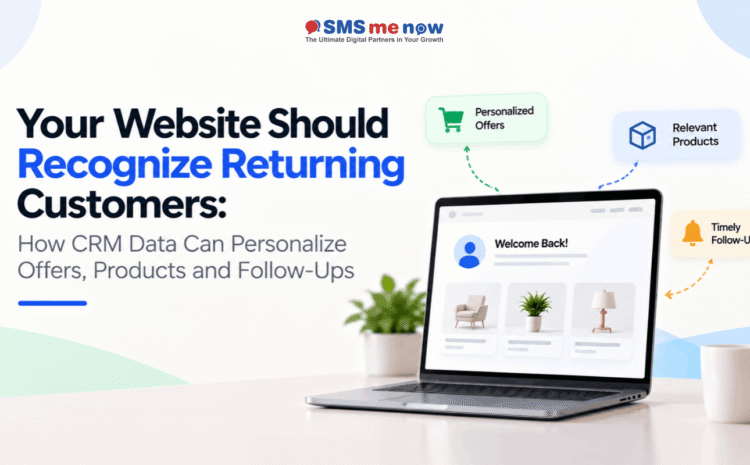
Your Website Should Recognize Returning Customers: How CRM Data Can Personalize Offers, Products and Follow-Ups
Most websites see all their visitors as newcomers.
This is lost business opportunity.
If you have made a purchase from a company, requested a quote from them, booked some service and communicated with their sales department, every time you visit their site, it shouldn’t look the same to you.
With the combination of CRM data with website interactions, companies will be able to offer more personalized experiences to returning customers. This may include customized offers, recommended products, easier way to get an answer to the questions asked and more efficient follow up of your requests.
Good CRM personalization strategy on the company’s website will assist in creating customer-oriented marketing from generic one.
It is not necessary to bombard your visitors with personalization.
What Is CRM Website Personalization?
CRM website personalization is the activity that involves the use of customer data from a CRM system in order to enhance the user experience for customers who visit the site repeatedly.
Based on the nature of the business and the customer consent, this could include the following information:
- Purchases made
- Services requested
- Products of interest
- Inquiries made in the past
- Status of leads
- The customer’s location
- Conversations in the past
- The sales person
- The customer membership or segment
- The follow-up record
Such data can be useful in determining the right content, offer or action needed by the customer at the particular moment.
Why Returning Customers Should Not Be Handled like First Time Visitors
There is something that a returning customer knows about your company.
He/She might have done any of the following:
- Shopped from you earlier.
- Sought price quotations.
- Talked with your staff members.
- Selected items in the shopping list.
- Briefed about consultation.
- Tried your services once.
- Cancelled an inquiry previously.
When you ignore all this on your website, then the customer will need to go through the process again of filling all the same details.
It becomes troublesome.
A tailored approach will enable the customer to get right into his work without doing things again.
CRM Data Can Help Enhance the Website Experience
The best ways to personalize are always about intent and not embellishment.
CRM data allows companies to enhance certain aspects of the customer experience journey.
1. Display Relevance Offers
Not all customers should get the same offers.
The returning customer will probably react better to an offer that involves any of the following:
- Purchase made earlier
- Complementary service
- Renewal offer
- Upgrade offer
- Duplicate booking
- Special offer for the season
For instance, the returning customer who had already purchased some particular service before would find it more relevant to offer upgrades or complementary services instead of generic first-time customer offers.
The most important thing here is relevance.
2. Suggest Relevant Products or Services
Through CRM data, one can determine what a repeat customer has previously purchased or shown interest in.
This enables the website to suggest relevant products or services.
Personalization that is relevant could be:
- Complementary products
- Reordered products
- Services upgrade
- Replacement products
- Renewals
- Related categories
This minimizes the work of finding what customers want.
However, recommendations should not be redundant. Companies should refrain from recommending a product that the client had previously bought.
3. Personalization of Calls-to-Actions
The call-to-action for a first-time visitor can be different from the one used for an existing customer.
The former may include:
Get a Quote
For the latter, it can be:
Place Your Reorder Now
Schedule Your Next Service
Complete Your Enquiry
Talk to Your Account Manager
Renew Your Plan
Personalizing calls-to-action makes the next step more clear and improves the customer experience overall.
4. Continue Previous Enquiries
One of the most important advantages of integrating CRM data into the website is continuity.
If the client asked for some information but did not buy the product, then the website will assist in continuing the enquiry.
Without asking the client to repeat the same actions and send the same information all over again, the company will be able to offer:
- The necessary service page
- A quotation follow-up
- Booking possibility
- The possibility to contact on WhatsApp
- The possibility of scheduling a call back
- A salesperson to contact with
5. Enhance Post-Visit Follow-Up Efforts
The process of website personalization should not end once the visitor leaves the website.
When a known customer visits back to review any product, service, or price page, then such behavior will be very helpful in future follow-up.
The sales team can prioritize leads on the basis of their true interests.
For instance, a customer visiting a particular service page time and again will surely be more relevant for follow-up rather than any lead who has not done anything recently.
The process of follow-up will become much more meaningful.
Rather than asking:
Are you still interested?
the company can discuss the actual need of the customer.
6. Create Better Customer Segments
CRM data helps businesses create segments based on useful criteria.
Some common customer segments are:
- New customers
- Returning customers
- High-value customers
- Low-value customers
- Existing leads
- Former customers
- Customers for specific products
- Subscribers
Segments can be offered different experiences on your website.
This approach improves relevancy without getting into complicated personalization.
Segmentation may be the best way to start for many businesses.
7. Minimize Redundant Form Fields
It is common for customers to be irritated with being asked about the same data repeatedly.
Where relevant and allowed, repeat visitors might get:
- Contact details pre-filled
- Small inquiry forms
- Benefits of quick booking process
- Faster checkout options
- Preserved preferences
- Customer account data
Form fields reduction can create an impression of speed and professionalism.
8. Assist Salespeople by Providing More Context
Personalized CRM website is beneficial not only for the customer but also for the sales department.
Connecting website actions and CRM data allows for knowing:
- The purchases made by the customer before
- The pages recently visited by the customer
- The service of interest
- The moment of the last interaction
- The stage of the sales funnel they are at
It will help to have better conversations.
The salesperson will spend less time gathering initial information and more time understanding the actual need of the customer.
Personalization for Increasing Conversion Rates
Personalization can also help to smooth out any process along the way for customers.
The advantages could include:
- Faster decision making
- Low repeat purchase rate
- More relevant inquiries
- Easier lead qualification
- Good customer retention
- Effective cross selling
- Higher customer lifetime value
- Effective follow up
But personalization should always be done with a purpose both for the business and for the customer.
Displaying the name of the customer on every page does not always constitute personalization.
The best personalization would always answer the question:
What does this customer want next?
CRM Personalization + WhatsApp
WhatsApp could be an extension of the personalized journey on the website.
Let’s say a repeat visitor lands on the service page and hits WhatsApp CTA.
The chat can be much more meaningful if the query is made with context from the particular page or service.
Rather than starting with the basic:
Hi
the conversation can start with:
Hi, I would like to talk about my service and options for upgrades.
It will make it easier for the sales team to respond and help create coherence between the website, CRM, and WhatsApp.
The entire journey will look like this:
Repeat Visitor → Personalized Website Journey → Relevant Offering → WhatsApp Chat → CRM Follow-Up
Privacy and Customers’ Trust Are More Important Than Personalization
Personalization must never put customers on edge.
Businesses have to be open about collecting and using their customers’ information.
The following measures are essential:
- Collect the necessary customer information.
- Collect and use customer information for business-related reasons.
- Abide by the rules of consent and communication preferences.
- Safeguard CRM systems and customer information.
- Ensure the availability of privacy information.
- Avoid any public exposure of sensitive customer information.
- Offer an option for changing communication preferences.
Personalization should be pleasant rather than invasive.
When a customer starts to think that a website knows too much about him/her, then something is definitely wrong.
Do Basic Things First
It is not required for an organization to make all of the components personalized on its website at once.
Some good steps might include:
- Determining recurring customers.
- Creating a couple of useful customer segments.
- Personalizing key call-to-actions.
- Displaying appropriate products/services.
- Linking web leads to the CRM system.
- Smoothening the follow-up processes.
- Assessing the conversion effectiveness.
Once these basic things get sorted out, then comes the time for advanced personalization.
Measures That Businesses Should Focus On
Businesses should measure their personalization strategies through business performance.
Some measures include:
- Conversions from return visitors
- Repeat purchase percentage
- Clicks on personalized calls to action (CTAs)
- Enquiries through WhatsApp
- Successful booking percentage
- Conversions for cross-sell/upsell
- Conversions from lead to customer
- Customer retention
- Value per customer
Testing of these measures will enable companies to know the effective personalization measures.
Conclusion
A website shouldn’t be treating returning customers as strangers.
When CRM data is utilized responsibly, companies can design more personalized experiences for those who have been interacting, purchasing, showing interest and making sales on the website before.
The goal is not to personalize everything.
The goal is to make it easy for the customer to move forward.
A good connected flow looks something like this:
CRM Data → Personalized Website → Relevant Offer → WhatsApp/Enquiry → Sales Follow-up → Repeat Customer
By combining website, CRM and communications tools, companies will be able to improve customer journeys, minimize unnecessary friction and enhance their customer relationships.
If you wish to develop a connected CRM website that is able to recognize returning customers and provide them with more personalized experiences, offers and follow-ups, schedule a consultation on our website.
Frequently Asked Questions
1. What is CRM Website Personalization?
CRM Website Personalization refers to the process by which a business uses customer data within its CRM system to offer more relevant content and offers to its returning website visitors.
2. Can a website recognize a returning customer?
Yes, if the technology allows, the customer has logged in, browser permission has been granted, and the customer has given their consent.
3. What customer data could be used for CRM personalization?
Some of the data that could be used include purchase history, services of interest, past inquiries, lead status, and customer segments where appropriate.
4. Does CRM Personalization aid in Sales?
Yes, it does. CRM personalization can aid in sales because it makes it easy for a customer to make the next move.
5. Do all Customers get personalized offers?
No, only when it makes sense and adds value to the customer.
6. Could data from CRM be used for product recommendations?
Yes. Past purchases and interests can help recommend additional, supplementary or repeated purchase products.
7. Can website forms be customized?
Yes. Past customers can have shortened or pre-populated forms when appropriate.
8. How could CRM customization help with follow-ups?
This would provide sales team with information on past customer interests, past discussions and their recent activity on the website.
9. Is it possible to integrate WhatsApp with CRM customization?
Yes. Information about website and CRM usage would allow making WhatsApp discussions more relevant.
10. Is customer segmentation required?
Customer segmentation is one of the easiest ways to implement customization. It will allow creating custom experience for new, repeat, inactive or valuable customers.
11. Can personalization be used just in eCommerce?
No, it can also be helpful for service companies, hospitals, education firms, real estate companies, B2B companies and any other customer-oriented company.
12. Is CRM website personalization safe?
Yes, if companies use personalization on their websites in a safe way and take appropriate actions in terms of privacy and security.
13. What is an appropriate amount of personalization for a website?
It depends on how much personalization is required to make your site more convenient for your customers.
Disclaimer
The content of this article serves a general educational and business purpose only.
The personalization features of a CRM tool may depend on the website platform used, CRM solution employed, identification techniques applied to customers, as well as business needs and capabilities to integrate tools.
A business must conform to all relevant privacy, data protection, cookie, consent and electronic communications regulations while handling the customer information. The results may vary.