
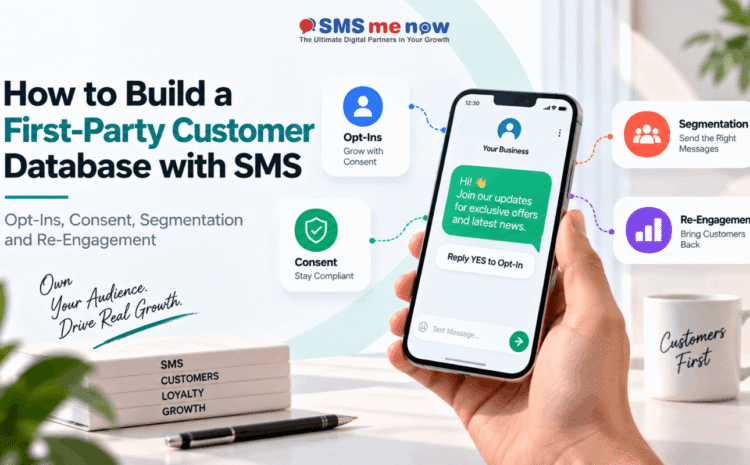
How to Build a First-Party Customer Database with SMS: Opt-Ins, Consent, Segmentation and Re-Engagement
Quick Answer
How to Build a First-Party Customer Database with SMS, An effective database for SMS isn’t the one that includes the most people; it is a permissioned list whose sources are known, customers are relevant to it and have certain preferences. Businesses must ensure that customers opt in during direct interaction, organize consent and preferences, segment based on behavior and make it easy for clients to unsubscribe from unsolicited communication.
“Opt-Ins, Consent, Segmentation and Re-Engagement to Build a First-Party Customer Database with SMS” is an important topic for business since the communication and marketing system is now a part of the customer experience process. Companies no longer choose systems solely for messaging and call capabilities, but rather determine their ability to attract leads, respond quickly, respect client consent and measure results.
The current guide addresses the SMS customer database from the practical viewpoint of 2026. It clarifies why the method is valuable, common mistakes made by businesses, implementation steps and what to track afterwards. This article doesn’t seek to fill up the conversation with technical aspects, but to give a useful framework to business owners and marketing or operations teams for their planning.
Why This Topic Is Important for Companies in 2026
• The definition of consent according to TRAI is the voluntary permission granted by a customer to receive commercial communication for a particular purpose, product or service.
• The list purchased from a third party may be large but is generally less contextual and lacks proper consent and purchasing intent.
• First party data involves the company’s connection with its customers – website inquiries, retail, sign-ups, transactions or service interactions.
• Segmentation increases the value of the same database since a targeted message to a small number of people is better than a generic mass broadcast.
• Consent and preference are important data which can be updated, withdrawn or audited.
SMS Guidelines for Reliability and Responsibility
• SMS is inherently brief. Start with the critical information, identify the sender properly, and then direct the customer to take the appropriate follow-up action if needed.
• Regulations and best practices for marketing converge: proper sender identification, approved templates, and target marketing with permission beat the quick fixes that result in customer complaints.
• Functional communications and promotions each have unique purposes and measures of success. A functional message succeeds when the consumer takes an action. A promotion succeeds when it generates a valuable reaction.
• Test template variables, links, timing, and target consumer data before scaling a promotion to a broad campaign. Little glitches can add up to big costs at scale.
Workflow Implementation
• Use proper opt-ins like web form submissions, shopping checkout, QR code scans, special events or services registration.
• Brief the customers on the nature of their communication consent.
• Log the source, date, reason and preferences data in the customer’s profile.
• Segregate customers based on their interest in product, geography, lifecycle stage and purchase behavior rather than mere demographics.
• Exclude the non-consenting or disqualified customers prior to each campaign.
• Conduct re-engagement efforts only with a valid justification and exclude permanently inactive contacts from frequent campaigns.
Use Cases for Businesses
• The retail shop could offer to subscribe their buyers to notifications for restocking or sales.
• The coaching institute could segregate inquiries for admission from queries by enrolled students for customer support.
• The restaurant could create an opted-in list of customers using QR codes for offers rather than purchasing random numbers in the locality.
Measure This
- Count the number of opt-ins. Be clear on exactly what the metric entails and who will be verifying it for consistency purposes when reporting.
- Count the active consent rate. Be clear on exactly what the metric entails and who will be verifying it for consistency purposes when reporting.
- Count the segment response rate. Be clear on exactly what the metric entails and who will be verifying it for consistency purposes when reporting.
- Count the opt-out rate. Be clear on exactly what the metric entails and who will be verifying it for consistency purposes when reporting.
- Count repeat purchase rate. Be clear on exactly what the metric entails and who will be verifying it for consistency purposes when reporting.
- Count the re-engagement conversion rate. Be clear on exactly what the metric entails and who will be verifying it for consistency purposes when reporting.
Common Pitfalls to Avoid
• Do not purchase big unverified phone databases. It normally leads to unnecessary costs, poor customer experience, poor reporting, or non-compliance risk.
• Do not use unclear consent language. It normally leads to unnecessary costs, poor customer experience, poor reporting, or non-compliance risk.
• Do not forget to document the origin of a phone number. It normally leads to unnecessary costs, poor customer experience, poor reporting, or non-compliance risk.
• Do not send each campaign to every customer. It normally leads to unnecessary costs, poor customer experience, poor reporting, or non-compliance risk.
• Do not continue messaging those who opted out. It normally leads to unnecessary costs, poor customer experience, poor reporting, or non-compliance risk.
Implementation Checklist
• Start with sender and DLT preparation. Make sure you have a Principal Entity, correct headers, templates, consent criteria and API configuration ready before campaign planning.
• Purify your recipient list; eliminate duplicates and make sure every single item has a business purpose to exist there. Quality counts more than quantity.
• Test actual wording registered along with all variables using real data – long names, order IDs, links that may influence message length or content rendering.
• Launch a limited batch first and analyze delivery reports and application logs before going into full volume sending.
• Audience, template, costs and business outcome of the campaign should be archived for future use after its completion.
30-Day Action Plan
• Week 1 – Compliance and Data: ensure that PE, headers, templates and consent have been validated; cleanse the list; delete duplicates; and identify reasons why each targeted audience will be able to receive the planned communication.
• Week 2 – Campaign planning: finalize the one objective, registered message wording, variables, destination and measurement method. Validate the actual template using realistic names, identifiers and links before deploying in production volumes.
• Week 3 – Campaign deployment: deploy a small set initially; validate delivery reports and downstream tracking; and then scale out only if everything works as planned, including message, audience and application behavior.
• Week 4 – Measurement: compare delivery, engagement, conversions, opting-out and costs. Segment or use case the result to help the business understand the value of the audience being communicated to.
• Use the first month to create a repeatable campaign checklist around approvals, list selection, template version, tracking, suppression and post-campaign measurement.
Frequently Asked Questions (FAQs)
1. What is First Party Customer Data?
First Party Customer Data is the data that is gathered through your own customer and prospects interaction and not purchased from any third party.
2. What is SMS Consent?
According to TRAI, consent refers to voluntary permission for a particular purpose or a product/service. It is best to adhere to the current consent process.
3. Can the Website Form take SMS consents?
Yes, as long as the form adequately informs the person about what he/she is consenting to.
4. Should I seek for consent during checkout?
It can be an effective time as long as you distinguish the consent for marketing purposes from that which is needed for the transaction.
5. What should I associate with my phone numbers?
Store useful data like the source of the number, whether the consent is given, the date, interests, and life cycle phase.
6. How many segments do I need to generate?
Generate a relatively small number that is actually associated with marketing actions. Otherwise, too many unused segments will just create unnecessary complexity.
7. How often should I update my list?
Check for opt-outs, invalid numbers, duplicates and inactive subscribers on a regular basis, especially prior to any large campaign.
8. Can I contact inactive subscribers?
Maybe, if the message is consistent with the nature of the relationship. Apply appropriate frequency of communication.
9. Why is a smaller list preferable?
Sometimes it is more beneficial to have a smaller permission-based segmented list than a very large unsegmented one that doesn’t work properly.
10. How can SMS Now be useful?
SMS Now can offer bulk-SMS solution while keeping proper customer data management.
Conclusion
A customer database on SMS works out to a good business practice in cases where there is a proper customer journey and clear owner along with a measurable impact. Such systems work best with a focused problem to solve, the right channel for the right task and improvement based on performance data as against just the addition of automation for its own sake. To know more about your specific case study, please check out SMSNow.in or SMS Me Now contact page to give us your requirements. We provide you services in Bulk SMS, Voice, WhatsApp Business API, Web and Digital Marketing which may be combined as per your business needs.
Plan your business communications and marketing workflow with SMS Me Now. Please visit SMSNow.in or contact us for the most suitable solution for your business.
Disclaimer
The above article is purely informative and should not be taken as professional advice. Please check the latest official documentation for the technical feasibility and compliance in any such implementation.