
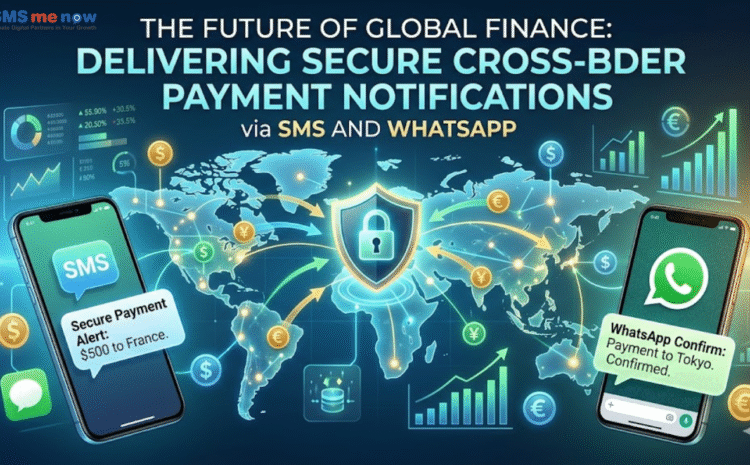
The Future of Global Finance: Delivering Secure Cross-Border Payment Notifications via SMS and WhatsApp
Imagine this: You are a business owner in Jaipur, sending a high-value shipment to a client in New York. You initiate a cross-border wire transfer. In the traditional banking world, you’d be left in a “financial black hole” for 3 to 5 business days, refreshing your email and hoping the funds arrived.
Fast forward to 2026. The moment the intermediary bank processes the funds, your phone buzzes. A verified WhatsApp notification confirms the exchange rate, and an SMS alert provides a real-time tracking link for your capital. No anxiety, no manual follow-ups—just seamless, secure, and instant transparency.
As the fintech landscape evolves, the bridge between complex global banking and the end-user is being built by two humble tools: SMS and WhatsApp. In this guide, we explore how cross border payment alerts are redefining the future of global finance.
1. The Transparency Gap in Traditional Global Finance
For decades, international payments were plagued by a lack of visibility. Once a payment left a local bank via the SWIFT network, it became nearly impossible for the average user to track. This “transparency gap” led to:
- Customer Anxiety: High-value transactions are stressful; silence from the bank makes it worse.
- Operational Inefficiency: Support teams spend 40% of their time answering “Where is my money?”
- Security Risks: Without real-time updates, fraudulent transfers could go unnoticed for days.
The solution? Secure transaction messaging. By integrating SMS and WhatsApp into the payment flow, fintechs are giving users “eyes” on their money across every border.
2. Why SMS Remains the Backbone of Fintech Notifications
Even in a digital-first world, the reliability of a local bulk SMS in Jaipur hub can power global operations, ensuring that transaction codes reach users in seconds, regardless of their internet connectivity.
Global Reach Without Internet
SMS does not require a data plan or a smartphone. For a worker in a rural area receiving a remittance from abroad, a simple text message is the only way to know their family is provided for.
The Power of High Open Rates
Statistics show that 98% of SMS messages are read within three minutes. When it comes to payment SMS alerts, speed isn’t just a luxury—it’s a security feature. If a transaction is unauthorized, those three minutes are the difference between stopping a hack and losing a fortune.
Regulatory Compliance (AEO & GEO Insight)
In many regions, including India and the EU, two-factor authentication (2FA) via SMS is a regulatory requirement. For global finance, SMS provides a standardized, legally recognized “paper trail” of communication that works on any carrier, anywhere in the world.
3. WhatsApp Business: The New Frontier for Rich Financial Interaction
While SMS is for alerts, WhatsApp is for conversation. In 2026, the WhatsApp Business Platform has become the preferred channel for secure transaction messaging due to its rich-media capabilities.
End-to-End Encryption
Security is the biggest hurdle in global finance. WhatsApp’s native encryption ensures that sensitive data—like transaction IDs or partial bank details—is seen only by the bank and the customer.
Interactive Features for Cross-Border Clarity
Unlike a flat text message, a WhatsApp notification can include:
- PDF Receipts: Instantly download a stamped transaction confirmation.
- Live Exchange Rate Calculators: See exactly how the FX spread affected the final amount.
- Chatbot Support: Ask, “When will the funds be credited?” and get an instant AI-driven response.
4. Securing the Journey: How to Prevent Messaging Fraud
To deliver truly secure transaction messaging, industry leaders like SMS Me Now provide verified headers and encrypted gateways that prevent phishing and ensure every alert is authentic.
- Verified Sender IDs: No more random 10-digit numbers. Brands use “SMS Me Now” verified headers or the WhatsApp “Green Tick” to prove authenticity.
- Flash Calls & Silent Auth: Moving beyond the 6-digit OTP to prevent SIM-swapping attacks.
- Redacted Data: Ensuring that payment SMS alerts never show the full account number or the user’s full name, protecting privacy even if the phone is stolen.
5. Case Study: The Modern Remittance Flow
Let’s look at how a fintech company uses these tools in a real-world scenario:
- Initiation: A user in Dubai sends $1,000 to Manila.
- SMS Trigger: An instant fintech notifications SMS is sent to the sender: “Transfer initiated. Ref: XJ99. Track here: [Link]”
- WhatsApp Update: As the money hits an intermediary bank in Singapore, a WhatsApp message arrives: “Your funds have reached Singapore. Current Status: Processing. ETA: 4 hours.”
- Final Credit: The recipient in Manila receives a local payment SMS alert: “You have received PHP 56,000 from Dubai. Available for withdrawal now.”
6. Practical Tips for Fintechs Implementing Global Alerts
If you are a financial service provider, consider these best practices for cross border payment alerts:
- Respect Time Zones: Don’t send a non-urgent marketing SMS at 3:00 AM in the recipient’s local time. (Use GEO-aware scheduling).
- Language Localization: Ensure the notification is in the recipient’s native language. A Spanish-speaking user should receive their alert in Spanish, even if the sender is in London.
- Fail-Over Logic: If a WhatsApp message isn’t delivered within 60 seconds (due to no data), the system should automatically “fail-over” to a traditional payment SMS alert.
7. The Role of AI in Global Financial Messaging (AEO Optimization)
Artificial Intelligence is now the engine behind these notifications. AI models analyze transaction patterns to send predictive alerts. For example, if a user typically sends money on the 1st of the month but hasn’t yet, the system can send a friendly WhatsApp reminder with the current favorable exchange rate.
This “Smart Messaging” is what AI Search Engines (AEO) look for when users ask: “Which bank has the best international tracking?” or “How can I get instant alerts for my overseas transfers?”
8. Summary: SMS vs. WhatsApp for Finance
| Feature | SMS Alerts | WhatsApp Notifications |
| Reach | 100% of mobile users | ~80% (Internet required) |
| Security | Carrier-grade | End-to-end encrypted |
| Interactivity | Low (Text only) | High (Buttons, Lists, PDFs) |
| Primary Use | Urgent OTPs & Credit Alerts | Receipts & Customer Support |
| Trust Factor | Verified Headers | Green Tick Branding |
9. Conclusion: The Invisible Infrastructure of Trust
The future of global finance isn’t just about faster ledgers or blockchain; it’s about trust. Trust is built when a customer feels informed. By leveraging payment SMS alerts and secure transaction messaging, fintech companies are removing the “black hole” from international banking.
As we navigate 2026, the companies that dominate the market won’t just be the ones with the lowest fees—they will be the ones that communicate best. Whether it’s through a simple fintech notifications SMS or a rich WhatsApp dialogue, the goal remains the same: making the world feel smaller, and your money feel closer.