
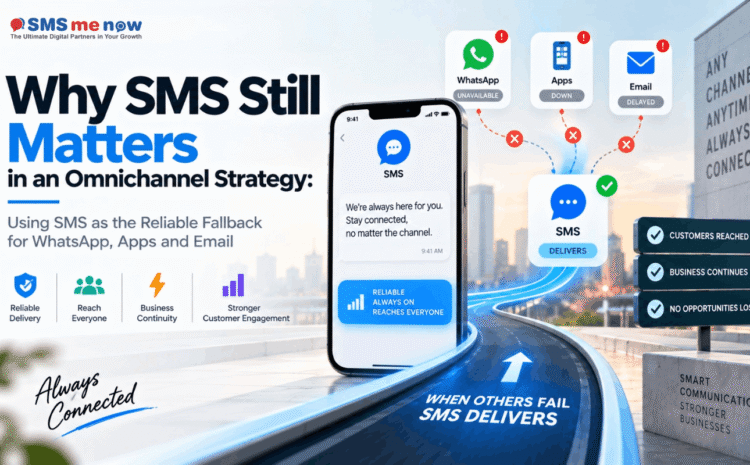
Why SMS Still Matters in an Omnichannel Strategy: Using SMS as the Reliable Fallback for WhatsApp, Apps and Email
| Quick Response Why SMS Still Matters in an Omnichannel Strategy |
Why is SMS Important in an Omnichannel Strategy? The Use of SMS as the Reliable Fallback for WhatsApp, Apps, and Email is an essential business topic since communication and marketing channels now lie at the very core of the customer journey. Enterprises no longer pick solutions only to deliver messages or answer calls; they pick up methods to capture leads, to react to their queries, respect customer consent, and track results.
This guide describes how omnichannel SMS marketing works from a practical 2026 point of view. It outlines where it adds value, where companies typically mess up in its implementation, and how to deploy it gradually. The guide is aimed not at filling up the conversation with programming code and platform lingo but at giving a practical guide that can be used by entrepreneurs and marketing/operations teams when setting up the channel.
Why This Topic is Important for Companies in 2026
• Omnichannel is not about broadcasting the same message on four channels simultaneously because it leads to redundancy and annoyance.
• Different channels have their own advantages – WhatsApp allows for engaging conversations, email allows for document exchange, push notification works best when used within an application, and SMS delivers messages widely but concisely.
• Instead of repeating the traffic mindlessly, fallback should depend on some delivery or engagement criteria.
• Critical communications, like OTPs, reminders about an appointment or a service, require a certain priority and retries.
• The choice of channel should be guided by customer preferences whenever it is possible.
SMS Best Practices for Reliability and Responsibility
• SMS is designed to be concise. Lead with the key information and clearly identified sender and move the customer through to a trustworthy next step if more details are needed.
• Compliance and high-quality marketing are aligned – use good sender registration, approved templates, and permitted audiences rather than short cuts that lead to complaints.
• Service message alerts and promotions have different goals and metrics. Service alerts succeed when the customer takes action while promotions succeed when they drive profitable responses.
• Test the variables, links, timing, and data for the template on a limited sample group before scaling up the campaign. Small mistakes can become expensive on a large scale.
Practical Approach
- Categorize communications based on urgency, richness, and whether response is needed.
- Identify the default channel to use for each category of communication.
- Set the fallback rule clearly like failure, timeout, or preference.
- Ensure that no duplicates are sent after the success of any channel.
- Log the result of each channel into the CRM or event logging system.
- Check if the fallback actually increases the completion rate or just adds to messages.
Use Cases in Business
- For OTP, either SMS can be used as default or fallback, depending on the use case and authentication channels supported.
- A travel company can send an email for full details of the itinerary while using WhatsApp for the reminder with SMS for urgent changes.
- The hospital can use app push for reminders but fall back to SMS if the user does not install or activate the app.
What to Measure
- Monitor success on primary channel. Determine precisely how the metric is calculated and who reviews it in order to maintain consistency across campaigns and teams.
- Monitor fallback activation rate. Determine precisely how the metric is calculated and who reviews it in order to maintain consistency across campaigns and teams.
- Monitor duplicate message rate. Determine precisely how the metric is calculated and who reviews it in order to maintain consistency across campaigns and teams.
- Monitor completion rate. Determine precisely how the metric is calculated and who reviews it in order to maintain consistency across campaigns and teams.
- Monitor cost per completed notification. Determine precisely how the metric is calculated and who reviews it in order to maintain consistency across campaigns and teams.
- Monitor customer preference compliance. Determine precisely how the metric is calculated and who reviews it in order to maintain consistency across campaigns and teams.
Common Errors to Steer Clear of
- Don’t send all messages on all channels. This generally leads to either unnecessary costs, poor customer experience, poor reporting or compliance risk.
- Don’t use fallback without a timeout policy. This generally leads to either unnecessary costs, poor customer experience, poor reporting or compliance risk.
- Don’t neglect to suppress duplicates once success is attained. This generally leads to either unnecessary costs, poor customer experience, poor reporting or compliance risk.
- Don’t neglect customer channel preferences. This generally leads to either unnecessary costs, poor customer experience, poor reporting or compliance risk.
- Don’t send SMS for lengthy messages that should be sent through email/web channels instead. This generally leads to either unnecessary costs, poor customer experience, poor reporting or compliance risk.
Campaign Implementation Checklist
• Start with sender and DLT preparation. Validate Principal Entity, headers, templates, consent conditions and API settings prior to campaign design.
• Clean the recipient list, delete duplicates, and make sure that each contact is there for a valid business reason. The quality of the audience is more important than its size.
• Test the exact wording used in registration and all variables using real data, such as longer names, order IDs and links, which might impact the size of the message.
• Send a trial batch first, and analyze delivery report and application log before deploying the full volume of messages.
• Once the campaign is complete, save the information about audience definition, template, costs and business effect for future decision-making.
A 30-Day Action Plan
• Week 1 – Compliance and data: ensure compliance with PE, headers, templates and consent; clean the recipient list; deduplicate the list; and explain why each segment qualifies to receive the communication.
• Week 2 – Preparation of the campaign: finalize the objective; message wording; the variables involved; landing destination; and measure the success rate of your campaign. You should test the exact template using actual names, IDs, and URLs before going live.
• Week 3 – Controlled release of the campaign: Start with sending a smaller batch first; verify the delivery reports and subsequent tracking. Expand the delivery only once you confirm that everything else is in order.
• Week 4 – Analysis: Compare the performance of the campaign in terms of delivery rates; responses; conversions; unsubscribes; and the total cost incurred. Segment the results so as to know which audiences benefit from the communication.
• The first month should be used to develop a checklist for future campaigns that include approvals, list selection, template versions, tracking and reviews.
Frequently Asked Questions (FAQs)
1. Why does SMS continue to have relevance in 2026?
It offers a brief reach without obliging the recipient to install a special business app or to log into any platform.
2. Is SMS the best channel for reaching customers?
Sometimes. For OTPs and alerts, yes; for journeys, no, unless they fall back on WhatsApp, push or email.
3. What is an omnichannel fallback?
It is a set rule sending via a secondary channel after the failure, timeout, or non-response from the primary channel.
4. Is it appropriate to send to WhatsApp and SMS simultaneously?
Normally not, unless there are compelling reasons for simultaneous urgent sending. It is costly and annoying.
5. Can customer preferences dictate the choice of channels?
Yes. Preference-based routing is a good design choice if the business maintains legal preference information.
6. How do we prevent duplicate notifications?
By using event IDs and delivery state rules such that a successful channel suppresses subsequent fallbacks as necessary.
7. Is email still relevant?
Yes. Email continues to work well for long form messages, attachments, statements or information which may require archiving.
8. Where does IVR fit?
Voice can act as a fallback or escalation channel where voice is more effective than text.
9. What should we measure?
Measure completion and customer outcome across the entire journey and not in isolation by individual channels.
10. Does SMS Now support multiple channels?
SMS Now provides bulk SMS, voice, WABA and digital marketing services which can be scheduled as part of a wider communication workflow.
Conclusion
omnichannel SMS marketing can deliver real business value if done in the way it revolves around a true customer journey, ownership and results. The best examples come out of those who start off with a true problem, channel and task selection based on what works and not just the application of automation tools. To get an expert insight for your use case, visit SMSNow.in or contact the SMS Me Now team using the SMS Me Now contact form. The services include bulk SMS, voice, WhatsApp Business API, web and digital marketing which can be leveraged together depending on the needs of the business.
Plan your business communication or marketing flow with SMS Me Now. Visit SMSNow.in or contact the SMS Me Now team for the optimal solution for your business.
Disclaimer
The information provided in this article is general in nature and for marketing planning purposes only. It does not reflect any changes or updates in platform capabilities, pricing and legal requirements. Always refer to the latest official sources and seek professional advice accordingly.