
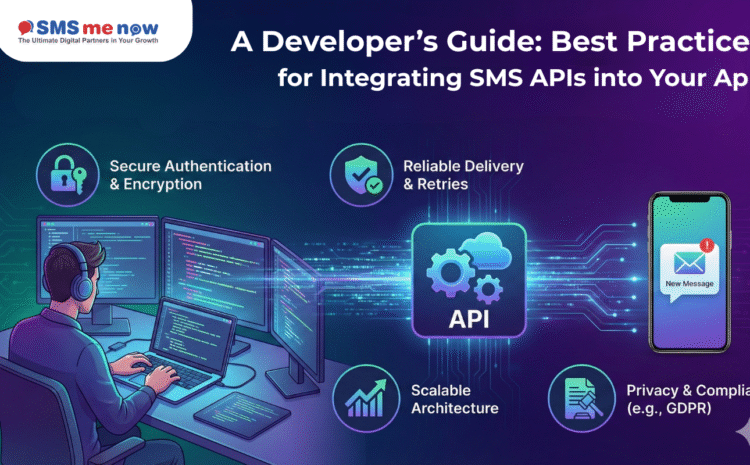
A Developer’s Guide: Best Practices for Integrating SMS APIs into Your App
SMS API Integration Best Practices, In 2026, SMS remains the most reliable “last mile” of communication. Whether you are delivering critical One-Time Passwords (OTPs), shipping alerts, or two-factor authentication (2FA), the bridge between your code and the telecom network must be indestructible.
However, many developers treat SMS APIs as simple “fire and forget” HTTP requests. This oversight leads to split messages, silent failures, and security vulnerabilities. This guide outlines the technical architectural standards required for professional-grade SMS API integration.
Robust Error Handling: Beyond the 200 OK
A 200 OK from an SMS gateway only means the gateway received your request—not that the user received the text. Your integration must handle errors at three distinct levels.
Level 1: Synchronous API Errors
Handle these immediately in your request-response cycle:
- 401 Unauthorized: Usually an expired API key or an IP not in your whitelist.
- 429 Too Many Requests: You’ve hit your account’s rate limit (Throttling).
- 402 Payment Required: Your wallet balance is empty.
Level 2: Asynchronous Delivery Failures
Messages often fail after the API accepts them (e.g., “Absent Subscriber” or “Invalid Number”).
- Strategy: Implement Webhooks. Your server should expose an HTTPS endpoint to receive status updates (DLRs).
- Action: If a webhook reports a “Permanent Failure,” flag the phone number in your database to prevent wasting credits on future attempts.
Level 3: Logic & Content Errors
- The 160-Character Trap: Standard SMS is 160 characters. Exceeding this triggers Concatenation, splitting your text into multiple parts (and multiple charges). In 2026, many gateways also charge extra for Unicode (emojis/regional scripts), which drops the limit to 70 characters.
Throughput & Rate Limiting: Managing the Flow
If you send 10,000 marketing messages at once, you might overwhelm your own backend when users click the links, or get flagged by carriers for “bursty” behavior.
- Implement a Message Queue: Never call an SMS API directly from your main application thread. Use a queue like RabbitMQ, Redis, or Amazon SQS. This allows your app to “fire” the message and continue, while a worker processes the actual API call.
- Exponential Backoff: If you receive a 429 error, don’t retry immediately. Wait 1 second, then 2, then 4. This prevents a “Thundering Herd” problem that can crash your integration.
- Token Bucket Algorithm: Use this logic to control your throughput. If your provider allows 50 SMS/second, your “bucket” should only release 50 tokens per second to your worker threads.
API Security: Locking Down the Gateway
Your SMS API key is essentially a blank check for your company’s bank account. If leaked, attackers can use it for “SMS Pumping Fraud,” sending thousands of high-cost international texts.
- Never Client-Side: Never include an SMS API key in a mobile app (Android/iOS) or frontend JavaScript. It must stay on the server-side.
- IP Whitelisting: Restrict API access so that only your production server’s IP addresses can trigger a send.
- Secrets Management: Use environment variables or tools like HashiCorp Vault or AWS Secrets Manager. Never hardcode keys in your Git repository.
- Webhook Verification: Attackers can “spoof” webhooks to make it look like an OTP was delivered. Always verify the HMAC Signature provided by your SMS vendor in the webhook header to ensure the data is authentic.
The 2026 Compliance Layer (DLT in India)
If you are sending messages to Indian numbers, your code must support Distributed Ledger Technology (DLT) parameters.
- PEID & Template ID: Every API call must include your Principal Entity ID and the specific Template ID approved by the telecom operators.
- Variable Matching: Ensure the “Variables” in your code exactly match the {#var#} format registered on the DLT portal (e.g., VilPower or Jio DLT). Even a missing space can cause a delivery failure.
Technical Comparison: Integration Methods
| Feature | REST API (JSON) | SMPP Protocol | Webhooks (DLR) |
| Best For | Web Apps / Startups | High Volume (Banks) | Real-time Status Tracking |
| Complexity | Low (Standard HTTP) | High (Requires Socket) | Moderate (Needs Endpoint) |
| Speed | Fast | Ultra-Fast | N/A (Reactive) |
| Security | API Key / OAuth2 | IP / Password | HMAC Signatures |
✨ Build a Bulletproof Integration with DialMeNow
Why build everything from scratch? At DialMeNow, we provide the developer tools and infrastructure to make SMS integration seamless.
- ✅ Developer-First SDKs: Libraries for Node.js, Python, PHP, and Java that handle retries and error mapping automatically.
- ✅ One-Click DLT Mapping: Easily manage your Entity IDs and approved templates within our dashboard.
- ✅ High-Throughput Routes: Optimized for OTP delivery with sub-2-second arrival times.
- ✅ Visual Log Explorer: Debug failures in real-time with our detailed delivery logs.
Scale your communication without the technical debt.
👉 [Get Your API Key and Start Testing for Free at DialMeNow Today!]
❓ Frequently Asked Questions (FAQ)
Q1: What is the difference between Transactional and Promotional API routes?
A: Transactional routes (OTPs/Alerts) are 24/7 and bypass DND. Promotional routes (Marketing) are only active from 10 AM to 9 PM and respect DND registries.
Q2: How do I handle “Message Splitting”?
A: Use an API that supports concat headers. Ensure your code accounts for the 153-character limit per part (7 characters are used for the “join” instructions).
Q3: Should I use Idempotency Keys?
A: Yes! If your network drops during a request, an idempotency key ensures that retrying the request doesn’t result in the user getting the same SMS twice.
Q4: How do I format international numbers?
A: Always use the E.164 format (e.g., +919876543210). Never include leading zeros or spaces.
Q5: What is a “Webhook Secret”?
A: It’s a shared string between you and your provider. You use it to hash the incoming webhook data to verify that the message actually came from your provider.
Q6: Can I send emojis via SMS API?
A: Yes, but be careful. Emojis switch the encoding to UCS-2, reducing your character limit per SMS from 160 to 70.
Q7: How do I monitor my SMS balance programmatically?
A: Most professional APIs (including DialMeNow) offer a GET /balance endpoint. Set up an alert in your app to notify you when credits fall below 10%.
Q8: What is a “Sender ID” or “Header”?
A: In India, this is a 6-character alphabetic code (e.g., DLMNOW) that identifies your brand to the recipient.
Disclaimer
The technical practices mentioned are based on industry standards for 2026. Developers are responsible for ensuring their specific implementation complies with local data protection laws (like GDPR or India’s DPDP Act). Always test your integration in a sandbox environment before moving to production traffic.
Conclusion
Integrating an SMS API is about more than just a successful “send.” It is about building a system that is secure, observable, and respectful of the user’s experience. By implementing a queue-based architecture, robust error handling, and strict security protocols, you ensure that your application remains a trusted voice in your user’s pocket.