
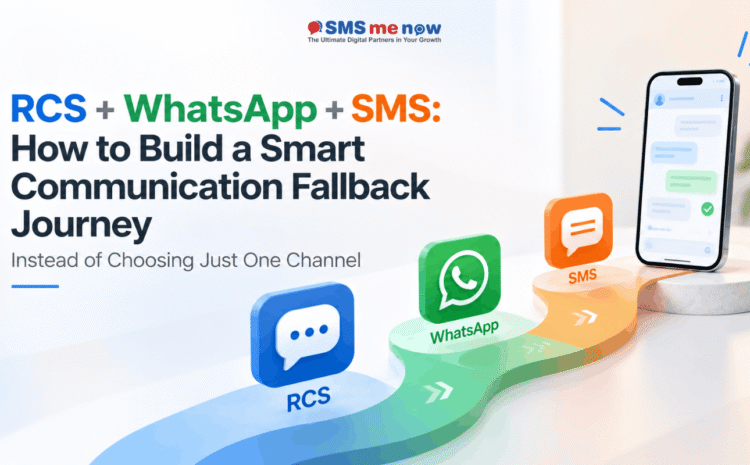
RCS + WhatsApp + SMS: How to Build a Smart Communication Fallback Journey Instead of Choosing Just One Channel
Should we use RCS, WhatsApp or SMS?
In most cases, the right approach would be to use all three but for different purposes and with fallbacks built intelligently.
The fact of the matter is that consumers use multiple types of devices, messengers, networks and communication channels. This means that an advertising campaign that relies completely on just one channel will suffer from limited reach as that particular channel may not be accessible at all to the consumer.
Using the correct approach to building the journey with the use of the fallback for RCS, WhatsApp and SMS could result in one of the following paths:
RCS → WhatsApp → SMS
or
WhatsApp → RCS → SMS
and it all depends on the particular customer and other factors.
What Is a Multichannel Messaging Fallback Strategy?
A fallback strategy is a predetermined approach which determines which communication channel will be used initially and how to proceed if the message fails to go through, cannot be transmitted, or is not getting an adequate response.
Examples:
Primary Channel: RCS
↓
RCS message could not be sent or has not been received
↓
Verify whether the contact is eligible for sending a message on WhatsApp
↓
WhatsApp message
↓
In case it’s unavailable and the communication is allowed
↓
SMS as a backup
Rather than considering separate channels as isolated tools for campaigns, the company uses them as components of the customer journey process.
The Google documentation for RCS for Business explicitly suggests invoking a fallback strategy based on the delivery state, expiration of the message, etc.
Why Businesses Should Not Rely on Just One Channel
There are pros and cons to all communication channels.
Benefits of RCS for Communication
RCS for Business can enable communications like:
- Media
- Rich cards
- Carousel
- Suggested replies
- Suggested actions
- Location actions
- Call actions
- Website URLs
- Conversational branded experiences
As mentioned by Google in their documentation, RCS rich cards include media, text and interactive elements, and are thus well suited for product discovery, deals and user experience guidance.
But RCS is dependent on certain conditions, like device capabilities, messaging client settings, carrier support and presence of the business agent in the user’s network.
This makes fallback necessary.
Why WhatsApp Is Best Suited for Conversations
WhatsApp will be especially helpful when customer conversations involve:
- Two-way conversations
- Customer service
- Lead qualification
- Appointment setting
- Sales conversations
- Suggestions
- ORDER updates
- Handover to human agents
The WhatsApp Business Platform can also automate conversations, yet it demands that businesses comply with its consent and messaging policies.
According to Meta’s current policy, businesses can reach out to customers on WhatsApp only if they obtain their mobile number and consent to communicate with them. Usually, conversations initiated by businesses need pre-approved message templates, while replies can be more flexible in customer service windows opened after the user initiates conversation.
Broad Coverage by SMS
SMS does not have the advanced features and the interactive capabilities of RCS and WhatsApp, but it is quite useful since it can reach out to a huge variety of mobile handsets.
SMS becomes especially useful as the final means of delivery for important information which could be:
- OTPs
- Transaction messages
- Appointments
- Deliveries
- Callbacks
- Important service messages
In India, commercial SMS will have to meet certain TRAI and DLT regulations including the registration of the Principal Entity and header requirements, among others.
The Correct Role for Each Channel
An effective strategy would be to give each channel a defined role.
RCS: Engage Visually
- When there is a need for visually interactive engagement, use RCS.
- Examples of journeys that fit include:
- • Product launches
- • Product catalogues
- • Interactive offers
- • Travel booking
- • Appointment booking
- • Vivid ordering process
- • Lead qualifying
WhatsApp: Discussion & Relationships
- When the client needs to discuss further, use WhatsApp.
- Examples of journeys that fit include:
- • Sales questions
- • Support discussion
- • Appointment discussion
- • Quote requests
- • Lead qualifying
- • Human agent support
SMS: Fallback for Reliability
When to use SMS:
- Rich messaging is not available
- The message is brief and urgent
- The customer is not on the primary messaging platform
- The message needs the broadest possible distribution
It is not: RCS vs WhatsApp vs SMS
It is:
What channel would be best for this customer, right now, for this particular message?
How the Smart Fallback Journey Works
One example of a realistic multichannel journey could follow six steps.
1. Establish the Purpose of the Message
First, the type of communication needs to be identified.
Is the communication:
- Promotional?
- Transactional?
- Service related?
- Sales follow up?
- Customer service?
- Timely?
The channel used should depend on the purpose.
A flash sale and one-time passcode should follow different communication guidelines.
2. Determine the Customer Preferences and Consent
Prior to determining the channel to use, it must be determined what types of communications the customer has opted into.
Ideally, the customer database or CRM should include:
- Mobile number
- WhatsApp opt in status
- Communications preferences
- Promotional opt in
- Date of last communication
- PREFERRED LANGUAGE
- History of channels engaged
Business-to-consumer WhatsApp communication requires appropriate opt in. Indian business-to-consumer SMS communications require appropriate customer consents and preferences.
3. Check for Available Channel
The system is capable of determining the availability of the channel.
In case of RCS, this may involve verifying whether or not the device and network of the user is capable of delivering the business messaging experience.
According to Google, sending messages to users who do not have adequate RCS capabilities can result in delivery failures that businesses can leverage to switch channels.
4. Set Delivery Time Window
Not all messages have to be sent in perpetuity.
For instance:
Appointment reminder: needs to be received within 15 minutes.
Marketing message: can be valid up to a number of hours.
Order notification: requires to be sent in real time.
With Google RCS, businesses can leverage message expiration or TTL features.
5. Activate the Next Channel If Required
In case an RCS message fails delivery,
your orchestration platform can then determine whether:
Is there proper consent for WhatsApp from this customer?
If yes, go ahead via WhatsApp.
Otherwise, it can verify whether SMS is an option.
The key is that each step has to be performed based on specific criteria rather than simply because your company would like to send messages through all possible channels.
6. Keep All in One Place in CRM
There must be only one communication history in the CRM, despite the channel.
That means no:
RCS campaign data on one side
WhatsApp data in some other place
SMS history in some other dashboard
The sales/support representative should see one history such as:
RCS Sent → Not Delivered → WhatsApp Sent → Customer Responded → Agent Assigned
Example of Smart Communication Journey
Let’s say you want to confirm an appointment.
Step 1: RCS
The company sends an RCS card that contains:
Appointment Confirmed
actions include:
Confirm | Reschedule | Call Us
Step 2: RCS Failure
The client’s phone cannot support the necessary RCS experience.
Step 3: WhatsApp
When there is valid WhatsApp consent, the appointment is confirmed via WhatsApp.
The client can respond to reschedule the appointment.
Step 4: SMS
Otherwise, a simple SMS is used to send the appointment details.
Much better than sending all three together.
Utilize CRM Data to Select the Optimal Channel
The more advanced messaging platform will allow you to move beyond static channel prioritization.
The following are just a few examples of information that your CRM could hold:
- The customer previously interacted with WhatsApp
- The customer often uses RCS
- SMS works better with certain notification types
- The customer has unsubscribed from marketing communications on one channel
The platform will then determine a preferred channel based on business rules.
Examples include:
Customer A: WhatsApp then SMS
Customer B: RCS then SMS
Customer C: SMS only
No Duplicate Messaging
One of the most common errors made in multichannel communication is sending the same campaign on RCS, WhatsApp, and SMS at the same time.
Customers will get:
RCS notification,
followed by a WhatsApp notification,
and then SMS
in minutes.
It will not be viewed as a helpful communication but more of a spam.
Thus, your orchestration rules must check for:
- Delivered
- Read
- Replied
- Failed
- Expired
- Opted out
and cease unnecessary fallback after the communication goal is accomplished.
The Human Handover Must Still be Made Available
While automation is very useful in delivering, routing and initiating simple conversations, there are occasions when a real person is needed.
Human handover must be done in case:
- Customer asks for an agent,
- Sales opportunity gets qualified,
- Negotiation is involved,
- Complaint gets complex,
- Quotation needs to be customized,
- The request cannot be understood by the automation.
Google’s guidelines for RCS clearly state that one should avoid dead end in conversations and acknowledge human handovers.
The same requirement in terms of clear options for human handover is set forth in the business messaging policy of WhatsApp.
Business Metrics to Measure
Do not measure channels based on message deliverability alone.
Measure the entire process:
- Delivery rate of RCS messages
- Delivery rate of WhatsApp messages
- SMS delivery rate
- Percentage of fallback
- Response rate of customers
- Read rate wherever possible
- Clicks on CTAs
- Generated leads
- Booked appointments
- Human handoff
- Conversions
- Opt outs
- Cost per successful conversation
The bottom line metric is, in fact, whether the message delivered its business objective
Mistakes to be Avoided While Implementing Multichannel Messaging Strategy
Some of the mistakes that companies must avoid while implementing multichannel messaging include:
- The company sending all messages across all channels
- The company ignoring consent and preference of the customers
- The company using SMS fall-back to bypass opt-out
- Keeping channel data in isolated systems
- Not establishing expiration policies
- Messages that promote something but sent as transactional messages
- Making the fall-back journey too complex
- Disregarding human fall-back
- Measuring only the number of messages
The ideal fall-back journey is one that does not get too complex so much that the customer notices the involvement of different systems.
Conclusion
The enterprise does not have to decide on a permanent channel among RCS, WhatsApp and SMS.
Every channel solves a distinct communication problem.
RCS allows rich and interactive communications.
WhatsApp facilitates more extensive interactions and customer engagement.
SMS acts as the universal fallback for communication that cannot be neglected.
The RCS – WhatsApp – SMS fallback strategy ensures seamless connections among these channels based on CRM data, customer consent, delivery status and automation such that the customer receives his or her message via the most suitable channel.
The future of enterprise communications, therefore, does not lie in single-channel communication.
It lies in intelligent channel orchestration.
Should you be considering the implementation of RCS Business Messaging, WhatsApp Business API, bulk SMS services and an intelligent fallback journey, you can book a consultation with us at our website.
Frequently Asked Questions
1. What is an RCS WhatsApp SMS fallback?
It is a messaging process in which a first channel of communication is chosen and the process automatically switches to a secondary one under certain predefined criteria relating to delivery, availability, or customer preferences.
2. Is RCS superior to SMS?
RCS messaging comes with more interactive capabilities, whereas SMS comes with better device support. The two serve separate functions and can complement each other.
3. Can RCS fallback to SMS?
Yes. RCS processes are capable of using availability and delivery cues to fallback on SMS or other pre-configured fallbacks. Google in particular advocates for a fallback process when RCS cannot deliver the message.
4. Can WhatsApp be automatically used in place of RCS?
It is possible. WhatsApp must meet the business messaging policy eligibility and messaging policies, however.
5. Should all three channels be used simultaneously for a message?
Generally not. Fallback should be done only when necessary.
6. What should be the primary channel?
It will depend on the use case, user preferences, consent, urgency, and availability of the channel.
7. What is RCS best suited for?
RCS is most suited for rich visuals, cards, carousels, suggested responses and interactive actions.
8. What is WhatsApp best suited for?
WhatsApp is most suited for conversational sales, customer service, lead qualifying, appointments and continuous customer engagement.
9. What is SMS best suited for?
SMS is best suited for critical information in a small message and as a wide reach fallback if other messaging services are unavailable.
10. Is customer consent required for fallback messaging?
The appropriate permissions and preferences are still relevant. It should never be used to circumvent a choice that should have been made by the user.
11. Is it possible to make a CRM manage the communication fallback?
Yes. Preferences, communication history, and campaign status may be stored in the CRM or communication orchestration system and used as a factor in choosing a channel.
12. How should businesses measure multichannel communications?
The delivery, fallbacks rate, engagement rate, responses, conversion rates, opt-out rate and final result should be measured as opposed to separate channels’ performance.
Disclaimer
This article is meant for informational and educational purposes. RCS, WhatsApp Business Platform, SMS, carrier capabilities and policies, pricing, and messaging capabilities can change over time and vary across different providers, devices, markets and networks. Businesses working in India should also comply with the requirements of TRAI/TCCCPR and DLT on commercial SMS, including sender registration, headers, templates and customer preferences.