
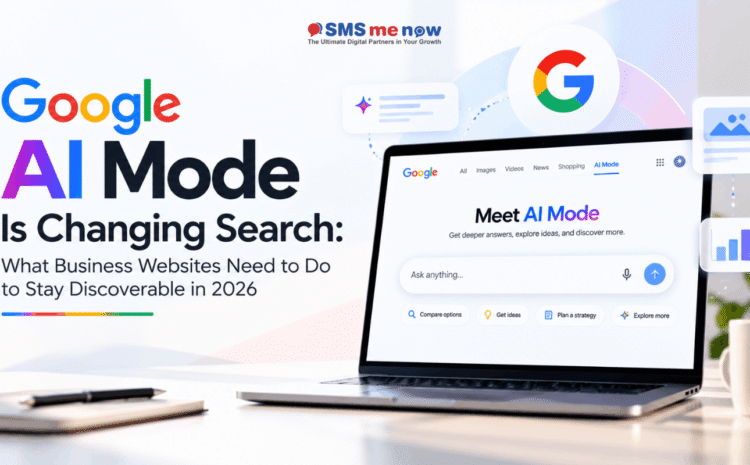
Google AI Mode Is Changing Search: What Business Websites Need to Do to Stay Discoverable in 2026
Google AI Mode SEO, Google Search is becoming more conversational in nature as it evolves from the traditional search engine list of links.
Thanks to Google AI Mode, AI Overviews, and other generative functionalities, people are able to ask very detailed questions, follow up on questions and get synthesized answers with relevant information from a number of websites.
This presents an important dilemma for businesses:
How do you ensure that your site will be discoverable as Google becomes more likely to give answers through AI?
The solution is not simply to disregard traditional SEO techniques or jump on all the new “AI optimization” bandwagons.
The current Google guidelines state that the basic principles of SEO continue to apply in the context of AI Mode and AI Overviews because Google’s AI-based search continues to use its search and ranking systems.
What Is Google AI Mode?
Google AI Mode is an AI-driven Search which is supposed to be able to provide answers to more complicated and conversational or exploratory questions.
Instead of asking a search engine:
“best CRM software”
a user would ask:
“What CRM would be suitable for a small service company with five salesmen who generates most of its leads via WhatsApp?”
And after receiving the first answer, the user could ask some follow-up questions without having to start the whole search again.
According to Google, AI Mode employs the technique of query fan-out, which involves performing several related searches to gather necessary data and then providing the answer with links to supporting materials.
In other words, companies will not have to compete on just one particular keyword.
Why Google AI Mode is Important for Businesses in 2026
AI search is not just a little test anymore.
In 2026, Google disclosed that AI Mode had reached one billion monthly users, while the number of monthly active users for AI Overviews exceeded 2.5 billion. In addition, Google informed that AI Mode searches were increasing steadily, because people used Search to ask longer and more complicated questions.
That is how businesses should perceive the concept of organic visibility now.
Earlier, most SEO efforts consisted of:
Keyword → Ranking → Click
Now, search process will likely be as follows:
Complicated Question → AI Answer → References → Follow-Up Question → Website Visit → Conversion
Your website should be able to do much more than just contain appropriate keywords now.
1. Maintain Conventional SEO
One of the largest misunderstandings regarding AI search is the belief that conventional SEO is now outdated.
Google thinks otherwise.
Its official guide to optimizing for AI search maintains that existing best practices of SEO are crucial since AI elements use the Search technology of Google.
Companies should work on enhancing:
- Crawlability
- Indexability
- Internal linking
- Page titles
- Headings
- Canonical URLs
- Mobile friendliness
- Site speed
- XML sitemaps
- Duplicate content handling
- JavaScript SEO where necessary
If Google is unable to crawl or understand your website, then the issue will not be solved with AI Mode.
2. Make Content of Unique Value
It has become very easy to publish content using AI technology.
It has also made content creation extremely generic.
As per Google’s guide for 2026, webmasters are advised to produce unique and valuable content that is non-commodities rather than copying content from hundreds of sites.
On a business site, original content may be derived from:
- Industry experience
- Research
- Questions from customers
- Case study
- Product knowledge
- Comparisons
- Actual process
- Insights of professionals
- Unique visuals
- Knowledge about locality
- Data of your business
Think of two articles.
In one:
“SEO helps businesses increase their website visibility.”
This is information that is available on thousands of sites.
The other article states:
“How should a service business of Jaipur design its location pages to not have competing pages and local duplicate content?”
Second article offers more value and is specific in nature.
3. Answer the Question, Not Just the Keyword
Keyword usage still works well, but organizations should move towards understanding the questions associated with the keywords.
A customer searching for:
“WhatsApp Business API”
might also like to know:
- How much is WhatsApp Business API worth?
- Is WhatsApp Business API available to many people?
- Does WhatsApp Business API work with CRM software?
- Does WhatsApp Business API have automated lead follow-ups?
- What’s the difference between WhatsApp Business API and WhatsApp Business?
- Is it possible for AI to answer queries using it?
- Is WhatsApp Business API suitable for small firms?
An informative page with all the questions answered offers more context to Google about the topic, as well as more value to users.
4. Make the Important Answers Accessible
AEO, which stands for Answer Engine Optimization, is often considered an entirely different thing from SEO.
According to Google’s guidelines, there is no need for any AEO or GEO strategies specifically aimed at optimizing Google’s generative Search experience. It believes that proper optimization for AI search will still be SEO.
Nevertheless, creating clear and answerable content can be a good strategy.
Use:
- Descriptive titles
- Short opening answers
- Legible sections
- Lists when appropriate
- Comparative tables when necessary
- FAQs
- Direct definitions
- Additional information after the direct answer
For example:
What Is Google AI Mode?
Answer the question right away in the opening paragraph.
Then provide additional information about it.
Don’t make users read 500 words just to find out the answer.
5. Show Your Expertise and Trustworthiness
As commodity AI-generated content becomes more commonplace, authentic expertise becomes more valued.
The business needs to improve ways to establish its identity and to explain why its information is worth paying attention to.
Key components on your site should include:
- Well-researched About us page
- Authentic information about authors
- Business contact information
- Service information
- Customer testimonials
- Case studies
- Professional qualifications, if applicable
- Policies
- Business information
- Real photos
- Updated information
Your website must make clear to users and to search engines alike:
Who produced this content?
Why is this source trustworthy?
Is this company knowledgeable about the topic?
6. Updating Content
The AI mode could collect data from several searches related to the same topic.
This means that outdated information could decrease the value of the optimized content.
Companies need to update information on pages related to:
- Prices
- Statistics
- Legislation
- Product specifications
- Software information
- Industry trends
- Service availability
- Policies
- Dates
- Tech tips
It could be useful to display an updated date if the content really got updated.
However, it is wrong to update a date for making old content look new.
7. Use Structured Data Properly
Google still values structured data where it does so because it enables clearer machine understanding of content.
The appropriate schema depending on the site could be:
- Organization
- LocalBusiness
- Product
- Article
- Breadcrumb
- Event
- Video
- JobPosting
But business owners shouldn’t expect schema to give any guaranteed visibility in AI Mode.
There isn’t any particular “AI Mode schema” that would have to be used by websites in order to get visibility in AI Mode or AI Overviews in Google’s generative search features.
Utilize structured data because it accurately represents your content—not for AI ranking hacks.
8. Enhance Image and Video Content
The modern version of Google Search is getting more and more multimodal.
Companies that depend only on written articles might be losing out.
As applicable, add:
- Product photos
- Services images
- Infographics
- Demo videos
- Product videos
- “Before and after” visuals
- Education graphics
In terms of 2026 generative AI optimization advice from Google, the search engine suggests considering images, videos, local and shopping content, in addition to text content.
Every piece of imagery must always be useful for the users.
9. Enhance Local SEO
When your business caters to certain cities or regions, then AI search doesn’t mean the end of the local aspect.
Have correct:
- Company name
- Address
- Phone numbers
- Business opening times
- Service locations
- Google My Business account
- Location pages
- Reviews
Don’t create hundreds of location pages that are almost identical, just changing the name of the city.
Content for each location must be meaningful for people there.
10. Never Disregard Website Experience
Ranking and citation are just the beginning.
Visitors also need to be able to trust and use your website.
Google’s recommendation persists to include a great page experience, which includes mobile-friendliness, good load time and clearly visible primary content.
Important actions on business websites need to be clear for the visitors:
- Contact Us
- Request a Quote
- Book Consultation
- Request Demo
- Purchase
- Schedule Appointment
There would be no business benefit from AI search visibility if visitors cannot convert.
11. Never Take Advantage of AI-SEO Shortcuts
As businesses, they are going to face more often solutions that promise guaranteed ranking in AI answers.
Be careful.
Google advises website owners to approach third-party solutions critically as external tools do not have access to Google’s proprietary ranking signals and therefore cannot guarantee any result.
According to the most recent guidance from Google, website owners don’t need to take advantage of tricks like content chunking, specific AI text file llms.txt or fake mentions in order to increase visibility in Google Generative Search Experiences.
12. Monitor AI Search Visibility via Search Console
No longer are companies expected to judge SEO solely on keyword rankings.
In 2026, Google released its dedicated Generative AI performance reports in Search Console, giving website owners better insight into impressions from features like AI Overviews and AI Mode.
According to Google, the roll-out was complete as of August 31, 2026.
Businesses will want to monitor:
- Organic Impressions
- Search Clicks
- AI feature impressions
- Landing page performance
- Conversions
- Branded Searches
- Engagement
- The revenue being generated by organic traffic
Ultimately, it is not just about appearing in the AI responses.
It is about creating real business results.
A Practical SEO + AI Search Checklist for 2026
Business websites need:
- Technical SEO fundamentals in place
- Crawlable/indexable pages
- High quality helpful original content
- Depth of topic knowledge
- Question-based sections
- Precise business information
- Original images/video
- Appropriate structured data
- Internal Linking
- Mobile friendly design
- Good page experience
- Local SEO where applicable
- Focused Conversion CTAs
- Search Console monitoring
- Ongoing content updates
The fundamentals create a website valuable to Search, AI Search and—most importantly—the customer.
Conclusion
AI Mode from Google is redefining the way users find businesses and products and gather information online; however, the fundamentals of sustainable search visibility are rather surprising and surprisingly stable.
Businesses should not ignore SEO and focus instead on using some short-term AI search hacks.
Instead, businesses should create accessible, valuable, well-structured, authoritative, up-to-date and user-friendly websites.
The key to success in 2026 is not just:
SEO vs AEO vs GEO.
It is about creating the most effective information source for your customers that will be easy to discover by search engines.
If you want to enhance your visibility in Google Search, AI Mode, AI Overviews, SEO and answer-driven search experience, then book a consultation on our website. We will analyze your website, its structure, technical SEO and your search strategy and create a plan for your successful future.
Frequently Asked Questions
1. What is Google AI Mode?
Google AI Mode is a generative Search feature that lets users pose complicated queries, get answers from the AI, and follow up with more conversational questions.
2. Is traditional SEO still needed for Google AI Mode?
Yes. Google clearly states that its established SEO guidelines apply since both AI Mode and AI Overviews are based on the underlying Search ranking and quality systems.
3. Are websites supposed to have extra optimization for AI Mode?
According to Google, there are no special technical prerequisites for listing in AI Mode and AI Overviews. Good SEO practices form the backbone of the process.
4. What is AEO?
AEO stands for Answer Engine Optimization—the process of organizing information in a way that enables answer engines to make sense of it. Google views optimization of its generative Search features as an aspect of SEO.
5. What does GEO mean?
It stands for Generative Engine Optimization. Google encourages sticking to classic SEO techniques and high-quality content instead of using alleged shortcuts in generative search.
6. Is there any website content used in Google AI Mode?
Yes. Google uses information obtained from Search systems for grounding in generative responses and linking the relevant web pages related to such responses.
7. What do businesses need to do to increase chances of getting into AI Mode?
It is necessary to focus on crawls, technical SEO, unique content, usefulness, answers, expertise, information, and UX.
8. Are FAQs still relevant in 2026?
Yes, if they address genuine users’ questions. They may simplify understanding important information, but at the same time, they shouldn’t be used merely for manipulations.
9. Is there any schema markup that would help with AI Mode?
Structure data could help Google identify content types, but there is no specific schema ensuring being in AI Mode.
10. Can businesses use AI content for SEO?
It could help in doing research and creating content, but Google discourages generating low-quality content by masses. It should bring unique and useful value in AI-assisted pages.
11. Is llms.txt file necessary for Google AI Mode?
The latest advice from Google on generative AI optimization does not recommend the use of an llms.txt file, which is not needed for being visible on Google Search and includes the list of unneeded techniques with regards to the use of AI text files.
12. Can companies track the visibility of their website in Google AI Mode?
Yes, Google offers special reports on generative AI visibility within Search Console starting 2026.
13. Will Google AI Mode lower website traffic?
The traffic may be affected due to the new search behavior, but businesses need to consider other aspects such as number of qualified visits, engagement and conversion rate, not only the clicks.
14. What is the most important SEO task in 2026?
Produce technically accessible, original and valuable content addressing customer’s problems better than its alternatives.
Disclaimer
The information contained herein is for informational and educational purposes only. The Google Search, AI mode, AI Overview, Search Console reports, ranking algorithms and associated features are continuously changing. Availability may vary from country to country and from search experience to search experience. Nothing that can be considered SEO, AEO or GEO can ensure rankings, AI citations, traffic or search visibility. Businesses need to base their implementations based on current Google Search documentation and their own needs.