
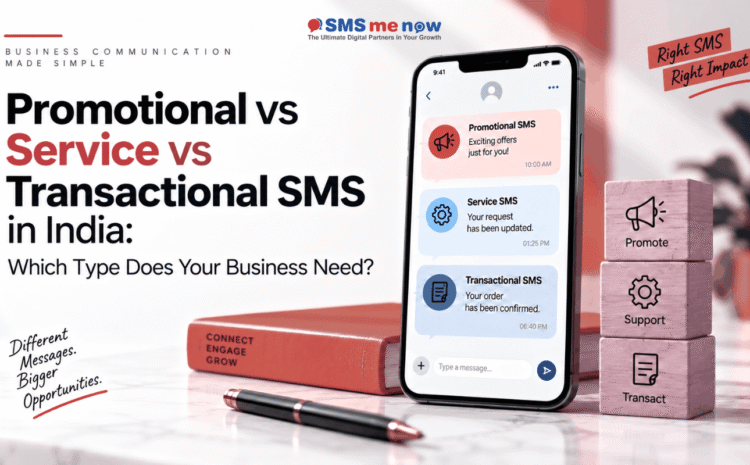
Promotional vs Service vs Transactional SMS in India: Which Type Does Your Business Need?
Fast FactsSMSs must be classified based on the intent behind the communication rather than the mode of delivery that would be the most cost-effective. In the case of the TRAI’s commercial communication guidelines, there is the requirement of a registered entity, registered template headers and messages, and also requirements of obtaining consent when necessary. |
Promotional vs Service vs Transactional SMS in India: What Kind Your Business Needs is a critical business topic since communication and marketing channels are now right in the middle of the customer journey. Business is not selecting systems for merely sending messages or making phone calls anymore; instead, it is selecting systems for capturing leads, responding quickly to customers, respecting their consent, and measuring results.
This guide will focus on promotional vs transactional SMS, taking into account its implementation and practicality in 2026. It will tell where the strategy makes sense, what mistakes businesses usually make, how to implement the solution in steps, and what to measure after its deployment. The purpose of this guide is not to complicate the topic with code or platforms’ language; rather, it is to provide a framework for business owners and marketing/operations teams in implementing the service.
Why This Topic Is Important For Businesses In 2026
- As per TRAI, Principal Entity making use of telecom resources for bulk messages will have to adhere to sender-registration norms including PE registration, headers, and content templates.
- In commercial communication, the business also needs to adhere to the requirements of consent, if any, and hence purchasing a list of mobile numbers unconnected to one’s business is not a viable option.
- Transaction/service communication occurs to facilitate a real customer transaction while promotional communication is done with the purpose of marketing one’s product/service.
- Classification errors may lead to refusal of templates, delivery issues, non-compliance, and unsatisfactory customer experience.
- The businesses need to consult their telecom/messaging partner to ensure correct routing and code of practice.
SMS Principles of Reliability and Responsibility
• Concision is inherent to SMS. Put the key facts at the top, clearly identify the sender, and direct the consumer to the next logical step for further details.
• Good compliance and marketing practice are in alignment here. Employ legitimate sender identity, legitimate templates, and legitimate recipients rather than quick fixes that will earn complaints.
• Service messages and promotions must have different aims and be reported separately. The former has achieved its aim if the customer performs a task; the latter has done its job if it earns a profitable reaction.
• Before going into production mode, always test message variables, links, timing, and recipient selection using a limited sample. A minor mistake in configuration becomes very costly when scaled up.
Practical Process for SMS Messaging
• Determine the exact use case for every SMS before designing the template.
• Make sure the company registers itself as a Principal Entity, wherever applicable.
• Gain and maintain the right header.
• Design the content templates using both static and dynamic components based on the actual message.
• Get and maintain customer consent if needed.
Business Case Studies
• An OTP for login verification is inherently different from an offer for a festival sale.
• The order-dispatch update is for an ongoing transaction and shouldn’t include any unnecessary marketing content.
• The promotion campaign must be addressed to customers who actually have the consent.
What to Measure
• Track delivery rate. Specify how the metric is calculated and by whom for consistency in reporting among campaigns and teams.
• Track template rejection rate. Specify how the metric is calculated and by whom for consistency in reporting among campaigns and teams.
• Track opt-out/complaint rate. Specify how the metric is calculated and by whom for consistency in reporting among campaigns and teams.
• Track click-through rate. Specify how the metric is calculated and by whom for consistency in reporting among campaigns and teams.
• Track conversion rate. Specify how the metric is calculated and by whom for consistency in reporting among campaigns and teams.
• Track cost per successful transaction. Specify how the metric is calculated and by whom for consistency in reporting among campaigns and teams.
Common Errors That Must Be Avoided
- Using incorrect classification for a message will most often cause either unnecessary cost, poor customer experience, poor reporting or non-compliance.
- Sending commercial messages without obtaining necessary consent will most often cause either unnecessary cost, poor customer experience, poor reporting or non-compliance.
- Making changes to the wording of a registered template in an inappropriate manner will most often cause either unnecessary cost, poor customer experience, poor reporting or non-compliance.
- Using unregistered or improper headers will most often cause either unnecessary cost, poor customer experience, poor reporting or non-compliance.
- Speaking promotionally through operational templates will most often cause either unnecessary cost, poor customer experience, poor reporting or non-compliance.
Implementation Checklist
- Prepare to start by being ready for the sender and DLT. Verify Principal Entity, headers, templates, consent requirements, and API configuration prior to the campaign.
- Purify the recipient list of duplicates and make sure each item in the list is used for its legitimate business purposes.
- Test all registered wording and variables in real life conditions including long names, order IDs, and links which might influence the length of the message.
- Send out a batch in controlled conditions first and analyze delivery and application logs before launching the whole volume.
- Archive the results of the audience definition, templates, costs, and business result after the campaign.
A 30-Day Action Plan
- Week 1 – Compliance and Data: ensure PE, headers, templates and consent are in place; clean the list of recipients; remove any duplicates; and explain why the target audience is eligible for the proposed communication.
- Week 2 – Campaign Setup: finalize one objective, the wording of the registered message, variables, destination page and the means of measuring the success of the message. Test the exact template using realistic names, IDs and links prior to going into production.
- Week 3 – Controlled Launch: send a small batch first, check the delivery reports and downstream tracking and scale only when the message works as expected.
- Week 4 – Analysis: compare delivery rate, response rate, conversion rate, opt-out rate and cost. Dissect the results based on segment or use case so that the business can determine the value the audience derives from the communication.
- Take the month to prepare a checklist for the campaign that includes approvals, list criteria, template version, tracking and post-campaign analysis. It will reduce both compliance and production risks.
Frequently Asked Questions (FAQs)
1. What is promotional SMS?
This refers to a commercial activity aimed at promoting purchase or advertisements that has to comply with TRAI/DLT and consent regulations.
2. What is transactional SMS?
This refers to messages that are aimed at supporting transactional or regulated use cases. The exact nature of the message needs to be classified based on current telecom regulations.
3. What is service SMS?
This refers to communication in relation to a service or existing relationship such as account, booking or order. This has to comply with current classification regulations.
4. Is DLT registration required for bulk SMS?
Based on TRAI sender guidelines, Principal entities carrying out bulk communication need to go through the entire process of registration which includes PE and header.
5. What is a sender header?
This refers to the alphanumeric registered identity used for commercial communication.
6. What is the need for content templates?
Pre-registered templates will facilitate the matching of message structure with the authorised sender and communication types.
7. Is consent needed for commercial messages?
Outreach must conform to relevant consent guidelines. TRAI has guidance on customer consent specifically.
8. Can I purchase a database and send out promotions?
Using an unrelated database for messaging will lead to consent and quality concerns. It is preferable to build up one’s own list of opted-in first-party customers.
9. Can I send an offer with order updates?
The inclusion of a promotional offer with a service or transactional template may alter the nature of the communication – check first.
10. Who can help me set up DLT?
The bulk SMS provider can help you operationalise this process, although the sender remains responsible for providing correct business, template and consent information.
Conclusion
It is possible for promotional and transactional SMSs to generate value for the businesses when the same are designed based on a specific customer journey and well-defined ownership along with measurable results. Some of the best applications begin by defining a specific problem statement, choose the right channel to deliver the message, and then evolve based on the performance data rather than adding automation. In order to discuss your requirement practically, you can refer to the website at SMSNow.in or fill out the “SMS Me Now” contact form. The company offers various services such as bulk SMS, voice, WhatsApp Business API, web and digital marketing services that can be customized as per business needs.
Plan your business communication or marketing flow with SMS Me Now. Refer to SMSNow.in or the team at SMS Me Now.
Disclaimer
The above document is provided for informational and marketing purposes only. The features, costs, regulation requirements, and availability of the platform may have changed. Please check the most up-to-date information available from the official documentation before proceeding.