
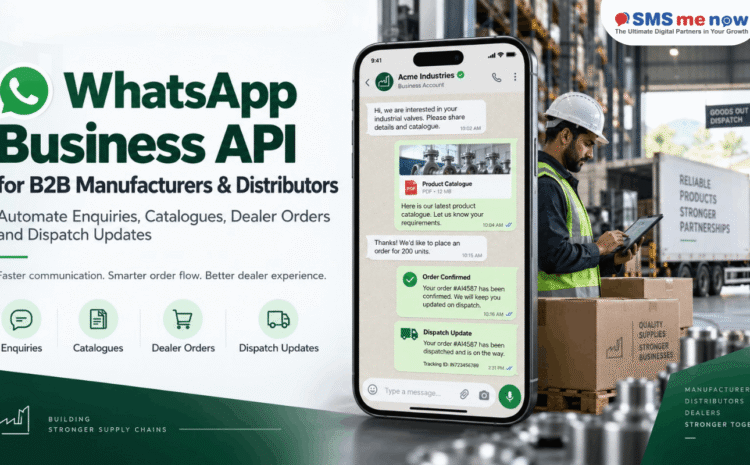
WhatsApp Business API for B2B Manufacturers & Distributors: Automate Enquiries, Catalogues, Dealer Orders and Dispatch Updates
Summary Response
WABA is suitable for manufacturers and distributors to structure repetitive communications from dealers without substituting their sales process. WABA can record questions about products and quantities, send controlled catalogs, direct quote requests, notify on order/delivery status, and ask for repeat orders while sales personnel carry out negotiations and account management.
“Using WhatsApp Business API for B2B Manufacturers & Distributors: Automate Enquiries, Catalogues, Dealer Orders and Dispatch Updates” is a relevant business issue because today communication and marketing platforms form part of the customer experience itself. Businesses do not pick up platforms for sending messages or calls anymore – they determine the process of lead generation, response time, customer consent and measuring success.
In this article, I will provide the guidelines on using WhatsApp Business API for manufacturers. I will share the area of application of the tool, typical errors that businesses make when using it, how to implement the approach gradually, and what metrics you need to use after you launch the system. My aim is not to complicate the discussion with technical details or terms, but rather provide owners and teams with a practical framework for planning the service.
Relevance of This Topic to Businesses in 2026
• Business-to-business discussions are likely to hop between calls, WhatsApp personal numbers, email, and spreadsheets, thereby making quotation history and ownership a problem.
• The dealers may raise operational questions regarding price lists, stock availability, dispatch, minimum order quantities, and documentation.
• A business account can bring together all these interactions in one place while retaining company ownership rather than relying on an individual salesperson’s device.
• The automation must be able to differentiate between useful updates and the actual negotiation, decision on credits, and commercial exceptions.
• The connection of the CRM or ERP system brings in the maximum advantage when the status update comes from live orders rather than copied information.
Principles of Good WhatsApp Business Workflow Design
• Use WhatsApp as a customer journey, not as an alternative to mass unsolicited messaging. The company must understand why customers joined the platform, what information is needed next, and when a human needs to intervene.
• Template governance is important. Maintain a controlled template library with details such as purpose, owner, audience, approval status, and last review date so old and duplicate templates do not remain forever.
• Quality of opt-in influences business effectiveness and customer experience. Relevant permission-based audiences increase the usefulness of automation as the company is able to tailor messages based on lifecycle and intent.
• Data shared through integration should be restricted to that which is necessary for the task at hand. It is unnecessary to provide full access to CRM or ERP systems through APIs to the chat platform.
A Practical Work Flow
• Collect details about the dealer, city, product family and quantity required.
• Send out the appropriate catalog or products instead of sending out a general dump.
• Send a quote request and allocate the account owner.
• Enter accepted orders into the business system instead of just confirming via chats.
• Based on internal status generate production, dispatch or invoicing notifications.
• Utilize purchase history to send courteous reorder requests to active dealers.
Use Cases for Business
• The textile company can route fabric inquiries based on type and minimum quantity before giving price quotes to the sales person.
• The equipment vendor can send brochures automatically but restrict technical sizing and quote generation to an engineer or sales expert.
• The distributor can inform the dealer that the shipment is dispatched without making repetitive phone calls.
Measure This
- Measure the response time for dealers’ inquiries. Clearly define how the metric is calculated and by whom so that the measurement process is consistent from one campaign/team to another.
- Measure quotation turnaround time. Clearly define how the metric is calculated and by whom so that the measurement process is consistent from one campaign/team to another.
- Measure the conversion rate from inquiry to order. Clearly define how the metric is calculated and by whom so that the measurement process is consistent from one campaign/team to another.
- Measure the reduction in order status calls. Clearly define how the metric is calculated and by whom so that the measurement process is consistent from one campaign/team to another.
- Measure repeat order rate. Clearly define how the metric is calculated and by whom so that the measurement process is consistent from one campaign/team to another.
- Measure sales follow up completion rate. Clearly define how the metric is calculated and by whom so that the measurement process is consistent from one campaign/team to another.
Typical Errors to Be Aware Of
- Never provide old price lists through your personal phone. It will normally result in either unnecessary costs, poor customer experience, bad reporting or compliance issues.
- Do not distribute B2B marketing messages to unrelated dealers. It will normally result in either unnecessary costs, poor customer experience, bad reporting or compliance issues.
- Never make automatic decisions about credit and discounts. It will normally result in either unnecessary costs, poor customer experience, bad reporting or compliance issues.
- Always document your chat results in ERP/CRM. Failing to do this will normally result in either unnecessary costs, poor customer experience, bad reporting or compliance issues.
- Never use WhatsApp as the sole system of record. It will normally result in either unnecessary costs, poor customer experience, bad reporting or compliance issues.
Implementation Checklist
- Identify a single process with obvious manual intervention or delayed responses first. Capture existing messages, individuals, systems and decisions from customers before selecting your automation capabilities.
- Establish the opt-in sources, template types, handover processes, business hours and escalations. After this, design the simplest possible workflow that resolves the issue from start to finish.
- Automate the CRM integration only after deciding how to handle record ownership and duplicates. Otherwise, the automation process will create more data cleansing work than value.
- Test the process within a single group of employees or customers. Analyze the chats, templates and handover results before increasing the message frequency.
- Create a monthly governance plan for templates, knowledge base information and any price policy changes.
30-Day Plan for Automation
- Week 1 – Discovery: export an example of customer interactions, analyse what drives people to reach out to the company and prioritise journeys with maximum delay, repetition or missed follow-ups. Verify opt-ins and the human owners of each journey.
- Week 2 – Design: compose the final message, qualifying question, handover criteria and CRM fields. Intentionally limit the scope of the initial version so that the team knows exactly what customer issue needs to be solved by automation.
- Week 3 – Pilot: launch the pilot within a team, branch or customer segment. Observe the conversation daily, track where customers get confused and monitor whether agents are provided with sufficient context when they are taking over from automation.
- Week 4 – Optimise: reduce unnecessary steps, improve poor templates, refine audience criteria and analyse response rates, conversions and costs against pre-launch baseline. Document the operational process before scaling up another journey.
- Make a decision whether to scale after 30 days based on customer result and efficiency rather than merely volume of messages and conversation automation rate. A small reliable process is always a better start point than a big fragile bot.
Frequently Asked Questions (FAQs)
1. Is WABA helpful for B2B companies?
Yes, as long as there is an existing preference between dealers and buyers to use WhatsApp for inquiries, documentation, order statuses, and follow-ups.
2. Can catalogs be distributed automatically?
Product-related documents or information can be sent out via workflows, but make sure that the content is updated and controlled.
3. Can orders from dealers be made via WhatsApp?
An order request or order information can be made using workflows, and after that, an order needs to be validated according to the company’s ERP system.
4. Can there be various agents for different sales areas?
Yes. Routing can be done based on locations, products, languages, or even account management.
5. Should quotes be made by the bot?
Quotes which have set rules can be automated; however, for negotiated B2B quotes, they require human interaction.
6. Can automatic dispatches be generated from ERP?
Yes, if the ERP provides good events or APIs and the messaging process is properly integrated.
7. What about the security of dealer’s information?
Ensure it using the approach of role-based access control, proper business accounts, limited data collection, and system integrations.
8. Can repeat order reminders help in selling more?
It depends on the fact that these reminders will be based on real purchasing periods and consent.
9. Will WABA become a substitute for e-mail?
No, it cannot be a substitute since e-mails are still useful for certain purposes.
10. What should be a good start for your first project?
The dealer enquires and order status messages since these tasks are repetitive and measurable.
Conclusion
WhatsApp Business API for manufacturing companies will be able to add value to business operations if it has been built keeping in mind a proper customer journey along with proper ownership and measurable impact. The best examples always begin from a clear problem statement, correct channeling of work and then performance measurement based on real performance metrics rather than simply adding more automation to the solution. If you want to have a discussion on your requirements, please visit SMSNow.in or contact us via the ‘SMS Me Now’ contact page where we provide bulk SMS, voice, WhatsApp Business API, web, and digital marketing solutions based on business requirement.
Plan your business communication or marketing workflow with SMSMeNow.in
Disclaimer
The information contained in this document is intended only as general guidance for marketing and planning purposes. Features, prices, regulatory obligations, availability, and technical specifications can evolve over time. Please verify current official sources and seek proper professional advice prior to implementation.