
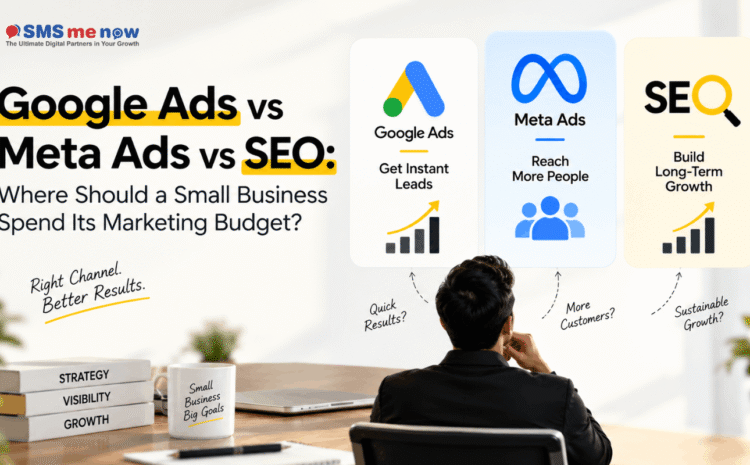
Google Ads vs Meta Ads vs SEO: Where Should a Small Business Spend Its Marketing Budget?
Answer in ShortGoogle Ads, Meta Ads and SEO have unique solutions for customer acquisition challenges. Search Ads work on satisfying existing demand, Meta Ads work well with discovery and interest-based creativity, and SEO gives long-term organic presence. The budget of a small company should be distributed based on customer intent and sales process, not just on choosing the latest trendy marketing approach. |
Google Ads VS Meta Ads VS SEO – Where Should My Business Spend Their Money? is a relevant business topic because communication and marketing solutions have been placed right into the customer experience path. Businesses don’t choose anymore whether they will be using solutions for sending and receiving messages, they have chosen how they will be capturing leads, responding to them, taking care of customer consents and measuring results.
The main purpose of this guide is to provide information about Google Ads VS Meta Ads VS SEO from a real-life 2026 perspective. I will tell you where does this solution provide its benefits, what mistakes are made in this context, how you can implement it step by step and what should you measure after implementation. I am not going to bombard you with any coding terms or platform-related jargon. I am here to provide a simple framework for owners and operations teams.
Why Is This Topic Relevant to Business in 2026?
• Google Search Ads will work best when there are people who are searching for that specific service or problem or product category.
• Meta Ads will drive demand by way of visuals, audiences and messaging via channels like WhatsApp.
• SEO is slower in compounding but will help in reducing dependency on having to pay per visit on the website.
• The blend will depend on gross margins, conversion rates, geographic markets, selling ability and demand requirements of the business.
• Advertising in paid media without good landing pages and follow-up will be a waste of budget despite good click-throughs reported by the platform.
Guiding Principles for Practical Digital Growth Strategy
• Marketing needs to have a specific business goal and customer action in mind. Reach and traffic matter only if they help with awareness, inquiry, purchase or retention.
• Channel mix must depend on customers’ intention. Search, social, messaging, email and calls serve various purposes and cannot be measured using one and the same metric.
• Landing pages and follow-up processes are included into campaign performance assessment. Advertising cannot forever fix poorly defined offers, slow response or bad sales accountability.
• Measurement is about bringing together data from platform metrics and CRM/sales performance so that the team understands what works.
A Practical Approach
• Value estimate the client and maximum acceptable cost for acquiring them.
• Determine if demand is there in search or has to be built up through discovery.
• Adequately budget the test into one or two channels, not too thin.
• Create landing pages and lead routing ahead of increased spending.
• Take note of the leads and sales by channel.
• Budget into channels that are generating profitable and repeatable results.
Business Case Studies
• An emergency fix service can prefer Google Search, since customers will actively seek the assistance required.
• The launch of a new fashion product can require Meta creative, where people should be reached before searching the product name.
• B2B software firm can use paid search to address urgent requirements as well as content creation for SEO to educate customers.
Things to Measure
• Cost per qualified lead
This metric should be tracked and its formula defined together with a person responsible for reviewing it in order to ensure consistency.
• Customer acquisition cost
This metric should be tracked and its formula defined together with a person responsible for reviewing it in order to ensure consistency.
• Conversion rate
This metric should be tracked and its formula defined together with a person responsible for reviewing it in order to ensure consistency.
• Return on ad spend
This metric should be tracked and its formula defined together with a person responsible for reviewing it in order to ensure consistency.
• Organic lead growth
This metric should be tracked and its formula defined together with a person responsible for reviewing it in order to ensure consistency.
• Lead to sale rate
This metric should be tracked and its formula defined together with a person responsible for reviewing it in order to ensure consistency.
Common Mistakes That Must Be Avoided
• Dont compare clicks versus customers; this always results in unnecessary expense, poor customer experience, poor reporting, or compliance issues.
• Do not expect SEO to perform at the same speed as paid advertising; this always results in unnecessary expense, poor customer experience, poor reporting, or compliance issues.
• Do not run Meta ads without having good creative; this always results in unnecessary expense, poor customer experience, poor reporting, or compliance issues.
• Do not direct all of the paid traffic to a general home page; this always results in unnecessary expense, poor customer experience, poor reporting, or compliance issues.
• Do not neglect tracking phone and WhatsApp conversions; this always results in unnecessary expense, poor customer experience, poor reporting, or compliance issues.
Implementation Checklist
• The place to begin implementation is with the customer journey and the baseline – traffic source, number of enquiries, response time, conversion rate and average customer value.
• The first step is to get your measurement right before increasing your budget. Each lead form, call, WhatsApp inquiry and sale needs sufficient data on the source for informed decision-making.
• Conduct experiments with one hypothesis at a time – new audience, creative, landing page or offer – to ensure the findings can be interpreted.
• Mix paid traffic generation for the short term with owned elements like good website content, CRM data and customer audiences.
Action Plan Over 30 Days
• Week 1 – Baseline: record current traffic levels, leads, conversion rate, customer value and response times. Verify your data, phone calls, forms and WhatsApp before you start analyzing data for the budget decisions from your campaigns.
• Week 2 – Build: optimize the most important landing pages or services pages, match the offer with customers’ intent and build a content/campaign test with a hypothesis and single conversion goal.
• Week 3 – Launch: start running the test and invest enough money/time to gather useful data. Focus on qualified leads and sales feedback, not on number of clicks, impressions or ranking.
• Week 4 – Learn: compare the qualified leads, conversions and acquisition cost to the baseline. Do not stop what works and do not repeat mistakes; choose the next experiment without changing more than one thing at once.
• The first 30 days should be seen as a measurement and learning cycle, not a guarantee of instant growth. Digital marketing performance is a result of repetitive improvement in offer, website, traffic and follow up.
Frequently Asked Questions (FAQs)
1. Which is Better: Google Ads or Meta Ads?
Both are not better. Google gets the intent from searching users, and Meta creates and shapes demand with the audience and creative.
2. Is SEO cheaper than ads?
SEO needs content creation and technical and time investments. SEO compounding is there, but it is not free and takes time.
3. How much should a small business spend?
The budget must be calculated on the basis of economic capacity and ability to test. Start with sufficient budget for learning purposes.
4. Run all three at once or not?
Not necessarily. If you have budget capacity to measure, then sure, otherwise many small businesses learn faster if not.
5. Which channel works fast?
Ads work fast when campaigns get approved; SEO needs time for creating visibility.
6. Which works better for local business?
Google Ads and local SEO work well for local demand, whereas Meta can help with offers, brand awareness and remarketing.
7. What metrics should I monitor?
Monitor your leads, appointments, sales and acquisition cost rather than just clicks and impressions.
8. Can WhatsApp be used for paid campaigns?
Yes. Meta campaigns can open a chat via WhatsApp, and any campaign can use WhatsApp to communicate.
9. Under what circumstances should I stop a channel?
Don’t stop based on one bad week alone. Collect enough data, see how good conversions are, take into account seasonality and how you can improve the execution.
10. Does SMS Now have these services?
SMS Now provides businesses with digital marketing, SEO, PPC, lead generation and related communication services.
Conclusion
Google Ads VS Facebook Ads VS SEO will add business value if it follows an actual customer journey, with proper ownership and measurement of results. The best examples come from defining a relevant problem, using the right channel for the right activity, and continuously learning from actual performance numbers rather than just applying automation blindly. For more information on your specific case, visit SMSNow.in or use the SMS Me Now Contact form to tell us what you need. The service provides bulk SMS, voice calls, WhatsApp Business API, and digital marketing which may be used together depending on the needs of the business.
Design a business workflow with SMS Me Now. Visit SMSNow.in or contact the team at SMS Me Now.
Disclaimer
The present piece of writing is intended to serve informational and marketing planning purposes only. Features and technical capabilities mentioned above are subject to change. Always check for up-to-date information on official documentation and get professional consultancy if required.