
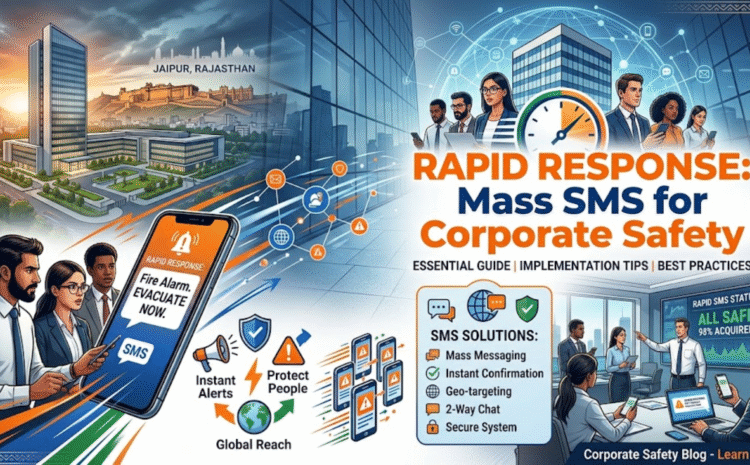
Rapid Response: How Mass SMS for Corporate Safety Saves Lives
Rapid Response: How Mass SMS for Corporate Safety Saves Lives
In an era of unpredictable weather patterns, industrial complexities, and global health concerns, the speed of information is the most critical factor in ensuring human safety. For a modern enterprise, “hope” is not a disaster management strategy. When a crisis hits—be it a chemical leak, a sudden flood in an urban center like Jaipur, or a fire emergency—the ability to reach 10,000 employees in seconds is the difference between a controlled evacuation and a catastrophe.
A mass notification system in India is no longer a luxury for the corporate sector; it is a fundamental pillar of Duty of Care. In this guide, we explore how corporate safety messaging via bulk SMS serves as the ultimate rapid response tool for industrial and commercial safety.
Why SMS is the Backbone of Disaster Communication in India
While high-tech apps and Slack channels are great for daily office work, they fail during a crisis. Data networks often become congested, and internet-dependent apps require a stable 4G/5G connection.
Bulk SMS for crisis management remains superior because:
- High Penetration: Even the most basic mobile handsets in remote industrial zones can receive a standard SMS.
- No Internet Required: SMS travels over the GSM signaling channel, which often remains functional even when data bandwidth is throttled or down.
- 98% Open Rate: Statistics show that most text messages are read within three minutes of delivery, making them far more effective than emails during disaster communication in India.
Key Use Cases: Implementing Corporate Safety Messaging
1. Industrial Alert Systems for Manufacturing Plants
For heavy industries, a split-second delay can lead to environmental or physical hazards. Industrial alert systems integrated with SMS can trigger automated alerts if sensors detect gas leaks, high pressure, or fire.
- Instant Evacuation: Send a “Code Red” message to all floor workers simultaneously.
- Post-Alert Check-ins: Use 2-way SMS to ask employees to reply with “SAFE” or “HELP.”
2. Office Safety and Natural Calamities
In bustling business hubs, weather-related emergencies (like flash floods or heatwaves) require a mass notification system in India to advise staff on whether to stay put or leave early.
- Scenario: A sudden monsoon flood blocks major roads.
- SMS Response: “CRITICAL: Heavy flooding on Main Street. All staff are advised to stay in the office until further notice. Food and water are being staged in the cafeteria.”
3. IT and Cyber Security Breaches
Safety isn’t just physical. In the event of a massive data breach or server failure, emergency SMS alerts can notify the IT response team instantly, regardless of the time of day, ensuring that the response begins before the damage spreads.
Features of a High-Performance Mass Notification System
To ensure your corporate safety messaging is effective, your chosen platform must have specific technical capabilities:
- Real-Time Delivery Reporting: You must know exactly how many people received the alert.
- Template Pre-sets: In a crisis, you don’t have time to type. Have pre-approved templates for “Fire,” “Medical Emergency,” and “System Failure.”
- Group Segmentation: Send alerts to specific departments (e.g., only the Maintenance Team) or specific locations (e.g., only the Jaipur Branch).
- Global Reach with Local Speed: Especially for MNCs, the system must be able to deliver bulk SMS for crisis management across borders without lag.
Best Practices for Crisis Communication
- Be Concise: Use the “Who, What, and Where” formula.
- Bad: “There seems to be an issue in the back.”
- Good: “FIRE ALERT: Building B, Floor 4. Evacuate via North stairs immediately.”
- Don’t Over-Alert: If you use your emergency SMS alerts for non-critical things like “Lunch is ready,” employees will start ignoring them.
- Test Your System: Run a quarterly “SMS Drill” to ensure your database is updated and the delivery gateway is active.
Conclusion: Priority One is Protection
Investing in corporate safety messaging is an investment in your most valuable asset: your people. By integrating a robust mass notification system in India, your organization moves from a reactive stance to a proactive one. In the face of danger, clear, instant, and reliable communication is the only way to ensure a rapid response.
Don’t wait for a crisis to find your solution. Implement a bulk SMS strategy today and ensure your team stays informed, safe, and secure.
Frequently Asked Questions (FAQs)
- How fast are emergency SMS alerts delivered?
With a high-throughput gateway, thousands of messages are delivered within 5 to 60 seconds. However, this depends on the network congestion of the local telecom operators. - Can bulk SMS for crisis management work if mobile towers are down?
If a specific tower is physically destroyed, local users may lose signal. However, SMS uses the signaling channel (Control Channel), which is often the last to fail and the first to be restored during disaster communication in India. - Is it legal to send mass safety SMS under TRAI regulations?
Yes. Critical safety alerts are categorized as “Transactional” or “Service Implicit” messages under TRAI rules, meaning they can be sent 24/7 to all users, including those on the DND (Do Not Disturb) list, provided they are genuine emergencies. - What is the difference between a standard bulk SMS and a mass notification system in India?
A standard bulk SMS service is usually for marketing. A mass notification system includes specialized features like high-priority routing, 2-way communication, and pre-integrated triggers for industrial alert systems. - Should we use 2-way SMS for corporate safety?
Absolutely. 2-way SMS allows employees to confirm their safety status. This helps rescue teams focus only on those who haven’t responded or have signaled for “HELP.” - Can we integrate our HR software with the SMS system?
Yes. Most modern safety platforms offer API integration, so when a new employee is added to your HR system, their number is automatically synced for corporate safety messaging. - How often should we update our contact database for disaster communication? At minimum, once every quarter. An outdated number is a life at risk during an emergency.