
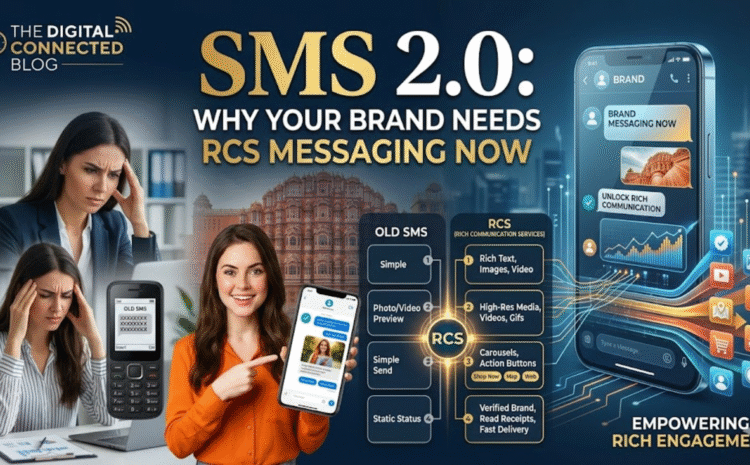
SMS 2.0: Why Your Brand Needs RCS Messaging Now
SMS 2.0: Why Your Brand Needs RCS Messaging Now
For decades, the humble SMS has been the workhorse of mobile communication. It was reliable, reached every handset, and had an open rate that email could only dream of. But as we move further into 2026, “plain text” is no longer enough to capture the attention of a digital-first audience. Consumers don’t just want to be informed; they want to be engaged.
Enter Rich Communication Services (RCS)—often hailed as SMS 2.0. This isn’t just an upgrade; it’s a revolution in how brands talk to customers. If your marketing strategy is still stuck in 160-character black-and-white text, you are missing out on a massive opportunity to build trust and drive conversions. Let’s dive into why RCS business messaging in India is the essential tool for your brand this year.
What is RCS? Understanding Rich Communication Services
Rich Communication Services is the modern evolution of SMS. It brings the features we love in apps like WhatsApp and iMessage—such as high-resolution photos, videos, typing indicators, and read receipts—directly into the native messaging app of a smartphone.
The “2.0” moniker comes from the fact that RCS requires no third-party app download. It’s baked into the Android ecosystem (via Google Messages) and, as of late 2024 and 2025, has seen massive adoption across Apple devices through iOS updates. In 2026, RCS officially became the universal standard for rich media messaging.
The Power of Branded Messaging in 2026
The biggest problem with traditional SMS is the “Sender ID.” Receiving a text from “AD-612345” looks suspicious. In an era of rampant phishing, consumers are hesitant to click links from unknown numbers.
Branded messaging 2026 standards solve this through Verified Sender Profiles.
- Brand Name & Logo: Instead of a random number, the user sees your full brand name and logo.
- Verification Badge: A “Verified” tick mark appears, instantly establishing trust.
- Custom Branding: You can customize the colors and header of the chat window to align with your brand identity.
This visual verification is a game-changer for RCS business messaging India, where consumer trust is the primary driver of click-through rates.
RCS vs WhatsApp: Which Wins for Business?
Many marketers ask: “Why use RCS when we already have WhatsApp Business?” While both are powerful, they serve different strategic purposes.
Reach and Accessibility
WhatsApp requires a user to have the app installed and an active account. RCS is native. If a phone has a SIM card and supports the protocol, it can receive an RCS message. This makes it a “fallback-proof” solution.
The Cost Factor
In many regions, including India, interactive SMS marketing via RCS can be more cost-effective than WhatsApp’s conversation-based pricing models, especially for high-volume transactional alerts that require rich media.
Frictionless User Experience
RCS doesn’t feel like a “separate app.” It’s part of the phone’s core functionality. There is no need to “opt-in” by saving a number or initiating a chat in the same way some platforms require.
Driving Conversions with Interactive SMS Marketing
The “Rich” in Rich Communication Services isn’t just about pretty pictures; it’s about interactivity. Traditional SMS forces a user to leave the messaging app to complete a task. RCS keeps them inside.
Suggested Action Buttons
Instead of asking a user to type “YES” to confirm an appointment, RCS provides a tappable button.
- Example: A flight update with a “Check-in” button that opens the browser directly to the passenger’s seat map.
- Example: A retail offer with a “View Collection” button that opens a carousel of products.
Rich Media Carousels
Imagine sending a mini-catalog through a text message. Users can swipe through up to 10 high-resolution cards, each with its own image, description, and “Buy Now” button. This turns a simple notification into a storefront.
Practical Use Cases for Indian Brands
The landscape of RCS business messaging in India is diverse, spanning from e-commerce to banking.
E-commerce & Retail
- Order Tracking: Send a map showing the delivery rider’s location in real-time.
- Abandoned Cart: Send a high-res image of the item left in the cart with a “Complete Purchase” button.
Banking & Finance
- Fraud Alerts: A verified message with “Yes, it was me” or “No, block card” buttons.
- Statement Summaries: Interactive carousels showing monthly spending categories.
Travel & Hospitality
- Mobile Boarding Passes: High-quality QR codes that work even without a data connection once the message is received.
- Hotel Check-ins: Interactive menus for room service or spa bookings.
How to Implement RCS in Your Strategy
Transitioning to rich media messaging doesn’t require a total overhaul of your tech stack.
- Audit Your Current SMS: Identify which messages (OTPs, delivery alerts, marketing blasts) would benefit most from images and buttons.
- Choose a Reliable Aggregator: Partner with an Indian CPaaS (Communications Platform as a Service) provider that supports RCS APIs.
- Segment Your Audience: Use RCS for users with compatible devices (which is now the vast majority) and have a clean SMS fallback for older handsets.
- A/B Test: Compare the engagement rates of a plain text SMS vs. an RCS message with a carousel.
The Future: AEO, GEO, and Messaging
As search shifts toward Answer Engine Optimization (AEO) and Generative Engine Optimization (GEO), the way brands provide information is changing. RCS fits perfectly into this “direct answer” world. Instead of making a user search for “Where is my order?”, the brand provides the answer proactively in a rich, scannable format.
Frequently Asked Questions (FAQs)
Q1: Does RCS work on iPhones?
Yes! As of 2025, Apple has fully integrated RCS support into its native Messages app. This means brands can now reach both Android and iOS users with a unified rich media messaging experience.
Q2: What happens if the recipient doesn’t have a data connection?
RCS requires an internet connection (Wi-Fi or mobile data). However, the beauty of the system is the SMS Fallback. If the RCS message cannot be delivered, the system automatically sends a standard text version so the customer never misses the update.
Q3: Is RCS business messaging more expensive than regular SMS?
While a single RCS message may cost slightly more than a standard 160-character SMS, the ROI is significantly higher. Because of the verified sender status and interactive buttons, engagement rates are often 3x to 5x higher than traditional SMS.
Q4: Is RCS messaging secure?
RCS for business uses TLS encryption, making it more secure than standard SMS. Additionally, the “Verified Sender” protocol ensures that customers are communicating with the actual brand and not a scammer.
Q5: Can I send videos through RCS?
Absolutely. One of the biggest advantages of RCS business messaging in India is the ability to send high-quality video clips, which is perfect for product demos or personalized brand stories.
Q6: Do users need to download an app to receive RCS?
No. RCS is a protocol, not an app. It works within the pre-installed “Messages” app on most modern smartphones.
Q7: How do I get my brand “Verified” for RCS?
You must work with a Google-partnered messaging provider. They will submit your brand details (logo, website, use case) to the carriers for verification.
Conclusion: Don’t Get Left Behind
The shift from SMS to Rich Communication Services is not a matter of “if,” but “when.” In 2026, a brand that communicates via plain, unverified text appears dated and potentially untrustworthy.
By adopting RCS business messaging in India, you are giving your customers a premium, secure, and interactive experience that drives real business results. From the visual appeal of rich media messaging to the trust of branded messaging in 2026, the tools are now in your hands.