
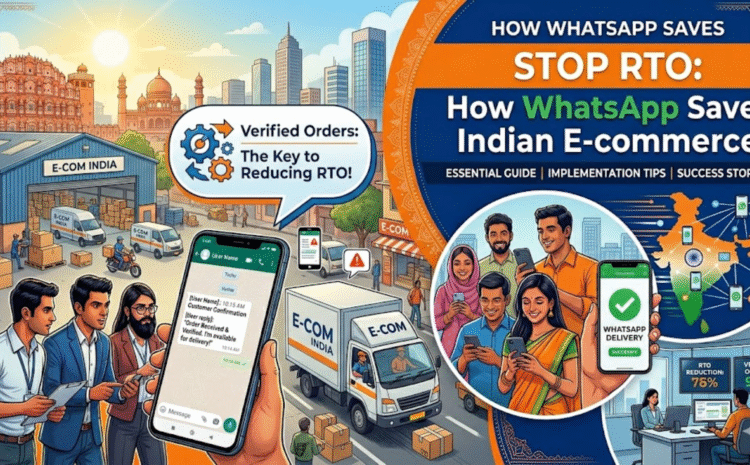
Stop RTO: How WhatsApp Saves Indian E-commerce
Stop RTO: How WhatsApp Saves Indian E-commerce
For Indian e-commerce sellers, Return to Origin (RTO) is the silent profit killer. You’ve spent money on marketing, picked the product, packed it with care, and shipped it—only for the courier to return it because the customer wasn’t available or, worse, “changed their mind” upon delivery. In India, where Cash on Delivery (COD) remains the king of transactions, RTO rates can soar as high as 30% to 40%.
However, a revolutionary tool is changing the game: WhatsApp Business API. By shifting communication from ignored emails and blocked SMS to India’s favorite messaging app, brands are finding a way to reduce RTO in WhatsApp strategies effectively. This guide explores how automated messaging is transforming e-commerce logistics in India and protecting your bottom line.
The RTO Crisis in the Indian Market
RTO isn’t just a lost sale; it’s a double loss. You pay for forward shipping and then pay again for reverse logistics. In the competitive landscape of e-commerce logistics India, high RTO can sink a small business within months.
The primary reasons for RTO include:
- Impulse Buying: Customers order on COD and regret it by the time the parcel arrives.
- Incorrect Addresses: Typos in the pin code or house number.
- Lack of Trust: Customers aren’t sure when the package is coming, so they aren’t ready with the cash.
- Failed Verification: Traditional COD verification SMS often goes to the “Spam” folder, leaving orders unconfirmed.
How to Reduce RTO WhatsApp: The Strategy
Using WhatsApp isn’t just about chatting; it’s about creating a seamless, automated workflow that keeps the customer engaged from “Checkout” to “Delivered.”
1. Automated Order Confirmation
The moment a customer places a COD order, an automated order confirmation message should be triggered on WhatsApp.
- The “Yes/No” Button: Instead of a text-only message, use interactive buttons. “Confirm Order” or “Cancel Order.”
- The Result: If a customer cancels immediately, you save the shipping cost. If they confirm, their commitment to the purchase increases.
2. Real-Time Address Correction
Many RTOs happen because of “Incomplete Address.” Through WhatsApp, you can send a message: “Hi [Name], we noticed your house number is missing. Please reply with your full address to ensure fast delivery!” This small step significantly improves the post-purchase customer experience.
3. Smart WhatsApp Shipping Updates
Don’t let your customer wonder where their package is. Sending WhatsApp shipping updates at every milestone (Shipped, Out for Delivery, Delayed) keeps the excitement alive.
- Out for Delivery Alert: “Hey! Your order is out for delivery today. Please keep ₹549 ready for the courier agent.” This ensures the customer is home and has the cash ready, directly addressing the biggest cause of COD failure.
Beyond RTO: Enhancing Post-Purchase Customer Experience
While the goal is to reduce RTO WhatsApp, the side effect is a massive boost in brand loyalty. When a customer receives professional, timely updates on an app they use every 10 minutes, their trust in your brand skyrockets.
- Feedback Loops: Once delivered, send a “How was your experience?” message.
- Upselling: “We saw you liked that shirt! Here is a 10% discount on matching trousers.”
- Human Touch: Unlike a rigid COD verification SMS, WhatsApp allows the customer to ask a quick question and get an automated or human response instantly.
Practical Implementation: Tips for Sellers
- Use Official API: Don’t use personal WhatsApp numbers; you will get banned. Use a verified WhatsApp Business API provider.
- Segment Your Data: Only send “Out for Delivery” messages to COD customers if you are on a tight budget, as they are the highest RTO risk.
- Keep it Brief: Nobody reads long paragraphs. Use emojis and clear buttons to guide the user.
Conclusion: Turning Conversations into Conversions
In the world of e-commerce logistics in India, the battle is won or lost at the “Last Mile.” By implementing a strategy to reduce RTO WhatsApp, you aren’t just saving shipping costs; you are building a reliable bridge between your warehouse and the customer’s doorstep. Automated, interactive, and high-intent messaging is no longer an “option”—it is the survival kit for modern Indian e-commerce.
Stop losing money to returned parcels. Switch to a WhatsApp-driven logistics strategy today and watch your delivery success rate climb!
Frequently Asked Questions (FAQs)
- Why is WhatsApp better than COD verification SMS?
SMS often gets filtered into “Promotions” or “Spam” folders. WhatsApp has a nearly 98% open rate, and interactive buttons make it much easier for a customer to confirm their intent with one tap. - Can I really reduce RTO WhatsApp significantly?
Yes. Brands using WhatsApp for automated order confirmation and address verification report a 15% to 25% reduction in RTO within the first three months of implementation. - Is it expensive to send WhatsApp shipping updates?
While WhatsApp API has a per-conversation cost, it is much cheaper than the cost of a returned shipment (RTO), which includes forward and reverse freight plus packaging damage. - How does WhatsApp improve e-commerce logistics in India?
It cleans up the data. Verifying addresses and intent before the “Pick-up” ensures the courier partner has a much higher chance of a successful first-attempt delivery. - Does it work for prepaid orders too?
While prepaid orders have lower RTO risk, WhatsApp shipping updates are still crucial for post-purchase customer experience, reducing “Where is my order?” (WISMO) calls to your support team. - Is it difficult to set up automated order confirmation?
Not at all. Most Shopify, WooCommerce, and Magento stores can integrate with WhatsApp API providers using simple plugins or apps in a few minutes. - Can customers reply to these messages?
Yes! That is the beauty of the platform. If a customer wants to change a delivery date or time, they can reply, and your team (or a chatbot) can handle the request immediately.