
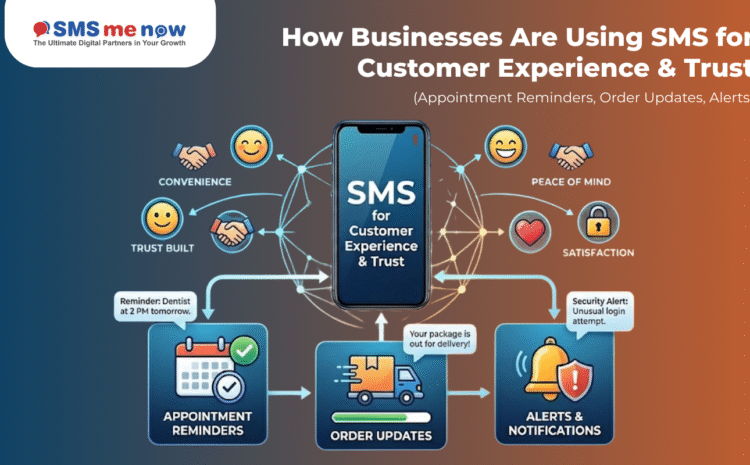
How Businesses Are Using SMS for Customer Experience & Trust
SMS for Customer Experience and Trust, In the hyper-competitive digital landscape of 2026, the battle for customer loyalty isn’t won through flashy advertisements or massive billboards; it is won in the small, micro-moments of a customer’s day. As inboxes become cluttered with hundreds of unread emails and social media feeds are drowned out by algorithms, the humble text message has emerged as the most powerful tool for building Customer Experience (CX) and Trust.
With a staggering 98% open rate—the majority of which occur within the first three minutes of delivery—SMS is the “direct line” to your audience. From a local dental clinic in Jaipur to a global e-commerce giant, businesses are leveraging SMS to provide transparency, reduce friction, and foster a sense of security.
This 1,500+ word guide explores the strategic role of SMS in modern business operations and how you can use it to transform your brand into a trusted household name.
The Psychology of Trust: Why SMS Works
Trust is built on predictability and transparency. When a customer interacts with a brand, they have an underlying anxiety: Did my order go through? Will the technician show up? Is my account secure?
SMS solves this anxiety instantly. Unlike email, which can feel formal and distant, or WhatsApp, which can sometimes feel intrusive, SMS is perceived as an “official” channel. When a message lands in a mobile inbox with a verified Sender ID (e.g., AD-DIALMN), it signals legitimacy.
- Immediate Gratification: SMS provides instant feedback, satisfying the modern consumer’s need for real-time information.
- Directness: There are no “Spam” folders to navigate. The message is right there on the lock screen.
- Reliability: SMS does not require a data plan or Wi-Fi, making it the only “fail-safe” communication method in areas with spotty connectivity.
Strategic Use Case: The Power of Appointment Reminders
“No-shows” are a silent killer for service-based businesses like salons, clinics, and consulting firms. They lead to wasted staff time and lost revenue. SMS appointment reminders are the most effective solution to this problem.
- The Nudge Factor: A simple reminder sent 24 hours before an appointment can reduce no-shows by up to 40%.
- Interactive Options: Modern SMS systems allow for two-way communication. “Reply 1 to Confirm or 2 to Reschedule.” This gives the customer control while providing the business with an updated schedule.
- Professionalism: Sending a professional reminder shows that you value the customer’s time as much as your own, elevating the perceived quality of your service.
Strategic Use Case: Order Updates & Logistics Transparency
In e-commerce, the period between “Order Placed” and “Package Delivered” is known as the “Anxiety Gap.” SMS bridges this gap by providing a step-by-step narrative of the product’s journey.
- Confirmation Alerts: An immediate SMS confirming the payment and order details.
- Shipping Notifications: “Your order is packed and ready to ship!”
- The “Final Mile” Alert: This is the most crucial message for CX. “Out for Delivery: Our rider is 10 minutes away.” This allows the customer to prepare for the delivery, reducing failed delivery attempts.
- Post-Delivery Survey: “How was your delivery? Click here to rate us.” This captures feedback while the experience is still fresh in the customer’s mind.
Strategic Use Case: Security Alerts & Two-Factor Authentication (2FA)
In an era of rising cyber-threats, security is the foundation of trust. Businesses that prioritize their customers’ data security build the strongest long-term relationships.
- OTPs (One-Time Passwords): SMS-based OTPs are the global standard for 2FA. They ensure that even if a password is compromised, the account remains secure.
- Login Alerts: “A new login was detected from a Chrome browser in Jaipur. If this wasn’t you, click here to secure your account.”
- Fraud Prevention: Banks use SMS to alert customers of high-value transactions instantly, allowing for immediate intervention if the activity is unauthorized.
Comparing SMS to Other CX Channels
| Feature | SMS | ||
| Open Rate | 98% | 20-22% | 90% |
| Response Time | < 90 Seconds | 90 Minutes+ | 10-15 Minutes |
| Perceived Urgency | High | Low | Moderate |
| Data Requirement | No (Works Offline) | Yes | Yes |
| Best For | Alerts, OTPs, Nudges | Newsletters, Invoices | Support, Sales Chat |
The Compliance Factor: Navigating TRAI & DLT in 2026
To use SMS for trust, you must first be trustworthy yourself. In India, this means strict adherence to the Telecom Regulatory Authority of India (TRAI) guidelines.
- DLT Registration: Every business must be registered on a Distributed Ledger Technology (DLT) platform (Jio, Airtel, BSNL, etc.) to prevent spam.
- Header Suffixes: In 2025, TRAI mandated suffixes to identify message types:
- -T for Transactional (OTPs/Confirmations)
- -S for Service (Invoices/Reminders)
- -P for Promotional (Marketing/Offers)
- Template Approval: Every message you send must match a pre-approved template on the DLT portal to ensure no malicious content is being broadcast.
Elevate Your CX with DialMeNow & SMSNow
Managing these diverse SMS workflows can be overwhelming for a growing business. That’s where DialMeNow comes in. Our SMSNow API is built for businesses that refuse to compromise on customer experience.
- ✅ Sub-3 Second Delivery: Our high-priority routes ensure that OTP and alerts reach your customers almost instantly.
- ✅ Full DLT Managed Service: We take the headache out of registration and template approvals.
- ✅ Omni-channel Integration: Connect your SMS alerts with WhatsApp and Email for a truly synchronized customer experience.
- ✅ Global Reach: Whether your customer is in Jaipur or New York, our network ensures delivery.
Don’t leave your customer experience to chance. Build trust, one message at a time.
Frequently Asked Questions (FAQ)
Q1: Is SMS still better than WhatsApp for business?
A: They serve different purposes. SMS is superior for critical, urgent alerts and OTPs because it works without internet. WhatsApp is better for two-way conversations and sharing rich media (like PDFs or catalogs).
Q2: How do appointment reminders save money?
A: By reducing “no-shows.” If your hourly rate is ₹2,000 and you save just 5 no-shows a month via SMS, you’ve saved ₹10,000—far exceeding the cost of the SMS service.
Q3: Can I personalize my SMS?
A: Yes! Using our API, you can include the customer’s name, specific order number, and appointment time. “Hi Rahul, your appointment with Dr. Sharma is at 4 PM.”
Q4: What is the character limit for a business SMS?
A: A standard SMS is 160 characters. If you use a variable (like a name), ensure your total length doesn’t exceed this to avoid being billed for two messages.
Q5: How do I handle customers who don’t want to receive SMS?
A: Always provide an Opt-out option (e.g., “Text STOP to opt-out”) in your promotional messages. Transactional and Service messages (like OTPs) are generally exempt from DND (Do Not Disturb) restrictions as they are essential for account functionality.
Q6: Why are my messages not being delivered?
A: Common reasons include the customer being on DND, an incorrect phone number format, or your DLT template not being approved. Our dashboard provides real-time failure reports to help you troubleshoot.
Q7: Can I send links in a Transactional SMS?
A: Yes, but the link must be a part of the approved DLT template and should ideally be a short URL to save character space.
Q8: What is a “Sender ID” and why does it matter for trust?
A: A Sender ID is the 6-character name (e.g., AD-DIALMN) that appears instead of a number. It builds trust because it confirms the message is from a verified business, not a random individual.
Disclaimer
The use of SMS for business must comply with the TCCCPR 2018 regulations and subsequent TRAI amendments. Businesses are responsible for obtaining customer consent before sending promotional messages. SMS delivery rates are subject to telecom operator availability and individual handset settings.
Conclusion
In 2026, SMS for customer experience and trust is no longer a “nice-to-have”—it is a core pillar of digital infrastructure. By providing timely reminders, transparent order updates, and secure alerts, you show your customers that you are attentive, professional, and reliable. While other channels may offer more “flair,” the humble SMS offers something more valuable: a guaranteed connection.