
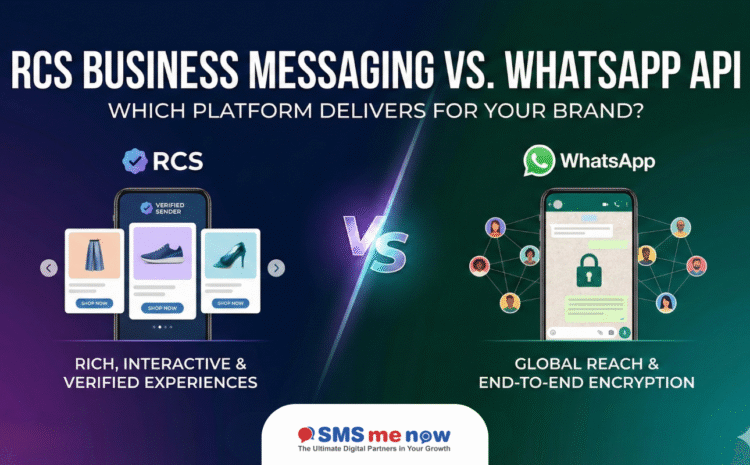
RCS Business Messaging vs. WhatsApp API: Which is Right for Your Brand
RCS Business Messaging vs WhatsApp API, In the rapidly evolving landscape of 2026, the way brands communicate with their customers has moved far beyond the 160-character limit of traditional SMS. Today, the battle for the customer’s attention happens in the “Rich Messaging” arena. Two giants dominate this space: RCS (Rich Communication Services) Business Messaging and the WhatsApp Business API.
While both platforms offer interactive features like carousels, buttons, and verified profiles, they cater to different strategic needs. With the recent full integration of RCS on iOS 18+ and the expansion of WhatsApp Pay in India, choosing the right “primary” channel can make or break your marketing ROI. This guide breaks down everything you need to know to make an informed decision for your brand.
Understanding the Contenders
What is RCS Business Messaging?
Often called “SMS 2.0,” RCS is the native upgrade to standard texting. It works directly within the default messaging app on Android and now on iPhones (iOS 18.1+). It doesn’t require the user to download a third-party app.
- Key Power: Universal reach on native messaging inboxes with verified brand identities.
What is WhatsApp Business API?
The enterprise version of the world’s most popular messaging app. It allows businesses to integrate their CRM and send automated, end-to-end encrypted messages to billions of users globally.
- Key Power: High conversational intimacy and a mature ecosystem for commerce and support.
Feature Comparison: At a Glance (2026 Edition)
| Feature | RCS Business Messaging | WhatsApp Business API |
| App Required | No (Native Inbox) | Yes (WhatsApp) |
| User Base (India) | ~700 Million+ (Growing) | ~550 Million+ (Dominant) |
| Verification | Blue Tick (Carrier/Google) | Green Tick (Meta) |
| Multimedia | High-res images, Video, Carousels | High-res images, Video, Catalog, Flows |
| Security | Encrypted in transit | End-to-End Encrypted |
| Fallback | Auto-falls back to SMS | None (Requires Internet/App) |
| Primary Use Case | Marketing, Notifications, Alerts | Conversational Support, Commerce |
Deep Dive: The Pros and Cons
Why Choose RCS Business Messaging?
- Zero Barrier to Entry: Because it’s native, the user doesn’t have to “opt-in” by installing an app. If they have a phone, they have RCS.
- Branding & Trust: Messages arrive with your logo and a “Verified” badge, which significantly reduces the “spam” perception compared to traditional SMS.
- Cost-Effectiveness for Bulk: In many regions, RCS is priced competitively with high-end SMS, making it ideal for large-scale “one-way” broadcasting like flash sales or shipping alerts.
- Seamless iOS-Android Bridge: As of 2026, the friction between iPhone and Android users for rich messaging has largely vanished, making RCS a truly universal standard.
Why Choose WhatsApp Business API?
- Two-Way Conversations: WhatsApp is designed for dialogue. It is the best platform for AI chatbots, handling FAQs, and complex customer support journeys.
- WhatsApp Flows: This 2026-standard feature allows users to book appointments, select seats, or fill out forms inside the chat without ever opening a browser.
- End-to-End Encryption: For industries like Banking, FinTech, and Healthcare, WhatsApp’s superior security is often a non-negotiable requirement.
- High Engagement: Users check WhatsApp multiple times a day. The “Read Rate” is consistently above 98%, often higher than any other digital channel.
Pricing Models in India (2026)
Understanding the cost structure is vital for SMBs.
- WhatsApp API: Moves away from per-message to Category-Based Pricing. Marketing conversations (proactive) are the most expensive, while Utility (order updates) and Authentication (OTPs) are significantly cheaper.
- RCS: Often follows a per-message or 24-hour conversational window model. In India, RCS marketing messages can sometimes be 15–20% cheaper than WhatsApp marketing templates, though prices vary by carrier (Airtel, Jio, Vi).
Which One Should You Pick?
Pick RCS if:
- You want to reach customers who might not have WhatsApp or are in low-data areas.
- You are sending “one-to-many” marketing broadcasts where you need high visibility but low interaction.
- You need a reliable fallback—if the internet is off, the message still arrives as a standard SMS.
Pick WhatsApp API if:
- You want to build a “Digital Storefront” where customers can browse and buy products.
- Your brand relies on high-trust, two-way communication (Support, Consultations).
- You want to leverage advanced AI and automation to reduce human agent costs.
✨ Maximize Your Reach with DialMeNow
Why choose one when you can have both? At DialMeNow, we help Indian brands navigate the complex world of rich messaging with a unified communication strategy.
- ✅ Omnichannel Dashboard: Manage your RCS, WhatsApp, and SMS campaigns from a single window.
- ✅ Intelligent Fallback: If your RCS message fails, our system automatically triggers a WhatsApp or SMS to ensure 100% delivery.
- ✅ Meta & Google Certified: We handle the “Blue Tick” and “Green Tick” verification process for you, ensuring your brand is trusted from day one.
- ✅ AI-Powered Chatbots: Deploy multilingual bots that work across both RCS and WhatsApp to keep your customers engaged 24/7.
Stop guessing which channel works. Start delivering everywhere your customers are.
👉 [Book a Free Rich Messaging Consultation with DialMeNow Today!]
❓ Frequently Asked Questions (FAQ)
Q1: Does RCS work on iPhones in 2026?
A: Yes! Since late 2024/2025, Apple has supported RCS. In 2026, it will be a standard feature on all modern iPhones running current iOS versions.
Q2: Is WhatsApp Business API free?
A: The “App” is free for very small businesses, but the API is a paid service intended for scaling. You pay per conversation or message category.
Q3: Which has better open rates?
A: Both are excellent, with open rates usually exceeding 90%. However, WhatsApp often sees higher “Response Rates” because users are accustomed to chatting there.
Q4: Can I send OTPs via RCS?
A: Yes. RCS is becoming a popular, secure, and branded way to send OTPs, often at a lower cost than international WhatsApp Authentication rates.
Q5: What happens if the customer has no internet?
A: WhatsApp will not deliver until the user is online. RCS, however, can fall back to a standard SMS, ensuring the message reaches the handset.
Q6: Do I need DLT registration for RCS?
A: Yes, in India, RCS content usually requires DLT (Distributed Ledger Technology) registration, similar to SMS, whereas WhatsApp is managed through Meta’s platform.
Q7: Can I include “Buy Now” buttons in RCS?
A: Yes, RCS supports interactive buttons that can trigger webviews or native payments, making it a powerful tool for e-commerce.
Q8: Can a small business use the WhatsApp API?
A: Absolutely. While it’s called “Enterprise,” many providers (like DialMeNow) offer “Starter” plans tailored for growing Indian SMBs.
Disclaimer
Pricing and carrier policies for RCS and WhatsApp are subject to change. Regional regulations by TRAI (India) may impact delivery protocols. Always ensure you have customer “opt-in” consent before initiating marketing messages to remain compliant with data privacy laws.
Conclusion
In 2026, the “RCS vs WhatsApp” debate isn’t about which is better—it’s about which is better for the specific task. Use RCS for its massive, frictionless reach and native branding. Use WhatsApp for its conversational depth and industry-leading security. By integrating both, you ensure that your brand is never just a “missed notification” but a valuable conversation.