
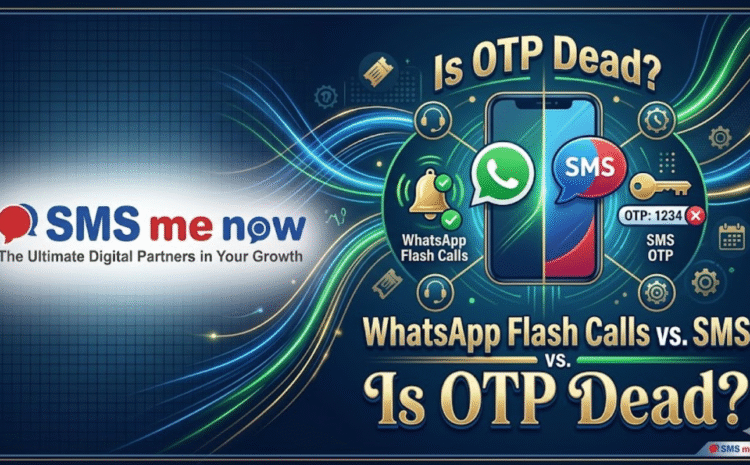
Is OTP Dead? WhatsApp Flash Calls vs. SMS: The Battle for Secure Login
For over a decade, the “ping” of a text message containing a six-digit code has been the universal heartbeat of digital security. Whether you’re logging into your bank, verifying a new social media account, or authorizing a high-value transaction, the One-Time Password (OTP) via SMS was the gold standard.
But as we navigate the digital landscape of 2026, the cracks in the SMS foundation have become impossible to ignore. From “SIM swapping” scams and SMS pumping fraud to the simple frustration of waiting for a code that never arrives due to network congestion, the traditional OTP is under siege.
Enter the contenders for the throne: WhatsApp flash calls and silent OTP authentication. The question isn’t just about convenience anymore; it’s about the evolution of identity verification technology. Is the traditional OTP dead, or is it just getting a massive makeover? Let’s dive into the next-gen 2FA showdown.
The Crisis of Traditional SMS Verification
To understand why we are moving toward secure login alternatives, we must first look at why SMS is failing. SMS was never designed for security; it was built for casual communication.
The Vulnerabilities of SMS:
- SIM Swapping: Hackers can trick telecom providers into porting your number to their SIM card, intercepting all your codes.
- SS7 Vulnerabilities: Sophisticated attackers can intercept SMS messages at the network level without ever touching your phone.
- Latency Issues: We’ve all been there—hitting “Resend Code” three times because the SMS is stuck in a carrier bottleneck.
- High Costs: For businesses, sending international SMS is becoming increasingly expensive, especially with rising “Interconnect” fees.
Because of these hurdles, developers and security experts are pivoting toward next-gen 2FA solutions that are faster, cheaper, and significantly more secure.
What are WhatsApp Flash Calls?
One of the most talked-about innovations in identity verification technology is the WhatsApp Flash Call. If you’ve recently re-installed WhatsApp or logged into a high-security app, you might have experienced it without realizing.
How it Works:
Instead of sending a text message, the system triggers an automated “missed call” to your number via WhatsApp’s infrastructure. The app on your phone intercepts this call, verifies that the last few digits of the incoming number match the expected verification string, and automatically logs you in.
- No Manual Entry: You don’t have to switch apps or type anything.
- Speed: It happens in milliseconds.
- Zero Cost to User: The call is “flashed” and disconnected before it’s even answered, meaning no airtime is consumed.
In the debate of SMS verification vs WhatsApp, flash calls win on user experience (UX) because they remove the friction of manual typing.
The Rise of Silent OTP Authentication
If flash calls are fast, silent OTP authentication is invisible. This technology is the “stealth fighter” of the security world.
Instead of a call or a text, the verification happens at the SIM/Network level. When you click “Verify,” the app communicates directly with the mobile network operator to confirm that the SIM card in the device matches the phone number on file.
Why “Silent” is the Future:
- Phishing-Proof: Since there is no code to see or type, there is no code for a hacker to steal via a fake website.
- Highest Conversion: There is zero drop-off from users getting bored or distracted while waiting for a message.
- True 2FA: It proves that the user possesses the physical SIM card, fulfilling the “something you have” requirement of Multi-Factor Authentication.
SMS Verification vs WhatsApp: A 2026 Comparison
Businesses today are caught in a tug-of-war between reach and reliability. Let’s look at how these two stack up in the current market.
| Feature | SMS Verification | WhatsApp Flash Calls |
| Reach | 100% (Any mobile phone) | ~80% (Smartphone users) |
| Speed | 5–30 Seconds | 1–3 Seconds |
| Security | Low (Susceptible to interception) | High (Encrypted infrastructure) |
| User Friction | High (Copy-pasting required) | Low (Automatic verification) |
| Cost | Increasing (Global carrier taxes) | Optimized (Bulk WABA rates) |
While SMS still holds the crown for absolute reach (it works on a $10 feature phone), WhatsApp is becoming the preferred choice for the smartphone-dominant “Gen Z” and “Alpha” demographics.
Next-Gen 2FA: Beyond the Mobile Number
As we look toward 2027, the industry is moving even further away from the “phone number” as the sole anchor of identity. Identity verification technology is integrating:
- Passkeys: Using your phone’s biometrics (FaceID/Fingerprint) to replace passwords and OTPs entirely.
- Device Binding: Ensuring that an account can only be accessed from a specifically “trusted” hardware device.
- Behavioral Biometrics: Analyzing how you hold your phone or the speed at which you type to confirm it’s really you.
Practical Tips for Businesses Migrating to New Auth Systems
If you are a developer or a business owner looking to move beyond the traditional OTP, here is your 2026 checklist:
- Implement Fallback Logic: Always start with a Flash Call or Silent Auth. If it fails (e.g., no data connection), fall back to WhatsApp SMS, and use traditional SMS as the final, absolute backup.
- Use Branded Senders: In 2026, trust is everything. Ensure your WhatsApp messages have the “Green Tick” and your SMS uses a registered Alpha Sender ID.
- Monitor “Time-to-Auth”: Use analytics to see which method is fastest for your users. A 2-second difference in login time can increase your conversion rate by 15%.
- Educate Your Users: “Silent” auth can sometimes confuse users who are expecting a code. Use a simple UI tip: “Verifying your number automatically… please wait a second.”
Frequently Asked Questions (FAQs)
1. What are WhatsApp flash calls?
WhatsApp flash calls are an automated verification method where a quick, missed call is placed to a user’s phone. The app automatically detects the call from a specific verified number and completes the login without the user needing to type a code.
2. Is silent OTP authentication safer than regular SMS?
Yes, significantly. Silent authentication happens between the app and the mobile network. Since no code is ever displayed on the screen, it cannot be intercepted by “screen-reading” malware or stolen through phishing websites.
3. Will SMS verification go away completely?
Not in the immediate future. SMS remains the only “universal” channel that works on every mobile device, including basic feature phones without data plans. It will remain the “ultimate fallback” for years to come.
4. Are WhatsApp flash calls free for the user?
Yes. The call is disconnected before it is answered, so it does not use any talk time or balance from the user’s mobile plan. It only requires a basic data connection to trigger the process.
5. What is “Next-Gen 2FA”?
Next-Gen 2FA (Second Factor Authentication) refers to modern methods like Biometrics (FaceID), Passkeys, Flash Calls, and Push-to-Verify notifications that are more secure and user-friendly than traditional 6-digit SMS codes.
6. How does identity verification technology affect my privacy?
Most modern methods like Silent Auth or Flash Calls actually improve privacy by reducing the amount of personal data (like your text messages) that can be intercepted. However, they do rely on sharing your device and SIM status with verified service providers.
7. Can I use WhatsApp flash calls if I don’t have WhatsApp installed?
No. This specific method requires the WhatsApp application to be present on the device to intercept and verify the call. If the user doesn’t have WhatsApp, the system will usually fall back to a standard SMS.
8. Why are businesses moving away from SMS?
Businesses are moving away due to three main reasons: Cost (SMS prices are rising globally), Security (SMS is easy to hack), and Reliability (SMS can be delayed or blocked by carriers).
Conclusion: The Verdict on OTP
Is the OTP dead? No. But the SMS-based, manual-entry OTP is certainly on life support.
In 2026, secure login alternatives like WhatsApp flash calls and silent OTP authentication have moved from “cool features” to “business necessities.” They offer the holy grail of technology: higher security with lower friction.
The future of digital identity is invisible. It’s a world where you don’t have to prove who you are by typing numbers into a box; instead, your devices and networks verify your identity silently and securely in the background.
Takeaway: If your business is still relying solely on SMS OTPs, you are overpaying for a system that is less secure and more frustrating for your customers. It’s time to switch to the “Flash” and “Silent” era.