
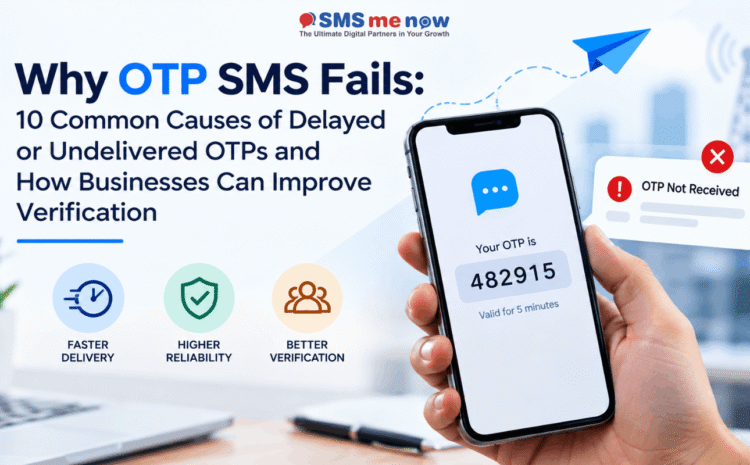
Why OTP SMS Fails: 10 Common Causes of Delayed or Undelivered OTPs and How Businesses Can Improve Verification
| Short Answer Why OTP SMS Fails, OTP errors may not necessarily originate from the SMS gateway itself. Failures may be caused by issues on the side of the sender or template registration, routing, carrier and device availability, whereas application-level problems might stem from short expiries, duplicate requests, poor resend logic, or even delays in the backend system. |
OTP SMS Failure: 10 Common Causes of Late or Failed OTP Delivery and What Companies Need to Do to Improve Verification is an important topic for a business because communication and marketing channels have become a part of the customer experience flow. Today, companies are not selecting communication platforms for the sake of message delivery or incoming calls, but for lead capture, quick response time, customer consent and result measurement.
The guide is centered on the implementation of OTP SMS verification from the practical point of view of 2026. It will cover the benefits of such approach, common mistakes made by companies while implementing it, step-by-step process of implementation and metrics that need to be considered after launch. The idea is not to overwhelm readers with code and technicalities, but to provide a solid framework for owners and marketing or operational departments.
Why It Is Important for Business in 2026
- TRAI stipulates that sender, header, and content-template need to be registered for bulk messaging, even for OTP senders, hence configuration mismatches may result in unreliable traffic.
- The OTP can be sent successfully but may still fail due to premature expiry by the app or due to the application invalidating the code whenever the user requests to resend the message.
- The user may receive more than one OTP because there is no countdown timer or any other form of progress being shown on the screen.
- The delivery time is subject to carrier and device variables and, therefore, the verification process has to accommodate delay realistically while maintaining security.
- Logging is necessary to tie the generation, API submission, provider response, delivery success and verification success.
Guidelines for Effective SMS Practices
- Consistency of the message is key. Place the critical content up front with the appropriate sender and take the customer to the appropriate next level where more details are needed.
- The rules of marketing and compliance both encourage accurate sender identification, approved templates and permission-based recipients instead of cut corners and the associated complaints.
- Operational communications and promotions need to be measured and managed differently since one wins on completion and the other wins through the response.
- Test template options, link management, timing and recipient information on a small sample before deploying a full-scale campaign. Minor configuration problems become major costs on a large-scale deployment.
Practical Workflow
- Check PE, header and registered template setup before going into production.
- Produce OTPs securely with an expiry appropriate to the risk and expected delivery time.
- Send via a stable API and capture provider message IDs.
- Present countdown prior to allowing resend.
- Decide on how a new OTP invalidates the old OTP and maintain consistent communications.
- Measure delivery latency, verification success rate and fallback usage by carrier and geographical region.
Business Scenarios
- The login process in e-commerce might fail even after the successful delivery of SMS because the frontend might submit the old OTP even after the customer asks for a new one.
- The financial flow may require shorter validity time and stricter rate limiting than a low-risk newsletter verification flow.
- Bad network implementation may result in an error message “OTP not sent” while the request has been sent to the backend and the message is on its way.
Measures to Monitor
• Monitor API acceptance rate. Clearly define what this measure means and how it should be calculated. Clearly define whose review will be needed for reporting consistency.
• Monitor delivery rate. Clearly define what this measure means and how it should be calculated. Clearly define whose review will be needed for reporting consistency.
• Monitor median delivery latency. Clearly define what this measure means and how it should be calculated. Clearly define whose review will be needed for reporting consistency.
• Monitor verification completion rate. Clearly define what this measure means and how it should be calculated. Clearly define whose review will be needed for reporting consistency.
• Monitor resend rate. Clearly define what this measure means and how it should be calculated. Clearly define whose review will be needed for reporting consistency.
• Monitor fallback rate. Clearly define what this measure means and how it should be calculated. Clearly define whose review will be needed for reporting consistency.
Mistakes to Watch Out For
- Do not always blame failures on the SMS service provider. Such a move would normally result in either additional costs, poor customer experience, bad reporting or compliance risks.
- Do not make expiry too short. Such a move would normally result in either additional costs, poor customer experience, bad reporting or compliance risks.
- Do not allow endless attempts at resending messages. Such a move would normally result in either additional costs, poor customer experience, bad reporting or compliance risks.
- Do not fail to correlate the delivery report with the application log. Such a move would normally result in either additional costs, poor customer experience, bad reporting or compliance risks.
- Do not neglect testing of the registered template variables. Such a move would normally result in either additional costs, poor customer experience, bad reporting or compliance risks.
Implementation Check List
• Starting point should be Sender Readiness and DLT Readiness. Ensure all Principal Entity, headers, templates, consents and APIs are configured before starting planning your campaign.
• Take care of your list of recipients. Clean up the duplicates and make sure there is a valid commercial purpose behind each one to receive a message.
• Test all the registered wording and variables, using realistic test data that includes long names, order id’s and links that can affect message length or rendering.
• Test a limited batch of your messages, analyze delivery reports and application log files.
• Final step after the campaign is to save information about your audience, template, cost and business result.
Action plan over 30 days
• Week 1 – Compliance and data: check PE, headers, templates and consent requirement; clean recipient list and deduplicate it; and explain why each of audiences is eligible to receive a message.
• Week 2 – Campaign setup: finalize one objective, wording of the registered message, variables, destination, and measurement approach. Test the exact template using realistic names, IDs, and links before deploying into the production environment.
• Week 3 – Controlled deployment: send the test batch first, validate the delivery and tracking reports, and then scale-up further only when the message, the audience, and the application behavior works as expected.
• Week 4 – Analysis: compare delivery, open rate, click-through rate, opt-out rate, and cost. Analyze the result segmented or by use case to understand who really values that message.
• Use first month to build the repeatable campaign checklist with all elements of the process such as approvals, list selection, template version, tracking, suppression and post-campaign review. It will minimize compliance and operational risks.
Frequently Asked Questions (FAQs)
1. Why does OTP delay occur?
The reasons for this could include carrier congestion, handset issues, routing, and any other telecom-related problems that may occur after the acceptance of the API request.
2. Could DLT be a reason for OTP failure?
Wrong sender, header or template registration may cause the issue, therefore you should verify the DLT settings before using it in production.
3. How long should the validity period for an OTP be?
This depends entirely on your needs and cannot be determined in advance. It will require testing on real-time traffic.
4. Should you generate a new OTP on each resend?
This is a security decision for your app. No matter what your logic, it needs to be consistent to prevent multiple valid OTPs from occurring.
5. What should the resend timer be?
Allow sufficient time for the message to get delivered, otherwise you’ll get too many duplicated requests.
6. What is a delivery report?
Delivery reports are provider or carrier reports on message delivery status. They must be kept together with the transaction record.
7. Is WhatsApp acceptable for OTP fallback?
While some companies rely on multi-channel strategies that are vetted and approved, this will require some due diligence.
8. Does it make sense to have voice OTP as a fallback?
While voice can help with specific situations, it is more costly, requires security considerations, and must be rate-limited.
9. What should we log?
We must log the request timestamp, provider message id, callbacks, verification attempts and failures without logging the actual OTP.
10. What is required when selecting an OTP provider?
Look at route quality, reporting capabilities, API stability, technical support, compliance help, and true delivery performance, not just the price.
Conclusion
The delivery of OTP SMS can have considerable value for the business only when it follows a real customer journey, clear ownership and measurable results. Best OTP SMS delivery practices begin from defining a single challenge, using the right channel for the task and optimizing by performance data, and not by implementing unnecessary automation. For a discussion of your specific case, please visit SMSNow.in or use the SMS Me Now contact form and specify your need. SMS Me Now provides bulk SMS, voice, WhatsApp Business API, web and digital-marketing solutions that can be bundled according to the need of the business.
Plan your business communications or marketing flow with SMS Me Now. Visit SMSNow.in or contact the team regarding the best setup for your business.
Disclaimers
This document is published for general information and marketing planning purpose only. The platform features, prices, regulatory requirements, availability and technical capabilities may change. Please verify the current official documentation and get appropriate professional advise prior to any implementation.