
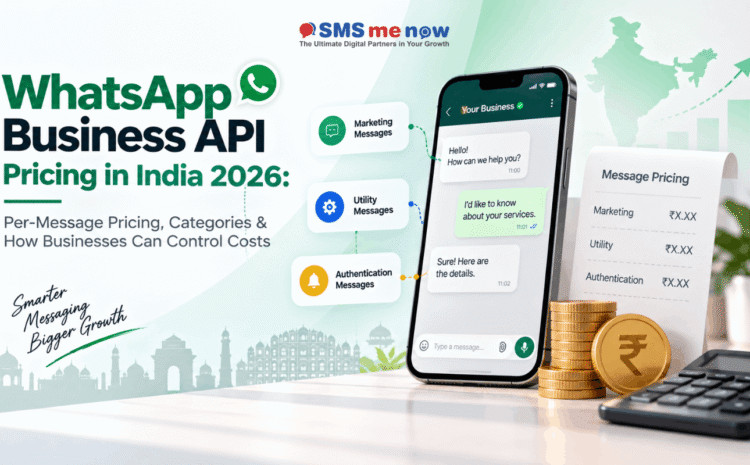
WhatsApp Business API Pricing in India 2026: Per-Message Pricing, Categories & How Businesses Can Control Costs
Quick Answer
The WhatsApp Business Platform pricing is now based on sent templates instead of using the previous model of per conversation. Businesses need to plan based on message type, destination country, and number of campaigns, and then cut down on unwanted message sending using automation and segmentation.
WhatsApp Business API Pricing India 2026: Per-Messages Charges, Categories & How Businesses Can Save Money is a significant topic for business due to the fact that the communication and marketing systems are currently built directly into the client experience flow. Businesses do not just choose their tools for message and call delivery; rather, they determine how their leads are collected, how responsive their teams are, how their client privacy rights are observed and how they track their performance.
The current guide addresses the subject of WhatsApp Business API pricing India in a practical manner in 2026. It highlights the value of the method, typical business missteps, phased implementation and metrics to monitor after launching the service. This guide does not aim to bombard the discussion with technicalities and codes; it strives to provide owners and marketing/operations teams with a practical framework when considering the service.
Why Is This Important for Business in 2026?
- Meta altered its Cloud API fees to a per message basis from July 1, 2025; hence, the articles describing single conversation fees could provide wrong budget projections.
- Templates have specific purposes depending on their uses, which include marketing, utility and authentication and the type determines how the campaign will be designed and measured.
- Not all inexpensive campaigns are the most effective ones; even the lowest-priced message to an irrelevant audience would not only waste money but negatively impact quality engagement.
- Fees for using the WABA platform/provider, Meta Messaging Fees, chatbot/inbox software, integration and staffing cost should be separately considered while calculating the total cost.
- Market variations could affect rates, therefore, it is recommended to check the latest official rate card instead of considering past rupees in the budgeting process.
Guiding principles for developing a strong WhatsApp business workflow
- Consider WhatsApp as a customer journey rather than an alternative to unsolicited mass messaging. It’s important to understand why the customer is on the channel, what information is needed at each stage of the journey and when to hand over to a human agent.
- Governance around templates is important. It’s important to maintain a library of templates with purpose, owner, audience, approval status, and last review dates. This way there won’t be a bunch of outdated and duplicated templates sitting around.
- Quality of opt-in is important for both commercial purposes and CX. A relevant permissioned audience makes automation valuable because the business will have the opportunity to personalize based on the customer journey and intent.
- It’s important to provide integrations with only the necessary data. A chat platform doesn’t necessarily need unrestricted access to all the data just because it has an API available.
Workflow Tips
- Identify every contact point on WhatsApp starting from opt-in through support, purchasing and re-engagement processes.
- Label every template as per its true intention before designing any campaign.
- Apply customer segmentation so that all promotional templates reach those customers who have some reason to receive them.
- Keep the customer support process away from avoidable outbound templates.
- Monitor both cost per deliver as well as open rate, click-through rate, reply rate and conversion rate.
- Evaluate templates that are consistently performing poorly and eliminate or re-write them.
Use Cases for Businesses
- Instead of broadcasting one offer to an entire database, a retail company may apply customer segmentation to promote products.
- A service based business may use a utility message for booking an appointment instead of disguising a promotion in the service message.
- An ecommerce company may use its templates for important messages such as launch or drop prices or re-engagement.
Metrics to Track
- Cost per deliverable template. Define how the metric is to be measured and by whom to ensure that reports are consistent from campaign to campaign.
- Reply rate. Define how the metric is to be measured and by whom to ensure that reports are consistent from campaign to campaign.
- Click through rate. Define how the metric is to be measured and by whom to ensure that reports are consistent from campaign to campaign.
- Qualified leads rate. Define how the metric is to be measured and by whom to ensure that reports are consistent from campaign to campaign.
- Cost per conversion. Define how the metric is to be measured and by whom to ensure that reports are consistent from campaign to campaign.
- Opt-out/block trend. Define how the metric is to be measured and by whom to ensure that reports are consistent from campaign to campaign.
Mistakes to Avoid
• Don’t use old assumptions about the pricing of conversations. It will lead to unnecessary cost or poor experience or poor reporting or compliance risk.
• Don’t send marketing messages without segmentation. It will lead to unnecessary cost or poor experience or poor reporting or compliance risk.
• Don’t assume that all the templates are interchangeable. It will lead to unnecessary cost or poor experience or poor reporting or compliance risk.
• Don’t measure message cost but ignore conversion quality. It will lead to unnecessary cost or poor experience or poor reporting or compliance risk.
• Don’t ignore BSP and integration costs while doing your analysis. It will lead to unnecessary cost or poor experience or poor reporting or compliance risk.
Implementation Check List
• Use one journey that involves visible manual work or response delay. Before automation, make sure that you have documented the present messages, people, systems, and customer actions.
• Specify the opt-in sources, template types, handovers, business hours, and escalation process. Create a workflow that solves the problem.
• Integrate CRM only after defining the ownership of records and duplicate rules. Else the automation will add to your data cleaning efforts.
• Test your workflow using one group or segment of customers. Analyze the chat transcripts, template usage, and quality of handover. Increase the number of messages only if necessary.
• Conduct a monthly review of templates, knowledge base data, policy changes, and platform changes.
A 30-Day Action Plan
• Week 1 – Discovery: export a sample of interactions with clients, analyse the reason behind reaching out and find out which customer journey takes too much time, repeats itself or skips follow-ups. Verify how you obtained permission for that particular journey and what human team owns that process.
• Week 2 – Design: write down approved text of messages, qualification questions, handovers and fields in the CRM. Create the first draft in a way that it stays focused on solving only one particular problem with one specific customer interaction.
• Week 3 – Pilot: launch with one team, office or customer group. Observe live conversation daily and write down where clients get confused and whether the agent who continues the conversation gets enough information.
• Week 4 – Optimization: strip out all unnecessary steps, refine templates if needed, tighten audience filters and analyse the performance versus pre-launch metrics. Document operating process before implementing the next journey.
• After 30 days, make a decision about further scaling depending on customer outcomes and efficiency of your team, not the total number of messages or the percentage of automated interactions. A small, well-optimized workflow is better than a huge broken bot.
Frequently Asked Questions (FAQs)
1. Was there any change in the WhatsApp Business API pricing in 2025?
Yes. Meta shifted to per-message pricing for template messages delivered through Cloud API as of July 1, 2025. It is advisable to review the current rate card before making any budgeting plans.
2. Are all WhatsApp messages chargeable?
No. The charging process varies depending on the message type, category and applicable customer service conditions. Companies should check their current Meta documentation for guidance on this.
3. What are marketing templates?
These are the templates that are used in the marketing outreach of offers, launches, or re-engagements of products or services to appropriate opted-in audiences.
4. What are utility templates?
These are templates that support a transaction or an existing relationship of orders, appointments or account-related messages whose contents justify the purpose.
5. What are authentication templates?
These are templates that are used for identity verification use cases like one-time password.
6. Does SMS Now determine Meta messages pricing?
WhatsApp Business Account Message Pricing is set by Meta. The service provider can charge additionally for software, onboarding, support or other.
7. How can I lower the cost of WABA?
Begin with proper opt-ins, narrow target groups, less useless mass broadcasts, templates and calculation of cost per business result.
8. Should I send more messages to boost sales?
No. More volume increases the cost without revenue improvement. Timing, relevance and segmentation are usually more helpful than the number of messages only.
9. Can the prices be changed again?
Yes. Products and their rate cards can change. Check pricing of Meta and your service provider before the campaign launch.
10. What should I look at while comparing WABA providers?
Onboarding, platform features, automation, reporting, integration and costs of service provider.
Conclusion
WhatsApp Business API pricing India has the potential to add business value only if it is built keeping the customer journey, ownership, and outcomes in mind. The best WhatsApp Business API pricing India implementations begin from an identified problem and channeling it through the right channel using performance data instead of just automating the process. In case of further discussions on your specific use case scenario, feel free to visit SMSNow.in or use our SMS Me Now contact form. Our experts will provide you with solutions like Bulk SMS services, Voice services, WhatsApp Business API services, Web services and Digital Marketing solutions as per your business requirement.
Plan your business communication or marketing workflows with SMS Me Now. Visit SMSNow.in or contact the team to plan out the best possible solution for your business.
Disclaimer
This article is written for educational purposes only. Platforms’ features, pricing, regulatory compliance requirements, platform availability and technical capabilities are subject to changes and may not remain the same. Always refer to official sources of information.