
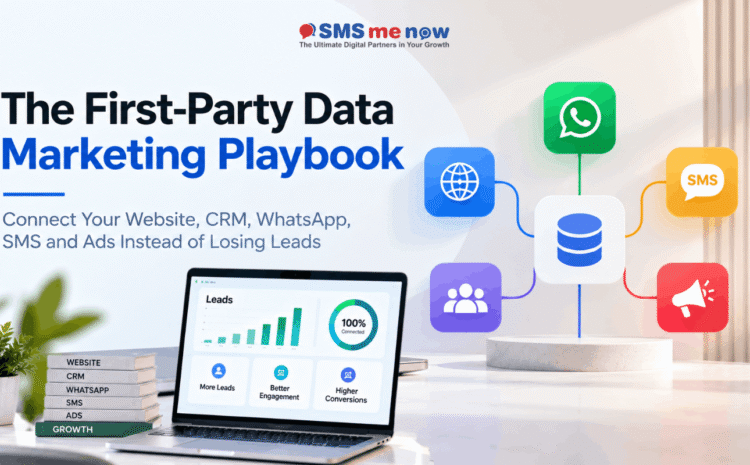
The First-Party Data Marketing Playbook: Connect Your Website, CRM, WhatsApp, SMS and Ads Instead of Losing Leads
Quick Answer
First-party data marketing involves creating growth using the data that customers provide to your business directly and the results you collect. A good approach involves matching the sources of acquisition with website or messaging capturing, keeping the data of ownership and consent in CRM, sending messages via WhatsApp/SMS/emails where necessary, and recording the conversion in order for your next budgets to be based on results not clicks on any platform.
The First-Party Data Marketing Playbook: Connect Your Website, CRM, WhatsApp, SMS and Ads Instead of Losing Leads is an important business subject since communication and marketing solutions have become an integral part of the customer journey. Companies are no longer selecting communication channels on their merits as messaging and calling systems but on how leads will be captured, team speed of response, customer consent, and result tracking.
The guide addresses first-party data marketing from a practical point of view in the year 2026. This includes the areas where this approach adds value, areas where mistakes are frequently made by companies and implementation steps. Moreover, there will be provided information about key performance indicators to be considered post-launch. The intention is not to clutter the topic with technical terms but provide a template for consideration in service design.
Relevance of This Topic to Businesses in 2026
- The contemporary business does not have attribution as the lead comes through forms, calls, Instagram, WhatsApp, and walk-ins separately.
- The CRM system is expected to be used to document the source, ownership, status, next step, and conversion.
- The consent and communication preferences go together with the customer in question to use the channel in a responsible way.
- The Meta approach of directing campaigns from one center and using WhatsApp business features make cross-channel journey a realistic prospect, however, data management is a business prerogative.
- The first-party data becomes more valuable with each passing campaign or sales team if they consistently define the source and outcomes.
Growth Principles for an Effective Digital Strategy
• The marketing campaign must be designed around a business objective, along with a definable consumer action that measures it. Reach and traffic can only serve their purpose if they help drive awareness, inquiry, purchase or retention.
• The channel mix will vary according to consumer intent. Search, social media, messaging apps, emails and calls all serve different purposes, and cannot be evaluated on the same metric.
• Landing pages and subsequent processes make up the campaign evaluation. No amount of advertising can overcome a lack of clarity, speed or sales ownership indefinitely.
• The measurements must tie together platform analytics with CRM or sales results, so the team understands what activities are driving demand and revenue.
Practical Approach to Workflow
- Tag each key acquisition channel and campaign prior to launching it.
- Import leads into a consistent CRM format regardless of how leads came through (by form, WhatsApp, calling or manually).
- Log consent and communications preference together with the lead whenever applicable.
- Specify ownership and the next step for the lead either automatically or using clear rules.
- Communicate with customers via WhatsApp, SMS, email or calls as appropriate instead of communicating everywhere.
- Loop back by tracking revenue, lost reasons and future purchasing against the customer and the original source.
Use Cases of Business
- Meta ads can launch WhatsApp, generate product interest and create a CRM lead before a salesperson gets involved.
- A website query can initiate a confirming SMS and a task for the assigned consultant to call back.
- The existing customer can get a timely renewal reminder related to previous purchases.
What to Measure?
- Monitoring Source To Qualified Leads Rate. Specify how exactly this metric will be measured and who is responsible for its assessment.
- Monitoring Time To First Follow-Up. Specify how exactly this metric will be measured and who is responsible for its assessment.
- Monitoring Lead-To-Sale Conversion Rate. Specify how exactly this metric will be measured and who is responsible for its assessment.
- Monitoring Cost of Customer Acquisition. Specify how exactly this metric will be measured and who is responsible for its assessment.
- Monitoring Repeat Purchase Rate. Specify how exactly this metric will be measured and who is responsible for its assessment.
Monitoring Revenue Per Source. Specify how exactly this metric will be measured and who is responsible for its assessment.
Mistakes to Avoid
- Avoid using uncontrolled spreadsheets. This will lead to unnecessary costs, poor customer experience, poor reporting, or compliance risks.
- Avoid losing source data when moving manually. This will lead to unnecessary costs, poor customer experience, poor reporting, or compliance risks.
- Avoid considering every customer fit for every channel. This will lead to unnecessary costs, poor customer experience, poor reporting, or compliance risks.
- Avoid optimizing your advertisements without considering CRM sales results. This will lead to unnecessary costs, poor customer experience, poor reporting, or compliance risks.
Avoid gathering data without an operational purpose. This will lead to unnecessary costs, poor customer experience, poor reporting, or compliance risks.
Checklist for Implementation
- Begin with the customer journey and the existing baseline: traffic source, number of inquiries, response time, conversion rates and average customer value.
- Solve measurement problems before expanding budget. Each significant form, call, WhatsApp inquiry and sales conversion should have sufficient source data to inform decisions.
- Conduct experiments with one hypothesis at a time: either new target group, creative, landing page or offer. This makes the results more interpretable.
- Use a combination of paid and owned tactics: paid customer acquisition and own resources like valuable website content, CRM data and customers’ permissioned audiences.
- Evaluate campaign performance against a business timeline and adjust budgeting according to the results, not vanity metrics.
Action Plan for the First 30 Days
- Week 1 – Baseline: measure existing traffic, lead generation sources, conversion rate, value of customers and response time. Verify the analytics, calls, forms, and WhatsApp before using the new campaign data to allocate budget.
- Week 2 – Build: enhance the landing and/or service page(s) that matter the most, ensure the offer matches customers’ intention and set up the content or campaign test with one hypothesis and one conversion goal.
- Week 3 – Launch: conduct the test with the budget or publications required to have reliable data. Focus on lead quality and sales feedback and not just on click-through, impression or ranking changes.
- Week 4 – Learn: compare the number of qualified leads, conversions and cost-per-acquisition against the baseline. Keep what works, document what doesn’t work and plan your next test without modifying multiple elements at once.
- The first 30 days should be seen as a measurement and learning process and not as an attempt at rapid growth. Digital success is achieved by consistently enhancing offer, web site, traffic quality and follow up.
Frequently Asked Questions (FAQs)
1. What is first-party marketing?
It uses data from your own customers and prospects including inquiries, orders, and preferences to enhance marketing and services.
2. Why link websites and CRMs?
It saves manual efforts, retains original information and offers instant ownership of new leads.
3. In which case does WhatsApp come in?
WhatsApp will be helpful in acquiring, qualifying and following up with leads provided that there are proper opt-ins and messaging processes.
4. In which case does SMS come in?
SMS will help to send notifications, OTPs and selected campaigns in accordance with telecom and consent policy.
5. Does every lead have to go to the CRM?
If it is a potential sale or service then CRM management usually offers better ownership and reporting.
6. What consent data should we save?
Save the data that will enable us to prove that the client’s consent and preferences were respected according to regulations.
7. How do we attribute phone calls?
Use source-specific phone numbers, capture the source in CRM, and track campaigns so that calls do not go unseen by marketing.
8. Can we automate all follow-ups?
Automate the repetitive elements of follow-ups while preserving human interaction where negotiation and relationship-building is required.
9. What is the most important advantage?
We can see the sources that generate income and track customers through the system rather than losing them due to disconnections between different tools.
10. How can SMS Now assist in this process?
SMS Now provides WABA, SMS Bulk, Voice, Web and Digital Marketing solutions that can be used as components of the unified acquisition and communications solution.
Conclusion
First party data marketing can be valuable for any organization, if it is based on the real customer journey, proper ownership, and measurable results. Effective first party data marketing should always begin with the right problem statement, right channel for the specific task and further improvement using performance data, and not just additional automation. To discuss this topic in more detail regarding your case, go to SMSNow.in or use the contact form on our website to get a consultation on your requirement. The team can provide bulk SMS, voice, WhatsApp Business API, web and digital-marketing services that can be combined based on the business needs.
Plan your business communication or marketing workflow with SMS Me Now. Go to SMSNow.in or contact us for discussion of the best solution for your business.
Disclaimer
The article is provided for general information and planning purposes only. Platform capabilities, pricing, regulatory requirements, and availability may vary. Consult the latest official documents and seek professional advice for compliance, security and other special requirements before implementation.