
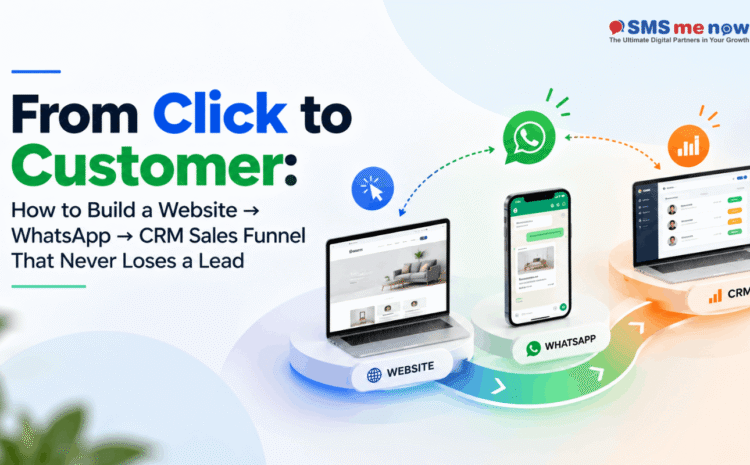
Click to Customer: Building a Website → WhatsApp → CRM Sales Funnel that Doesn’t Lose Any Lead
Getting a lead is just the first step. The hard part is ensuring every lead flows through seamlessly from interest to conversation and qualification without losing the lead at any stage in between.
The Website → WhatsApp → CRM sales funnel brings together the three most critical phases of the customer’s experience. The Website helps identify intention, WhatsApp allows for quick conversations while the CRM manages leads till you achieve the desired outcome.
If you run a service business, retail store, real estate firm, healthcare company, educational institution, B2B firm or a local business, this strategy could help you cut down on missed leads.
Website → WhatsApp → CRM Sales Funnel?
It’s a connected lead management funnel where:
- A visitor arrives at your website via SEO, PPC, social media or referral.
- The website prompts them to perform certain actions such as asking for a quotation, booking a consultation appointment or WhatsApp session.
- WhatsApp facilitates easy communication for the prospect and receiving replies.
- The lead is recorded in the CRM system along with the source and follow-ups performed by the salesperson.
- The sales team keeps the discussion going till the lead is converted or goes into the nurture stage.
The goal is straightforward: every serious inquiry must be captured, allocated and pursued.
Reasons Businesses Lose Opportunities between Click and Customer
Businesses typically run a website, WhatsApp, and a CRM separately. This leads to:
- Website forms landing in a mailbox that is rarely checked.
- WhatsApp contacts left in the personal mobile phone of the employee.
- Duplicates in the CRM database.
- No definitive lead origin.
- Lack of follow-up.
- Two employees communicating with the same lead.
- Loss of leads during responsibility transfer.
- Lack of visibility in conversion rates.
Connected funnels work on the principle that the whole process should be one single process rather than three separate tools.
Step 1: Make Your Website a Lead Magnet
Your website must direct its visitors to their next move. Add strong calls-to-action to your service page, product page, landing page, pricing page, and contact page.
Some good examples of CTAs are:
- Get a Quote
- Schedule a Consultation
- Ask for a Callback
- Chat with us on WhatsApp
- Try a Demo
Use a simple form. Ask for information that is required to start the dialogue – full name, phone number, email address, service needed and city.
Also, your website should be fast, mobile-friendly, secure and easy to navigate. If it is not user-friendly, the potential customer may leave your website even before getting to WhatsApp or CRM.
Step 2: Use WhatsApp for the Conversation Layer
The use of WhatsApp can eliminate friction by allowing the prospect to go straight from searching to conversing.
Here is what a good WhatsApp flow would include:
- Prefilled text describing the intention of the visitor.
- A quick confirmation that the inquiry has been received.
- Easy-to-use options for commonly asked questions.
- Easy handoff to the salesperson when required.
- The same message for the whole team.
Automation must help in the conversation but not take over the conversation.
Step 3: Drive Every Lead into the CRM
The CRM must serve as your go-to source of truth about your sales processes.
Fresh leads must give rise to a lead entry holding valuable data such as:
- Contact information
- The source and campaign
- Product/services of interest
- Assigned sales rep
- Current lead status
- Date of next follow-up
- Notes and call history
Doing so will reduce the effort of manual entries while giving managers a better insight into your sales funnel.
Above all else, this is essential so that the lead does not get lost because you missed an email or your salesperson failed to update a spreadsheet.
Step 4: Create a Defined Lead Pipeline
Every lead should have a definite stage.
An effective pipeline process could be:
Lead → Contacted → Qualified → Quotation Submitted → Follow Up → Negotiate → Closed Won/Lost
The stages give guidance on the next step that should be taken for each type of lead.
For instance, a lead requires contacting, whereas a qualified prospect requires scheduling a follow-up. The lead which has no assigned owner or next action is highly unlikely to be overlooked.
Pipeline stages simplify sales report tracking for managers..
Step 5: Automating Follow-Ups While Maintaining the Human Element
A lot of sales opportunities are lost right after the initial conversation. The client may have an interest in your products/services but he could be busy, comparing options or just not ready to make a decision.
How CRM workflows could help you:
- Bring your sales reps to follow-ups.
- Send acknowledgement messages about enquires.
- Activate your contacts after the certain period of inactivity.
- Notify managers of unattended valuable leads.
- Transition inactive leads to the nurturing stage.
- Automate communication with clients after the sale.
Automation is meant not to deliver additional messages, but to ensure that the correct action is taken at the proper moment.
Automation is to automate repetitive actions while sales reps concentrate on learning customers’ needs and building relations.
Step 6: Monitor the Entire Customer Lifecycle
The power of an integrated funnel is even greater when you know where the leads originated from, as well as what transpired after their arrival.
Key metrics that could be included are:
- Conversion rate on your website
- Conversations initiated through WhatsApp
- Turnaround time for leads
- Qualified-lead ratio
- Ratio of completed follow-ups
- Ratio of proposals converted into sales
- Cost-per-lead ratio
- Cost-per-customer ratio
- Business generated from campaigns or sources
This helps marketing and sales teams to be on the same page.
Rather than measuring success of the campaigns solely on impressions or clicks or inquiries, companies can focus on determining the channels that are delivering qualified leads and customers..
How SEO and AEO Enhance the Funnel
SEO works to ensure that your website is shown to potential customers who search for the right product, service or solution.
AEO (Answer Engine Optimization) is all about ensuring that the information is made easily digestible by search engines and AI-driven answer experiences when users ask a certain question.
To get better SEO and AEO results:
- Use descriptive and question-driven headlines.
- Provide immediate answers in the main parts.
- Ensure that content matches real search intent.
- Provide useful internal links to related services and content.
- Maintain up-to-date company/business information.
- Add relevant structured data.
- Create a good mobile and desktop experience.
- Create valuable original content rather than repetitive keyword-rich pages.
SEO and AEO help to attract qualified visitors through the customer funnel. With the Website → WhatsApp → CRM funnel structure, the qualified visitors will be able to turn into leads and finally customers.
Critical Principles that Help in Avoiding Any Lead Leakages
It is crucial to adhere to some principles when setting up an effective sales funnel:
- All enquiries must generate or update lead records.
- The lead owners must be assigned.
- There must be a next action for every open opportunity.
- Duplicate leads must be dealt with.
- The source of each lead must be recorded.
- The sales activities must be visible for authorized team members.
- Response times must be clear.
- The reason for all lost opportunities must be provided.
- The customer consent must be considered.
- Funnel performance must be evaluated regularly.
The adherence to these principles will help not only hold the sales team accountable but also will allow the management to find gaps before losing any opportunities.
Frequently Asked Questions
1. What is a Website → WhatsApp → CRM Sales Funnel?
A sales funnel that connects website enquiries, adds leads to WhatsApp messages, and records every lead in a CRM.
2. Why should WhatsApp be connected with a CRM?
Connecting WhatsApp with a CRM will avoid keeping enquiries inside individual chats. It allows for shared view and management of every lead’s journey and history.
3. Can it work for my small business?
Yes. Small businesses can start with basic lead management process and then develop automation as they grow.
4. Do I need an advanced website to implement it?
No. It is enough to have concentrated web pages, calls-to-action, enquiry forms, and a way to get in touch with your business for potential customers.
5. Do I need to direct all my website visitors to WhatsApp messages?
No. Some users may prefer enquiry forms, phone numbers, emails, booking etc. What is important is to make sure that every valuable enquiry goes through the same process.
6. What data does my CRM need to track?
Begin with the basics like contact information, source of lead, customer need, associated salesperson, stage of lead and follow-up step. Only add more fields if they help you track your real sales process.
7. How soon after receiving a lead should the lead be followed up on?
Follow up as soon as possible within business hours, depending on what your team is able to do consistently. Set an internal goal for response time and set CRM reminders to ensure that leads are not overlooked.
8. Are sales follow ups able to be automated?
Yes. Follow up reminders, acknowledgements, routing and selected nurturing steps can all be automated. Have human intervention available for high-intent leads and conversations.
9. How will this funnel increase marketing ROI?
The funnel links marketing sources to valuable leads, customers and sales dollars. This allows companies to measure their campaign success in terms of opportunity and sales rather than just traffic or clicks.
10. Can leads from Google Ads and Meta Ads be put into the same funnel?
Yes, since campaign and landing page information can be linked to the lead record in the CRM system.
11. Is WhatsApp sufficient without a CRM?
WhatsApp suffices in the case of a very few inquiries. However, as the business grows, a CRM is useful as it gives ownership and helps with follow-ups, lead sources, team coordination, etc.
12. Does AEO substitute traditional SEO?
No, because AEO works with SEO. Good and organized website content is still necessary for both traditional and AI search results.
Conclusion
The ideal sales funnel is not just an assortment of marketing elements. It’s an integrated process where every lead is trackable and measurable.
Your website needs to capture intent. Your WhatsApp channel needs to provide frictionless communication. Your CRM system must ensure that all leads are assigned, followed up and tracked until a clear resolution is achieved.
By integrating these three elements, you’ll be able to react quicker, stop lead leakages, determine which marketing channels actually generate clients and create a more consistent buying experience.
If you’re thinking about creating a sales funnel using Website → WhatsApp → CRM integration for your business, schedule a free consultation via our website.
Disclaimer
The details mentioned in this article are meant for education and planning purposes only. The real outcome may vary based on the industry, offer, quality of traffic, response time, CRM configuration, messaging strategy and sales process.
WhatsApp, CRM solutions, ad platforms and analytical tools can be changed anytime in future. Businesses should check the current platform requirements before implementing any automation or customer communication workflows.