
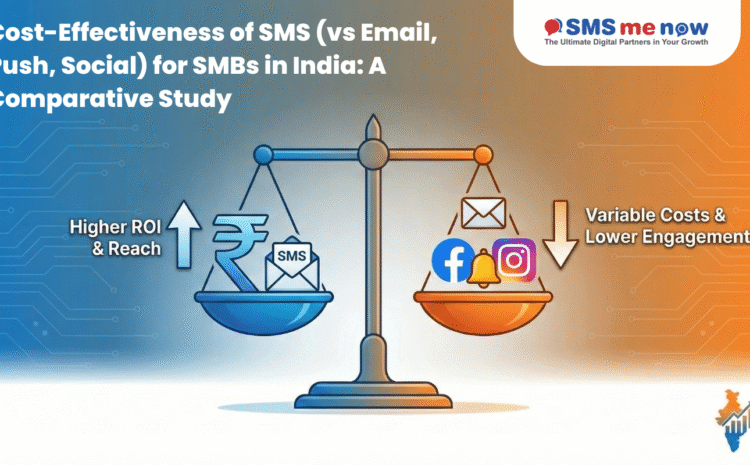
Cost-Effectiveness of SMS (vs Email, Push, Social) for SMBs in India: A Comparative Study
Cost-Effectiveness of SMS for SMBs in India, For Small and Medium Businesses (SMBs) in India, marketing is a game of “paisa-vasool” (value for money). With limited budgets and a hyper-competitive local market, every rupee spent on digital outreach must deliver measurable results.
As we navigate 2025, business owners are bombarded with options: Should I run Instagram Ads? Send a newsletter? Or stick to a “traditional” Bulk SMS? While social media is flashy and email is cheap, Bulk SMS marketing remains the silent powerhouse of the Indian economy. In a country where mobile data is affordable but reliable internet connectivity can still fluctuate in Tier 2 and Tier 3 cities, SMS offers a level of “direct-to-consumer” access that other channels simply cannot match.
This comparative study evaluates the cost-effectiveness, engagement metrics, and overall ROI of SMS against Email, Push Notifications, and Social Media, specifically through the lens of the Indian SMB landscape.
The Indian Digital Landscape: A Unique Context
India’s digital journey is mobile-first and mobile-only for millions.
- The “Feature Phone” Reality: While smartphones are everywhere, a significant portion of the Indian population still uses feature phones or has limited data plans. SMS reaches 100% of these users.
- The TRAI Framework: India has one of the world’s most regulated telecom environments (DLT/TRAI). While this adds a layer of compliance, it also means the SMS inbox is much less “spammy” than an email inbox.
- Attention Span: The average Indian consumer is flooded with notifications. The “ping” of an SMS still commands more immediate attention than a social media notification buried among hundreds.
Head-to-Head Comparison: SMS vs. Other Channels
To understand cost-effectiveness, we must look beyond the “cost per message” and focus on the “cost per conversion.”
A. SMS vs. Email Marketing
Email is often touted as the “cheapest” channel, with platforms like Mailchimp or Brevo offering thousands of sends for a low flat fee.
- The Open Rate Gap: Email open rates in India hover around 18-22%. SMS open rates are a staggering 98%.
- Immediacy: 90% of SMS are read within 3 minutes. Emails can sit in the “Promotions” tab for days.
- The Verdict: For Indian SMBs, email is great for long-form newsletters, but for flash sales or urgent updates, SMS is 5x more cost-effective when measured by “Revenue per Read.”
B. SMS vs. Push Notifications
Push notifications are “free” once you have an app. However, the barrier to entry is high.
- App Fatigue: Most Indian users have limited storage on their phones and delete apps frequently.
- Opt-in Challenges: Many users disable push notifications immediately.
- The Verdict: SMS doesn’t require an app. It is “universal push.” For an SMB, the cost of developing and maintaining an app far outweighs the small per-message cost of SMS.
C. SMS vs. Social Media (Paid Ads)
Social media (Meta/Instagram/Google) is an “Awareness” channel, whereas SMS is a “Conversion” channel.
- Rising CPCs: The Cost-Per-Click (CPC) on Facebook and Instagram in India has risen by 40% in the last two years.
- Algorithm Dependence: You don’t own your social media audience; the platform does.
- The Verdict: Social media is essential for finding new leads, but SMS is significantly more cost-effective for nurturing and retaining existing ones.
The Math of ROI: A Sample Scenario for an Indian SMB
Let’s look at a hypothetical local clothing boutique in Jaipur running a weekend sale.
| Feature | Bulk SMS | Social Media Ad (Paid) |
| Budget | ₹5,000 | ₹5,000 |
| Reach / Impressions | ~20,000 Contacts | ~50,000 Impressions |
| Open / Click Rate | 98% Read (19,600) | 1% Click (500) |
| Conversion Rate (at 2%) | 392 Sales | 10 Sales |
| Cost Per Sale | ₹12.75 | ₹500.00 |
While the Social Media Ad reached “more people,” the high intent and visibility of the SMS led to a 30x better cost-per-sale. This is the definition of cost-effectiveness.
Why SMS Wins for Indian SMBs in 2025
A. 100% Offline Accessibility
Unlike WhatsApp or Email, SMS does not require a 4G/5G connection to be delivered. For businesses in semi-urban or rural India, this is the difference between a successful campaign and a total failure.
B. DLT Trust Factor
Because of TRAI’s DLT (Distributed Ledger Technology) rules, every business SMS must have a registered “Header” (e.g., BR-DIALMN). This builds instant brand authority. A customer is more likely to trust a verified SMS than a random WhatsApp message or a social media ad.
C. Zero Friction
There are no apps to download, no “Promotions” tabs to check, and no “Accept Cookies” banners. The message is simply there.
Maximizing Your SMS Budget: Strategic Tips
To ensure your SMS campaigns are truly cost-effective, you shouldn’t just blast your entire list.
- Surgical Segmentation: Don’t send a “Men’s Shoe Sale” to your entire database. Segment your list by gender or past purchase history. This reduces your “cost per send” and increases your “conversion per send.”
- The Power of the Link: Always include a trackable short link. This allows you to measure exactly which customers clicked, helping you calculate your ROI to the paisa.
- Timing is Everything: In India, sending a promotional SMS at 10:30 AM or 6:00 PM yields the highest engagement. Avoid late nights to prevent being seen as intrusive.
Take Your Marketing ROI to the Next Level with Us
Understanding the cost-effectiveness of SMS is the first step. The second step is execution. Navigating DLT registrations, crafting high-conversion templates, and managing your database can be overwhelming.
We specialize in helping Indian SMBs build high-ROI SMS engines.
- ✅ End-to-End DLT Support: We handle the paperwork so your Header gets approved fast.
- ✅ Advanced Analytics: We provide deep insights into delivery rates and click-through rates.
- ✅ Omnichannel Integration: We don’t just do SMS; we help you integrate it with Email and WhatsApp for a unified marketing front.
Stop wasting your marketing budget on “hopes and prayers.” Switch to the channel that actually gets read.
Frequently Asked Questions (FAQ)
Q1: Isn’t Bulk SMS expensive compared to free WhatsApp?
A: WhatsApp Business API actually charges a per-conversation fee that is often higher than a standard promotional SMS in India. Additionally, SMS doesn’t require the user to have data enabled.
Q2: What is DLT, and do I have to pay for it?
A: DLT (Distributed Ledger Technology) is a mandatory registration system by TRAI to prevent spam. There is a one-time registration fee (usually around ₹5,900) paid to the telecom operators, but it is essential for legal compliance.
Q3: Can I send promotional SMS to DND (Do Not Disturb) numbers?
A: No. Legally, you cannot send promotional content to DND-registered numbers. However, you can send Transactional or Service Implicit messages (like OTPs or order updates) to everyone.
Q4: What is the ideal length of an SMS?
A: One SMS “credit” is 160 characters. If you go over this, you are charged for two messages. Keeping your copy punchy and under 160 characters is key to cost-effectiveness.
Q5: Is SMS better for B2B or B2C?
A: It works for both! B2C uses it for sales and alerts. B2B uses it for lead nurturing, webinar reminders, and appointment confirmations.
Q6: How do I know if my SMS was delivered?
A: Our platform provides real-time Delivery Reports (DLRs), showing you exactly which numbers received the message and which ones bounced.
Q7: Can I include my website link in an SMS?
A: Yes! In fact, you should. Using a shortened, trackable link is the best way to measure the conversion success of your campaign.
Q8: Does SMS marketing still work in the age of Instagram?
A: Yes. In fact, as social media becomes more cluttered, the “quiet” and “direct” nature of the SMS inbox has become even more valuable for businesses wanting to cut through the noise.
Disclaimer
The cost-per-message and ROI figures provided in this study are based on average market rates in India as of late 2025 and are subject to change based on telecom operator regulations and TRAI mandates. Individual business results may vary depending on list quality, industry, and the strength of the offer.
Conclusion
The data is clear: while every marketing channel has its place, SMS remains the champion of cost-effectiveness for Indian SMBs. Its combination of 98% open rates, offline accessibility, and the trust established by the DLT framework makes it the most reliable tool for driving immediate revenue. In the tug-of-war for the Indian consumer’s attention, the humble 160-character text message is still the strongest rope.