
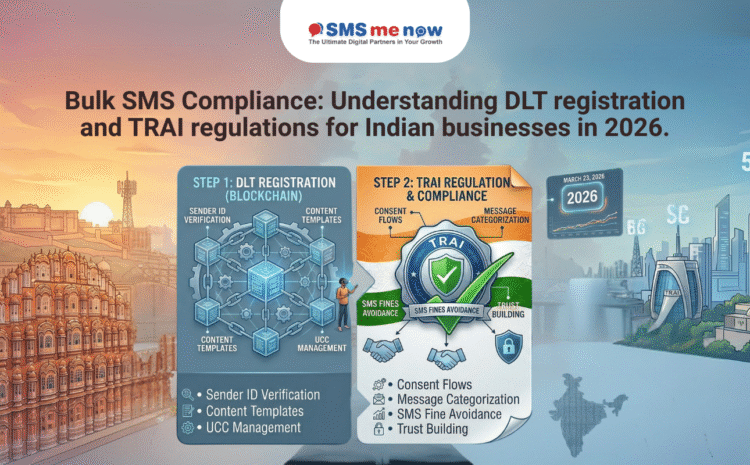
Bulk SMS Compliance 2026: The Definitive Guide to DLT Registration & TRAI Regulations in India
Bulk SMS Compliance India 2026, In the fast-evolving digital landscape of 2026, mobile messaging remains the most direct way to reach the Indian consumer. However, the days of “blindly” blasting text messages are long gone. With the Telecom Regulatory Authority of India (TRAI) intensifying its crackdown on spam and fraudulent communications through the TCCCPR (Third Amendment) Regulations, 2026, compliance is no longer a choice—it is a survival requirement for your brand.
Whether you are a startup in Bangalore or a heritage business in Jaipur, understanding Distributed Ledger Technology (DLT) is the key to ensuring your OTPs, alerts, and marketing offers actually land in your customer’s inbox.
What is DLT? The Blockchain Shield for SMS
Distributed Ledger Technology (DLT) is a blockchain-based registration system mandated by TRAI to curb the menace of Unsolicited Commercial Communication (UCC). Think of it as a transparent, digital record book where every business must register its identity, its “Headers” (Sender IDs), and its specific message templates.
The 2026 Shift: AI-Powered “Scrubbing”
In 2026, telecom operators have deployed AI/ML-based UCC_Detect systems. These systems don’t just check if you are registered; they perform real-time content matching. If your sent message varies even slightly from your DLT-approved template, the AI flags it, and the operator blocks it instantly.
Step-by-Step DLT Registration Process (2026 Update)
Registration can be done on any major telecom operator’s portal (Jio, Airtel, Vi, or BSNL). You only need to register with one; the data syncs across all operators.
Phase 1: Principal Entity (PE) Registration
This is your business’s “KYC.” You must register as a Principal Entity to get a unique PE ID.
- Documents Needed: Business PAN, GST Certificate, Letter of Authorization (on company letterhead), and Identity Proof of the authorized signatory.
- Timeline: 48–72 hours for approval.
- Cost: Approximately ₹5,900 (one-time fee for most portals).
Phase 2: Header (Sender ID) Registration
The “Header” is the 6-character name that appears on the recipient’s phone (e.g., DIALME).
- Rules: Headers must relate directly to your brand name. In 2026, TRAI has become stricter—generic headers like “PROMOT” are no longer allowed.
Phase 3: Content Template Registration
Every single message format must be approved.
- Transactional: For OTPs and critical alerts (sent 24/7).
- Service Implicit: For account updates or purchase confirmations.
- Promotional: For offers and marketing (strictly restricted to 10 AM – 9 PM).
Key TRAI Regulations You Must Know in 2026
| Regulation | Requirement | Business Impact |
| DND Scrubbing | Messages must be checked against the National DND Registry. | High: Prevents heavy fines and blacklisting. |
| Timing Rules | Promotional SMS only between 10:00 AM and 9:00 PM. | Medium: Requires automated scheduling. |
| Variable Limit | Only small portions of a template can be variables (e.g., OTP codes). | High: Prevents “template hacking” for spam. |
| Consent Records | Explicit consent must be digitally recorded on the DLT platform. | High: Critical for legal defense against spam complaints. |
Common Compliance Pitfalls to Avoid
- Template Mismatches: Changing a single word in an approved template will cause the message to fail. Always copy-paste from your DLT portal.
- Ignoring Suffixes: In 2026, some operators require specific suffixes (like “-AD”) for promotional headers to help users identify marketing content easily.
- Ghost Headers: Using headers that haven’t been mapped to your specific PE ID in the aggregator’s panel.
- Expired KYC: Failing to update your GST or PAN details on the DLT portal when your business structure changes.
✨ Seamless Compliance with DialMeNow
Navigating TRAI’s bureaucracy shouldn’t stop your business growth. At DialMeNow, we simplify the entire compliance chain so you can focus on your customers.
- ✅ DLT Assistance: Our team helps you navigate the Jio/Airtel/Vi portals to get your Entity and Headers approved in record time.
- ✅ AI Template Validation: Our platform pre-checks your message content against your DLT templates before sending, ensuring a 99.9% delivery rate.
- ✅ Automated Consent Management: We provide tools to collect and store verifiable user consent, keeping you safe from legal disputes.
- ✅ Real-Time DND Filtering: Our system automatically scrubs your list against the latest TRAI DND database in milliseconds.
Don’t risk your brand’s reputation with unverified messaging.
❓ Frequently Asked Questions (FAQ)
Q1: Is DLT registration mandatory for all Indian businesses?
A: Yes. Whether you are a small shop or a large corporation, any commercial SMS terminating in India requires DLT registration.
Q2: Can I use one DLT registration for multiple brands?
A: No. Each legal entity (based on PAN) must have its own registration. However, one entity can have multiple Headers (Sender IDs).
Q3: Why are my OTPs failing even though I’m registered?
A: This is likely a “Template Mismatch.” Ensure the exact spaces, punctuation, and variable format {#var#} match your DLT-approved template.
Q4: How much does DLT registration cost in 2026?
A: Most operators charge a one-time fee of approx. ₹5,900. Some portals like Jio occasionally offer fee waivers for specific sectors.
Q5: What are the hours for promotional SMS?
A: Promotional messages can only be delivered between 10 AM and 9 PM. Transactional/OTP messages can be sent 24/7.
Q6: Does DLT apply to WhatsApp Business API?
A: No, DLT is currently exclusive to SMS and Voice services. However, TRAI is exploring unified consent frameworks for 2027.
Q7: What happens if I send SMS without registration?
A: The messages will be blocked at the operator level, and your account could be flagged for “spamming,” leading to a permanent ban of your brand header.
Q8: Can I change my Sender ID later?
A: Yes, you can add new Headers to your existing Principal Entity account, but each new Header requires a separate approval process.
Q9: What is the maximum length of a Header?
A: For Transactional/Service messages, it is exactly 6 alphabetic characters (e.g., DIALMN).
Q10: What is “Service Explicit” category?
A: This is for messages sent to customers who have given explicit consent to receive marketing updates from your brand.
Q11: Do I need a different template for every message?
A: Yes, every unique message structure needs a template. You can use variables {#var#} for dynamic data like names, dates, or codes.
Q12: How long does it take to get a template approved?
A: Usually 24 to 48 hours, though some AI-integrated portals can approve them in a few hours.
Q13: Can I register on multiple DLT portals?
A: You can, but it is unnecessary. One registration syncs across the entire Indian telecom network.
Q14: What is the “PE-TM Chain”?
A: It is the link between you (Principal Entity) and your SMS provider (Telemarketer). You must add your provider’s TM ID in your DLT portal to authorize them.
Q15: Does DLT registration expire?
A: Most registrations are valid for 1 year and require a nominal annual renewal fee to keep the PE ID active.
Disclaimer
TRAI regulations are subject to periodic updates. The information provided here is based on the 2026 regulatory framework. Businesses are advised to check the official TRAI website or consult with a certified telemarketer for the latest compliance mandates. DialMeNow is a registered telemarketer and provides services in accordance with TCCCPR guidelines.
Conclusion
Navigating Bulk SMS Compliance in India may seem daunting, but it is the foundation of a trusted digital brand. By following the DLT registration roadmap—Entity, Header, and Template—you ensure that your communication is not just seen, but respected. In 2026, the brands that win are the ones that play by the rules.