
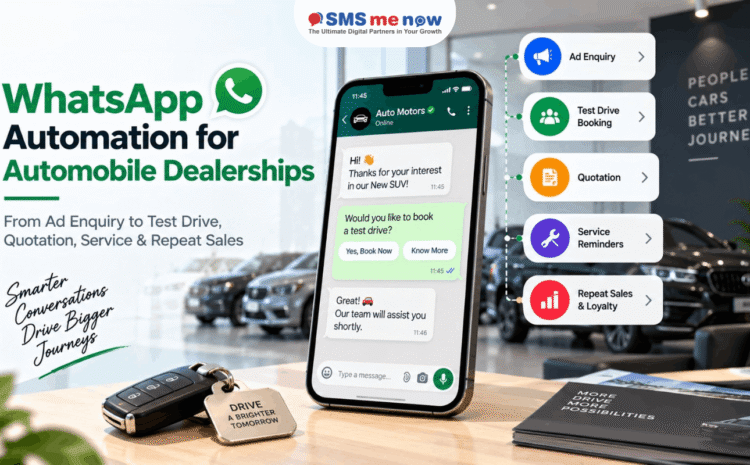
WhatsApp Automation for Automobile Dealerships: From Ad Enquiry to Test Drive, Quotation, Service & Repeat Sales
| Question in Brief WhatsApp Automation for Automobile Dealerships, Yes, a car dealership can leverage WhatsApp as a connected leads and lifecycle marketing channel by receiving ad inquiries, qualifying models, scheduling test drive, allocating sales personnel, sending approved communications, and at a later stage reminding them about service or renewal. The benefit lies in quick response and systematic follow up, not in additional messaging. |
WhatsApp Business API for Automotive Dealers from Ad Enquiry through to Test Drive, Quotation, Service, & Repeat Sales is a business-related topic as communication and marketing systems are now built into the customer journey process. Companies do not decide which tools are used anymore solely based on the ability to send messages or receive calls, but they decide which leads will be captured, how fast they will be contacted and what will be done about respect for customer rights and measurement of results.
This document provides insights about the use of WhatsApp Business API for automotive dealers from the 2026 practical perspective. It highlights how the strategy adds value, how it is likely to go wrong and how the strategy can be rolled out step-by-step. This is not intended as another piece about how to write code for the platform, but rather an outline that could help the owner and marketing or operations team in planning the service.
Importance of This Topic for Businesses in 2026
• The lead generation for a dealership is typically done through ads on Meta and Google, the website, walk-ins, and calls, making it hard to own the response without integrations.
• The car buyer needs multiple rounds of information—variant, price range, financing, availability, test drive, and trade-in—until he or she becomes ready to talk to a salesperson.
• WhatsApp helps cut down repetitive typing by employing pre-approved information, buttons, flows, and CRM handovers.
• Beyond the sale, WhatsApp will help remind of appointments and communicate with the owner, if there is the necessary relationship and consent from the customer.
• The dealer should stop bombarding the customer with the templates every day once the buyer has already picked his or her model or purchased one.
WhatsApp Business Workflow Design Principles
• Since it’s about a customer journey rather than mass unsolicited marketing, your business needs to know why the customer is on WhatsApp and what comes next as well as when it becomes time for a human to step in.
• Template management is important. Make sure that there is a managed library which includes the template name, purpose, owner, target audience, approval state and date of last review in order to avoid clutter from outdated or duplicate templates.
• Your opt-in quality impacts not only business results but customer experience as well. When you have relevant permissioned audiences you get the ability to use automation for personalising according to lifecycle and intent.
• Integrations should share only necessary data for completing specific tasks. There’s no need for a chat platform to access every field of CRM/ERP via an API.
Work Flow
- Funnel click-to-WhatsApp or website leads into one funnel.
- Ask for the model, city, choice of variant, and if a test drive is wanted via concise structured questions.
- Funnel the qualified leads to the right showroom or the right salesperson.
- Provide the ability to the salesperson to send the details of the quote and/or brochure from their controlled business resources.
- Send automated reminders for appointments, booking, delivery, and services when needed.
Use Case for Business
- The prospective buyer who clicks an ad for the compact SUV can now indicate whether they want petrol or electric version before being contacted by the salesperson.
- A group of dealerships can direct inquiries to the specific cities and showrooms rather than forwarding screenshots on the internal WhatsApp groups.
- The customer after delivery will get the service reminder for the scheduled service.
What to Measure
- Monitor first-response time. Clearly define how this metric will be measured and by whom, to ensure consistency in reporting for all campaigns.
- Monitor lead-to-test-drive rate. Clearly define how this metric will be measured and by whom, to ensure consistency in reporting for all campaigns.
- Monitor test drive show rate. Clearly define how this metric will be measured and by whom, to ensure consistency in reporting for all campaigns.
- Monitor quotation to booking rate. Clearly define how this metric will be measured and by whom, to ensure consistency in reporting for all campaigns.
- Monitor cost per qualified lead. Clearly define how this metric will be measured and by whom, to ensure consistency in reporting for all campaigns.
- Monitor service re-booking rate. Clearly define how this metric will be measured and by whom, to ensure consistency in reporting for all campaigns.
Mistakes to Avoid
- Don’t assign leads manually without ownership. It usually results in either unnecessary cost, bad customer experience, weak reporting or compliance risk.
- Don’t ask too many questions via chatbots before connecting with a human. It usually results in either unnecessary cost, bad customer experience, weak reporting or compliance risk.
- Don’t send the same offers to all segments in your model. It usually results in either unnecessary cost, bad customer experience, weak reporting or compliance risk.
- Don’t fail to sync up lead results with your CRM. It usually results in either unnecessary cost, bad customer experience, weak reporting or compliance risk.
- Don’t treat service reminders as something separate from the sales process. It usually results in either unnecessary cost, bad customer experience, weak reporting or compliance risk.
Implementation Action Points List
• Begin with a single process that shows obvious manual labor or delayed responses. Record the present message flows, people, systems, and customer decisions before deciding on automation capabilities.
• Lay down the criteria of the opt-in sources, template groups, human handover, business hours, and escalation. Create the minimal workflow to solve the issue.
• Connect the CRM only when the rules for record ownership and duplicates are defined. Otherwise, the automation process may produce more cleaning than benefits.
• Test the process first with a single team or customer group. Analyze the chat transcripts, template performance, and handover quality before adding more messages.
• Conduct monthly review of templates, information from knowledge base, policy/price changes, and system update.
A 30-Day Action Plan
- Week 1 – Discovery: export a sample of customer conversations, find out what reasons people reach out to the company and pinpoint the journeys with the most time delay, repetition or follow-up missed. Validate the source of the opt-in and human teams responsible for each journey.
- Week 2 – Design: create the approved messages, qualifying questions, handover procedures and necessary CRM fields. Start with a very simple version, to make sure that the team understands the customer problem solved by the automation.
- Week 3 – Pilot: launch the bot with one team, branch or customer segment. Monitor real-life conversations daily and see where customers get confused. Check how much information the agents get when they take over from automation.
- Week 4 – Optimisation: eliminate superfluous steps, enhance weak templates, refine the target audiences and compare the performance (response rate, conversion and costs) to the baseline metrics. Document the process before scaling to a new journey.
- A month later, evaluate whether to scale based on the customer experience and team productivity, not just based on the message volume and percentage of automated conversations. The foundation is more important than the scale.
Frequently Asked Questions (FAQs)
1. Can a dealer get ad leads directly via WhatsApp?
A click-to-WhatsApp campaign will help you get leads that you can then take on a journey using automation and routing.
2. Can a bot schedule test drives?
Yes, it is possible to gather details about preferred car model, date, location, and contact details, depending on dealership availability.
3. Can you send quotes in WhatsApp?
It is possible to distribute relevant quotes in your business’ workflows and sales process.
4. Can various dealerships use one WABA configuration?
You can route conversations to the right locations or teams depending on your configuration.
5. Can WhatsApp replace dealer’s CRM?
In most cases, WhatsApp cannot replace a CRM system because it is still necessary for ownership and reporting.
6. Can service reminders be automated?
Service-due notifications can be scheduled through customer and vehicle information once all requirements for consent and messages policies are fulfilled.
7. When should a digital lead be contacted?
The process should take place as soon as possible. Automation should be used to confirm right away and assign to an appropriate salesperson.
8. Should finance inquiries be automated?
Basic information can be sent out, however, personalized finance, eligibility, and commitment need to be taken care of by the correct department.
9. What do we need to measure?
Response time, conversion of test drive, bookings, lead source quality and service engagement after the sale.
10. What can SMS Now do for us?
SMS Now can review WABA, messaging, voice and digital marketing elements which could be integrated around the dealership lead process..
Conclusion
The WhatsApp Business API implementation for automobile dealers will generate business value if it is done based on a true journey of the customer, accountability, and measurable objectives. The best WhatsApp Business API implementation cases start with the identification of a specific problem, use the correct channel for a specific task, and develop through real performance analytics rather than just automating everything. In case you need any help in discussing the same from a practical perspective, you can visit SMSNow.in or use the SMS Me Now Contact Page for submitting your requirements. They offer Bulk SMS, Voice, WhatsApp Business API, Web and Digital Marketing services that can be combined as per the business need.
Design your business communication or marketing workflows with SMS Me Now. Visit SMSNow.in or contact the team for getting the best-suited implementation for your business.
Disclaimer
The information provided above is for the purpose of knowledge only. The features, pricing, regulation and other factors can change in time. Please verify the latest official documentation or get proper professional guidance accordingly.