
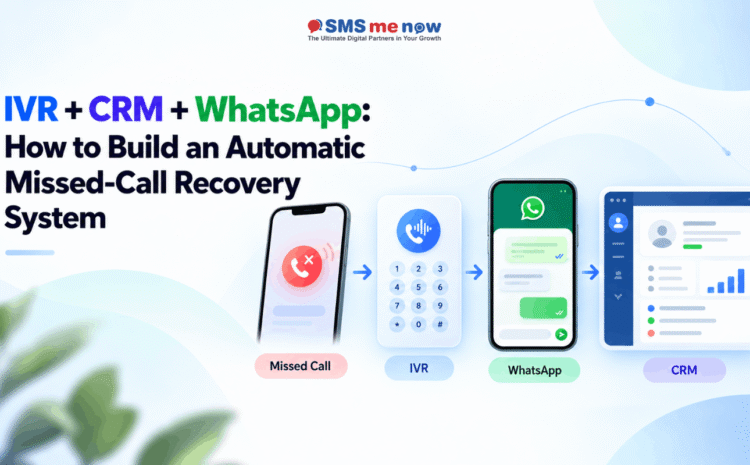
IVR + CRM + WhatsApp: How to Build an Automatic Missed-Call Recovery System
A missed business call could mean a missed enquiry, appointment, support request or potential sale. The issue becomes more pressing when businesses get high call volumes, calls outside working hours or enquiries when every available employee is busy.
An Automatic Missed-Call Recovery System would address this by tying IVR, CRM and WhatsApp into one, coordinated workflow.
Instead of allowing unanswered calls to vanish from the sales process, the system could be used to identify the caller, record the interaction, create or update a CRM lead, send an appropriate WhatsApp follow-up and assign a callback task to the right employee.
The aim is to turn Missed Calls into Leads with WhatsApp Responses which are then assigned to a Human for follow-up and Conversion.
Modern cloud telephony systems are already capable of connecting incoming calls with CRM records and creating follow-up activities, whilst CRM platforms can assign leads, alerts and workflow actions automatically. WhatsApp Business Platform integrations can then add WhatsApp messaging and two-way customer conversations to the mix.
What is a Missed Call Recovery Solution?
A missed call recovery solution is an automated process that determines which calls have gone unanswered and prompts specific actions in order not to lose the inquiry.
This depends on configuration and it could:
- Save the customer’s phone number
- Log the time of call and IVR interaction
- Create or update a customer in CRM
- Assign a lead to the staff member
- Initiate an allowed WhatsApp contact
- Queue a callback
- Broadcast to the sales and support teams
- Check if the customer has been contacted
- Escalate leads that have not been addressed
The purpose is not just about sending an automated message.
The aim is making sure each customer inquiry is put into the follow-up process.
The Reasons Why Businesses Miss Out on Their Chances Due to Missed Calls
Missed calls are usually due to:
- All the agents being busy
- Out-of-hours calling by the client
- Missed calls occurring at busy times
- Receiving calls in the wrong department
- A missing mobile alert to the employee
- Disconnecting during hold time
- More calls coming in than what the team can manage
Without automation, employees will have to go through all the calls manually and try to make callbacks.
This becomes inefficient as the number of calls grows.
A proper system will ensure that the missed call becomes part of the lead management process.
The Place of IVR in Missed Call Recovery Process
An IVR or Interactive Voice Response System is normally the first step in the call flow.
It can direct customers based on their needs, like:
Press 1 for Sales
Press 2 for Support
Press 3 for Order Tracking
More importantly, telephony platforms are capable of recording calls even if there is no successful connection made.
The information recorded may include:
- Caller Number
- Number Called
- Date and Time of the call
- Department selected
- Status of the Call
- Duration of the call
- The assigned Agent
- If the call was picked up or not
Telephony platforms in the cloud, like Exotel provide missed call services, multi-level IVR, and integrations where information regarding the incoming call and follow-up actions can be integrated into CRM records.
This call data becomes the trigger for the next step.
The Role of CRM
The CRM needs to become the primary record of the missed enquiry.
Rather than maintaining the missed call record only in the telephony system, the integration can create or update a lead or contact record.
A CRM record could have:
- Customer phone number
- Customer name, if available
- The source of the call
- Time of the call
- Department chosen
- Interest in product or service
- Owner of lead
- Lead status
- Callback deadline
- History of previous conversation
- Outcome of follow-up
This way CRM automation can route the leads to right users/queues and create tasks, reminders and other follow-ups automatically. For example, Salesforce CRM allows automatic assignment, routing, task creation and follow-up actions.
Why CRM Integration Is Important
CRM integration means that a missed call will always be a phone call.
With CRM integration, it becomes a sales or customer service activity with ownership and status.
That’s what makes the difference and generates accountability.
The Role of WhatsApp in Missed-Call Follow-Up
WhatsApp could become that digital layer which is immediately needed.
In cases where the conditions of consent, WhatsApp guidelines, and message requirements are met, the company will be able to use the workflow of the WhatsApp Business Platform to continue interacting with customers.
The missed call workflow could include sending messages like:
“We saw that we failed to reach you. Please let us know what you need here and our team will help you.”
It will give the chance to a customer to move forward without making any phone calls.
Notifications and two-way messaging through WhatsApp Business Platform integrations make WhatsApp a good platform for customer service and follow-up processes.
Working of the IVR + CRM + WhatsApp Workflow in Detail
Workflow can be broken down into seven steps.
1. Customer Calls the Company
Call lands at the cloud telephony or IVR system.
Customer may choose between sales, support, booking or other departments.
2. No One Picks up the Call
Depending on the configuration parameters, the system will log that the call was missed, unanswered or abandoned based on the telephony configuration.
3. CRM Is Updated
Caller’s phone number is matched against the CRM database.
If the person is there already, the activity can be logged as part of his record.
If the person is not there, the system could create a new enquiry or lead.
This would also help avoid having the same caller become a duplicate lead.
4. WhatsApp Follow-up Is Initiated
In case the communication is allowed by the law, customer gets a pertinent WhatsApp message.
Message should prompt customer to do something useful instead of saying:
“We missed your call.”
Useful options would be:
- Ask for a callback
- Tell us your requirement
- Make an appointment
- Speak to sales
- Talk to support
5. Assignment Of The Lead
CRM assigns the lead by considering the criteria like:
- Department
- Location
- Product
- Branch
- Language
- Sales territory
- Account owner
- Agent availability
The process of automatic lead assignment is a common process of CRM automation that can prevent leads from not being assigned.
6. Callback Task Is Generated
Task or notification is generated for the responsible individual.
Examples would be:
New missed call lead – requires callback
In addition, the internal deadline for the response could be set.
If the assigned individual does not act on it, the lead could be assigned to someone else.
7. The Result Is Registered
After making contact with the customer, the employee updates the CRM with the result.
Possible results could be:
Connected | Qualified | Callback Later | Scheduled Appointment | No Interest | Converted
This will give management a clear picture of what happened next.
Integrate Lead Prioritisation into the Process
All missed calls do not have equal urgency levels.
Prioritisation can be done based on the information that is readily available in the CRM system.
For instance, lead prioritization can take into account:
- Existing customers
- Open opportunities
- Repeat callers
- High value leads
- Upcoming appointments
- Ongoing support cases
This would enable the team members to concentrate first on those leads which have urgency associated with them.
What Should the WhatsApp Follow-Up Contain?
Keep the initial message brief.
An effective follow-up in case of missed calls will include:
- Business identification
- Expression of regret about failed contact
- Information about the next step
- Simple way of contacting the company
- No additional promotional information
Promotion is not the goal of such message; the goal is to get in touch with the customer.
Further conversation may happen through WhatsApp or voice communication based on requirements.
When Should Automation Pass the Conversation to a Human Being?
The main task of automation is to make it easier for a human being to communicate with the client, not to prohibit such communication.
Salesperson or support staff should handle the communication in the following cases:
- The customer requires callback
- The purchase intention is revealed
- Quotation is required
- Negotiations begin
- The issue is complex
- The customer is dissatisfied
- The existing customer requires assistance with his account
- The automation fails to cope with the request
In the CRM system the employee will receive all necessary information before he calls the customer.
Common Mistakes to Avoid
Not Following Up on Messages Without a Follow-Up Owner
An auto-reply message on WhatsApp will not be of much use if there is no follow-up after the message is sent.
Duplicate CRM Leads Creation
Always verify whether the caller is a duplicate lead before creating the record.
Treat all Missed Calls as a Sales Lead
There might be some missed calls from spam contacts or existing customers. Classify such calls properly.
Excessive WhatsApp Messaging
Follow-up messages must be relevant and should be done as per WhatsApp messaging requirements.
No Business Hours Differentiation
The solution needs to know the difference between business hours and non-business hours in terms of missed calls.
Failure to Measure Effectiveness
Companies must be able to determine the effectiveness of the solution depending on whether there was communication or sales from the retrieved calls.
Key Metrics for Businesses to Monitor
An effective missed call recovery dashboard can track:
- Number of incoming calls
- Call answering rate
- Missed calls rate
- Customers contacted through missed calls
- Average callback time
- WhatsApp response rate
- Retrieved leads
- Qualified leads
- Appointments created
- Sales generated
- Untouched missed calls
Do not judge effectiveness based only on the number of automatic messages sent out.
Judge effectiveness on how many lost leads have been recovered.
Benefits of IVR+CRM+WhatsApp Combination
In case the system is implemented correctly, then:
- Quicker responses from the client
- Less number of missed calls
- Automated lead generation
- Greater sales staff accountability
- Historical customer data centralized in one place
- Automated callback management
- Improved lead allocation
- Better reporting
- Less manual review of call log
- More uniform experience for the customers
For companies that receive many incoming calls, just by salvaging some of the missed inquiries will justify the entire process.
Which Businesses Are Suitable for Missed-Call Recovery System?
The following businesses can utilize the system:
- Automobile dealerships
- Hospitals & Clinics
- Real Estate businesses
- Travel businesses
- Educational institutions
- Retail shops
- Financial Services
- Home Service businesses
- B2B businesses
- Customer Support centers
- E-Commerce businesses
- Professional Service businesses
The actual process will depend on the way that clients contact the business and what employees have to do next.
Conclusion
Missed calls do not need to be lost opportunities.
By combining IVR, CRM, and WhatsApp, it is possible to turn the missed call into a structured follow-up process.
The best Automatic Missed Call Recovery Process works based on one simple idea:
Catch the call → find out the client → update CRM entry or create a new one → reach out via WhatsApp if necessary → assign to somebody → perform the callback → record results.
With such a system in place, it becomes possible to keep track of the inquiries even if staff members cannot pick up each call instantly.
If your company needs an IVR implementation, cloud telephony, CRM integration, WhatsApp Business API automation or automatic missed call recovery process setup, please book a consultation via our website. We can help you set up the entire customer communication process depending on your call volume, departments, lead generation process, etc.
Frequently Asked Questions
1. What is an Automatic Missed-Call Recovery System?
This is an automated process which collects information about missed calls and helps in performing tasks like creating CRMLeads, WhatsApp conversations, assignment of agents and call-back reminders.
2. How does IVR assist in the recovery of missed calls?
Using IVR and Cloud Telephony, calls can be recorded, and customers can be guided to the right departments. A missed call can trigger the recovery process.
3. Is it possible to create CRMLeads from missed calls automatically?
Yes. Using a proper Telephony-to-CRMintegration, missed call information can be leveraged for generating a lead or updating a customer.
4. Is it possible to initiate WhatsApp messages automatically after a missed call?
With a proper WhatsApp Business Platform integration, it is possible to perform automated messaging processes according to customer permissions and WhatsApp policies.
5. Why integrate IVR and CRM?
The IVR-to-CRMintegration helps in providing an owner, status and follow-up process to each relevant missed call instead of being within the call log in a telephone.
6. Does the system know whether the caller is an existing customer?
Yes. It is possible to match the number of the caller with CRM data to identify existing customers and treat them accordingly.
7. Can missed call leads be automatically assigned?
Yes. CRM automation allows for automatically assigning leads based on their location, department, product, branch, salesman, etc.
8. What if the assigned salesman fails to call back?
It is possible to establish workflows that set up reminders or escalate the lead to another person according to the established business logic.
9. Should all missed calls be greeted with a WhatsApp message?
No. It depends on how a company sets up the process.
10. Is there an option to ask for a callback via WhatsApp?
Yes. The missed-call recovery message can give an easy way for eligible customers to make a callback request or continue communication via WhatsApp.
11. Can this approach help small businesses?
Yes. Automation can be especially valuable for small groups who cannot constantly be available for every incoming call but still need a proper process of recovering enquiries.
12. What do companies need to track?
Some of the important KPIs are: missed call ratio, callback time, WhatsApp reply rate, leads recovery, qualified leads, appointments, and sales conversion.
13. Is this process going to substitute human staff?
No. This process aims to automate the work with leads, routing, and other routine follow-ups. Human employees are crucial for sales calls, complicated enquiries, complaints, and relationship-building.
Disclaimer
This document is meant to provide general information only. Features and services of IVR, CRM, cloud telephony, and WhatsApp Business API may vary by vendors and change from time to time. Before automating messaging and callbacks, businesses should consider the most up-to-date WhatsApp message policies and customer consent requirements.