
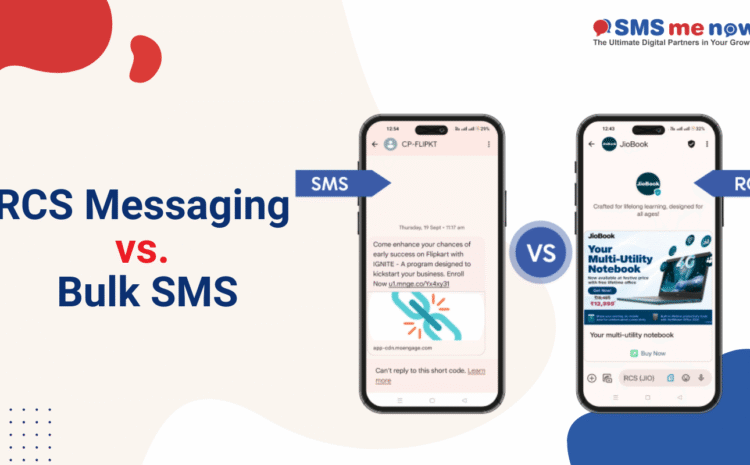
RCS Messaging vs. Bulk SMS: Is “Rich Communication Service” the Future of Mobile Marketing in India?
RCS Messaging vs Bulk SMS India 2026, For nearly three decades, Bulk SMS has been the undisputed king of mobile marketing in India. From OTPs to “50% Off” flashes, the humble 160-character text has reached every corner of the country. But in 2026, the landscape is shifting.
With over 500 million RCS-enabled devices currently active in India and the recent integration of RCS by Apple (iOS 18 and later) alongside Android, the “Rich Communication Service” protocol is no longer a futuristic experiment—it is the new gold standard. If Bulk SMS is the reliable postman, RCS is a high-end digital concierge.
But does this mean Bulk SMS is dead? Or is there a world where both coexist? Let’s dive into the evolution of mobile messaging in the Indian market.
Understanding the Contenders: SMS vs. RCS
To understand why 2026 is the “tipping point” for RCS in India, we must compare the technical and experiential differences between the two.
- Bulk SMS (Short Message Service): The “Universal Reach” channel. It works on every mobile phone—from a ₹1,000 feature phone to the latest flagship. It is text-only, limited in length, and relies on cellular networks rather than data.
- RCS (Rich Communication Services): Often called “SMS 2.0,” RCS brings the features of WhatsApp or iMessage (high-res images, videos, carousels, and read receipts) directly into the native messaging app of the phone. No app download is required.
The “Trust” Factor in 2026
In an era of rising phishing scams in India, Verified Sender Branding is the biggest differentiator. While an SMS comes from a cryptic 6-digit header (e.g., AD-DIALME), an RCS message displays your Company Logo, Brand Name, and a Verified Checkmark.
Feature Comparison: The 2026 Breakdown
| Feature | Bulk SMS | RCS Business Messaging |
| Content Type | Plain Text (160 characters) | Images, Video, Carousels, PDFs |
| Interactivity | None (Static links only) | Action Buttons (Call, Locate, Pay) |
| Branding | Sender ID (Header) | Logo + Verified Brand Profile |
| Analytics | Delivery Status Only | Read Receipts + Button Click Rates |
| Network | Cellular (No internet needed) | Data / Wi-Fi (with SMS Fallback) |
| Average Open Rate | ~45% – 70% | ~98% |
| Typical Cost (India) | ₹0.10 – ₹0.15 | ₹0.11 – ₹0.20 |
Why RCS is Exploding in the Indian Market
The rapid adoption of RCS by India’s “Big Three” operators—Reliance Jio, Airtel, and Vi—has created a unified ecosystem.
- Zero-Friction Engagement: Unlike WhatsApp, where a user might need to “Opt-in” or save a number, RCS lands in the default inbox. There is no barrier to entry.
- The “Carousel” Effect: Indian e-commerce brands are seeing a 4–6x higher click-through rate (CTR) by using carousels. Instead of saying “Check our new collection,” you can show 10 swipeable products with “View Price” buttons right in the text thread.
- Conversational AI Integration: In 2026, RCS is being paired with AI chatbots. A customer can track a package, reschedule a flight, or verify a COD order through a series of suggested reply buttons without ever leaving the message app.
- Cost Efficiency vs. WhatsApp: While RCS is slightly pricier than Bulk SMS, it is often 70-80% cheaper than a WhatsApp Business API “Marketing Conversation,” making it the most cost-effective “Rich Media” channel in India.
When to Use Which? A Strategic Hybrid Approach
The “Future” isn’t about choosing one; it’s about Omnichannel Intelligence.
- Use Bulk SMS for:
- Universal Reach: Reaching rural populations or users with feature phones.
- Critical Alerts: Emergency notifications where data/Wi-Fi might be unavailable.
- High-Volume OTPs: For basic logins where cost-efficiency is the priority.
- Use RCS for:
- Marketing Campaigns: Product launches, festive sales (Diwali/Holi), and abandoned cart recovery.
- Customer Support: Interactive FAQs and automated booking flows.
- Trust-Critical Messages: Transactional alerts where a verified logo reduces customer anxiety.
✨ Future-Proof Your Messaging with DialMeNow
At DialMeNow, we don’t just send messages; we build conversations. As a leading messaging partner in India, we help businesses navigate the transition from plain text to rich media.
- ✅ Unified API: One integration that handles Bulk SMS, RCS, and WhatsApp with automatic SMS Fallback (if a user doesn’t have RCS, they get an SMS).
- ✅ Brand Verification: We manage the 5–10 day Google/Operator verification process to get your brand the “Green Tick” and logo.
- ✅ Rich Media Builder: Use our drag-and-drop tool to create carousels and interactive “Suggested Actions” without writing a line of code.
- ✅ Real-time Analytics: See exactly who opened your message and which products they swiped on.
The era of “Texting” is over. The era of “Engagement” is here.
❓ Frequently Asked Questions (FAQ)
Q1: What is the current reach of RCS in India?
A: As of early 2026, over 500 million devices in India support RCS, covering the vast majority of smartphone users across Jio, Airtel, and Vi networks.
Q2: Does RCS work on iPhones in India?
A: Yes! Following the iOS 18 update, Apple supports RCS. However, the experience may vary slightly from Android depending on carrier settings.
Q3: What happens if I send an RCS to a phone that doesn’t support it?
A: This is handled by “Smart Fallback.” The system detects the device capability and automatically delivers the message as a standard Bulk SMS so your reach is never compromised.
Q4: Is RCS messaging more expensive than Bulk SMS?
A: Yes, typically RCS costs between ₹0.11 and ₹0.20 per message in India, compared to ₹0.10-₹0.12 for Bulk SMS. However, the ROI is usually higher due to increased engagement.
Q5: Do I need DLT registration for RCS?
A: While Bulk SMS requires DLT (Distributed Ledger Technology) template registration, RCS currently follows a brand verification process through Google and the telecom operators.
Q6: Is internet required for RCS?
A: Yes, RCS requires a data connection (3G/4G/5G/Wi-Fi). If the user is offline, the message can fall back to traditional SMS.
Q7: Can I send videos via RCS?
A: Absolutely. RCS supports high-definition video, GIFs, and high-resolution images, unlike SMS/MMS.
Q8: How is RCS different from WhatsApp Marketing?
A: RCS is “native,” meaning it doesn’t require an app download and lives in the phone’s default SMS app. It is also generally more affordable for bulk promotional campaigns than WhatsApp.
Q9: Can I include “Buy Now” buttons in RCS?
A: Yes, you can include interactive buttons that link to your website, open a map, or even trigger a UPI payment app.
Q10: What are “Suggested Replies”?
A: These are pre-set buttons at the bottom of a message (e.g., “Yes,” “No,” “Track Order”) that allow the user to respond with a single tap.
Q11: Can RCS be used for OTPs?
A: It can, but most businesses prefer Bulk SMS for OTPs due to its ability to work without an internet connection.
Q12: How long does it take to set up an RCS campaign?
A: Once your brand is verified (which takes about a week), launching a campaign can be done in minutes using a platform like DialMeNow.
Q13: Does RCS support group chats for businesses?
A: RCS supports group chat features for P2P, but for Business-to-Person (B2P), it is primarily a 1-on-1 interactive channel.
Q14: Is there a character limit in RCS?
A: RCS allows for much longer messages than the 160-character SMS limit, typically up to several thousand characters plus media.
Q15: How can I track the success of an RCS campaign?
A: Unlike SMS, you get detailed reports on Delivery, Read Receipts, and Click-through rates for every button in your message.
Disclaimer
RCS availability is dependent on the recipient’s device, operating system, and mobile network operator. Pricing and regulations (including TRAI guidelines) are subject to change. DialMeNow acts as a service aggregator and complies with all current Indian telecom regulations.
Conclusion
RCS is not just a “new type of SMS”—it is a bridge between the reliability of telecom and the richness of the modern mobile web. For Indian businesses, the question is no longer if they should adopt RCS, but how fast. By combining the massive reach of Bulk SMS with the interactive power of RCS, you can create a communication strategy that is both universal and irresistible.