
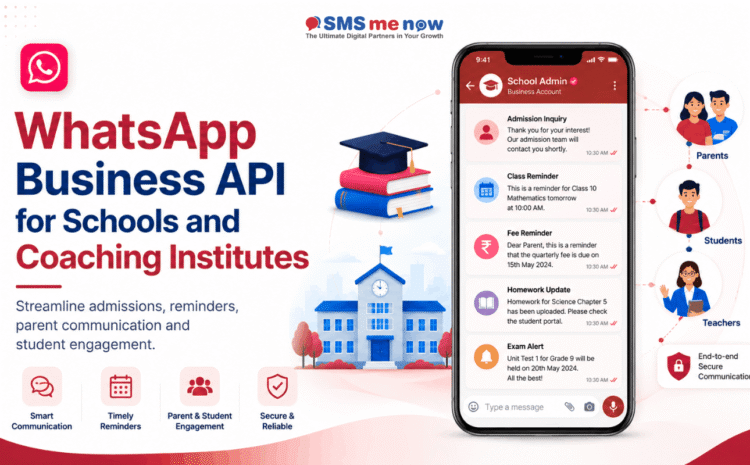
WhatsApp Business API for Schools and Coaching Institutes
Quick Answer: How Can Schools and Coaching Institutes Use WhatsApp Business API?
The WhatsApp Business API for Schools and Coaching Institutes helps educational organizations manage admission enquiries, qualify prospective students, share course details, send fee reminders, provide class updates, issue attendance alerts, schedule counselling sessions and respond to frequently asked questions through automated and human-assisted WhatsApp conversations.
It can be connected to a school’s website, mobile application, CRM, student information system, learning management system or admission-management software.
The WhatsApp Business Platform is designed for organizations that need to communicate at scale through APIs. It supports conversational journeys, interactive calls to action, rich media, backend integrations, notifications and automated customer-service workflows.
Introduction
Communication is one of the most important parts of managing a school, college, academy or coaching institute.
Parents want timely updates about attendance, fees, examinations and school activities. Students need information about class schedules, study materials, test results and upcoming deadlines. Admission teams must answer questions about courses, eligibility, fees, facilities, scholarships and application procedures.
When all these conversations are handled manually through phone calls or personal WhatsApp numbers, several problems can arise:
- Admission enquiries may remain unanswered.
- Staff may repeatedly answer the same questions.
- Important messages may get lost.
- Parents may not receive updates on time.
- There may be no clear record of previous conversations.
- Multiple staff members may contact the same student.
- Follow-ups may depend entirely on individual employees.
- Personal phone numbers may be used for official communication.
- Management may struggle to measure response and conversion performance.
The WhatsApp Business API for Schools and Coaching Institutes offers a structured solution to these communication challenges.
It enables institutes to automate routine messages, organize student conversations, connect multiple staff members, integrate with existing software and deliver a more convenient experience to parents and students.
However, successful implementation requires more than sending bulk messages. Educational institutions should create clear communication journeys, obtain appropriate permission, protect student information and combine automation with human support.
What Is WhatsApp Business API?
The WhatsApp Business API, commonly presented by Meta as the WhatsApp Business Platform, allows organizations to integrate WhatsApp with their websites, applications, CRM platforms and backend systems.
Unlike a normal personal WhatsApp account, the platform is designed for structured and scalable communication.
It can support:
- Multiple authorized users
- Automated chatbots
- Admission enquiry management
- Interactive message buttons
- WhatsApp Flows
- Approved message templates
- CRM integration
- Student database integration
- Lead assignment
- Conversation tracking
- Automated reminders
- Human-agent handover
- Delivery and messaging reports
Meta describes the WhatsApp Business Platform as suitable for medium and large organizations that need programmatic access and customer communication at scale.
WhatsApp Business App vs WhatsApp Business API for Education
The WhatsApp Business App and WhatsApp Business API are different solutions.
WhatsApp Business App
The standard Business App may be enough for:
- Small tuition centres
- Individual tutors
- Limited daily enquiries
- One or two staff members
- Mostly manual conversations
- Basic greeting messages and quick replies
WhatsApp Business API
The API is better suited for:
- Large schools
- School groups with multiple branches
- Coaching institutes with many courses
- Universities and colleges
- Online learning platforms
- Admission consultancies
- High enquiry volumes
- Multiple counsellors
- Automated communication
- CRM or ERP integration
- Centralized conversation management
A growing coaching institute may start with the Business App, but the API becomes more useful when enquiry volumes increase and multiple employees need access to organized conversations.
Important Uses of WhatsApp Business API for Schools and Coaching Institutes
1. Admission Enquiry Automation
Admission teams receive many repetitive questions, such as:
- Which courses are available?
- What is the fee structure?
- What is the admission process?
- What is the age or qualification requirement?
- Is transportation available?
- Are scholarships available?
- What are the class timings?
- Where is the institute located?
- Can I book a counselling session?
A WhatsApp chatbot can answer these questions instantly and guide the user toward the correct course or admission department.
Example welcome message
“Welcome to our institute. Please select the information you need.”
Suggested options:
- New Admission
- Course Details
- Fee Structure
- Book Counselling
- Existing Student Support
- Talk to Our Team
This helps users find the next step without typing a long message.
2. Lead Qualification for Admissions
Not every admission enquiry has the same level of interest.
A chatbot or WhatsApp Flow can collect:
- Student’s name
- Parent’s name
- Current class or qualification
- Course of interest
- Preferred branch
- City
- Admission session
- Learning mode
- Budget range
- Preferred counselling time
The system can then categorize the enquiry as:
- High-intent admission lead
- Information-seeking lead
- Scholarship enquiry
- Existing student
- Parent support request
- Ineligible enquiry
- Future-session prospect
This allows counsellors to prioritize students who are ready for the next step.
WhatsApp Flows supports structured, form-like experiences inside WhatsApp and can be used to collect information, book appointments and create customized user journeys without requiring the user to leave the chat.
3. Course and Programme Recommendations
A coaching institute may offer multiple programmes, including:
- School tuition
- Competitive examination preparation
- Government examination coaching
- Engineering entrance preparation
- Medical entrance preparation
- Language courses
- Professional certifications
- Skill-development programmes
- Online classes
- Test series
The chatbot can recommend a suitable programme based on the student’s:
- Current academic level
- Examination target
- Preferred learning mode
- Available timings
- Location
- Preparation stage
Example
A student selects:
- Current class: 12th
- Goal: Engineering entrance
- Learning mode: Offline
- Preferred branch: Jaipur
The system can automatically share the appropriate programme, batch schedule, brochure and counselling options.
4. Counselling and Campus Visit Booking
Students and parents can schedule:
- Admission counselling
- Career guidance sessions
- Campus visits
- Demo classes
- Scholarship tests
- Parent meetings
- Faculty consultations
A structured WhatsApp Flow can display available dates and time slots and allow the user to submit a booking request.
The system may then send:
- Booking confirmation
- Location details
- Counsellor information
- Required-document list
- Reminder before the appointment
- Rescheduling options
This reduces manual coordination and makes the admission process easier.
5. Click-to-WhatsApp Admission Campaigns
Schools and coaching institutes can run Facebook and Instagram advertisements that allow prospective students or parents to begin a WhatsApp conversation directly.
A complete journey may work like this:
- A parent sees an admission advertisement.
- The parent clicks the WhatsApp button.
- An automated greeting appears.
- The chatbot asks about class, location and admission session.
- The system shares relevant information.
- The lead is saved in the CRM.
- A counsellor receives the enquiry.
- A callback or campus visit is scheduled.
Official WhatsApp guidance identifies ads that click to WhatsApp as an entry point through which users can begin business conversations. Other possible entry points include website buttons, social posts and QR codes.
6. Fee Reminders and Payment Updates
Educational institutions can send approved, non-promotional notifications related to:
- Upcoming fee due dates
- Pending instalments
- Payment confirmations
- Receipt availability
- Late-payment notices
- Scholarship adjustments
- Refund updates
- Transport-fee reminders
Example fee reminder
“Dear Parent, the second-term fee for your child is due on 10 September 2026. Please complete the payment through the secure link provided in the student portal. Ignore this message if payment has already been completed.”
Messages should include only necessary information. Sensitive financial or student data should not be exposed unnecessarily.
7. Attendance Alerts
The API can be connected to an attendance-management system to send notifications such as:
- Student absent today
- Student arrived late
- Student checked in
- Consecutive absence detected
- Attendance percentage below requirement
Example
“Dear Parent, your child was marked absent from today’s first session. Please contact the school office if this information is incorrect.”
Attendance notifications should be accurate, timely and based on verified system data.
8. Class Schedule and Timetable Updates
Institutes can use WhatsApp to communicate:
- Batch timings
- Classroom changes
- Faculty changes
- Extra classes
- Cancelled classes
- Rescheduled lectures
- Online class links
- Practical session timings
- Test schedules
- Holiday notices
This can be particularly useful for coaching institutes where batches and faculty schedules change frequently.
9. Examination and Result Communication
WhatsApp can support communication related to:
- Examination dates
- Admit-card availability
- Test reminders
- Seating instructions
- Result publication
- Scorecard links
- Performance reports
- Re-test schedules
- Parent-teacher meetings
Rather than including complete confidential results in a message, the institution can send a secure link to the student portal after appropriate verification.
10. Study Material and Learning Resources
Students can receive:
- Notes
- Assignment links
- Recorded class links
- Practice worksheets
- Test-series information
- Revision schedules
- E-books
- Important-question lists
- Faculty instructions
The institute should avoid sending large numbers of files without context. Resources should be organized according to class, course, subject and batch.
11. Frequently Asked Question Chatbot
A school chatbot can answer common questions about:
- Admission process
- Course eligibility
- School timings
- Uniform rules
- Transport service
- Fee payment
- Examination dates
- Holiday schedule
- Required documents
- Contact details
Routine automation can reduce repetitive work, while complex questions should be transferred to the correct staff member.
The WhatsApp Business Platform supports automated conversational flows and smart routing to live agents when human help is needed. It can also integrate with CRM and marketing-automation systems.
12. Parent Communication
Schools can create structured communication journeys for:
- Parent-teacher meeting reminders
- Attendance concerns
- Academic progress
- Event invitations
- Consent requests
- Transport updates
- School notices
- Emergency closures
- Assignment reminders
- Administrative announcements
Messages should be relevant and sent only to the appropriate recipients.
Real-World Education Example
Learnwise, a Kerala-based higher-education support platform, used WhatsApp Flows with ads that click to WhatsApp to automate its lead-screening process.
Prospective learners entered a short automated conversation that asked about their educational level, desired programme and reason for enquiry. The answers helped counsellors identify high-intent prospects and route them to the appropriate team.
According to the official WhatsApp case study, Learnwise reported:
- Four times more qualified leads
- A 60% reduction in employee time spent qualifying leads
- A 31% reduction in cost per qualified lead
These results were self-reported and are not guaranteed for every organization, but the case illustrates how structured qualification can improve an education admission funnel.
Benefits of WhatsApp Business API for Educational Institutions
Faster Enquiry Response
An automated assistant can reply immediately, including outside regular office hours.
Better Admission Management
Prospective students can be qualified and assigned to the appropriate counsellor.
Reduced Staff Workload
Routine questions, reminders and confirmations can be automated.
Centralized Conversations
Multiple authorized employees can work through an organized business inbox instead of using personal numbers.
Personalized Communication
Messages can be customized based on course, class, branch, language, admission stage or student type.
Improved Follow-Up
Counsellors can view previous interactions and understand the student’s requirement before responding.
Better Parent Experience
Parents receive important information through a familiar communication channel.
Integration With Existing Systems
WhatsApp may be connected to:
- Admission CRM
- School ERP
- Student information system
- Learning management system
- Fee-management software
- Attendance system
- Appointment calendar
- Website
- Mobile application
Performance Measurement
Institutions can measure:
- Number of enquiries
- Flow completion rate
- Qualified leads
- Counselling bookings
- Admission conversions
- Message delivery
- Response time
- Agent performance
Scalable Communication
The API allows institutions to manage growing communication volumes without depending entirely on manual processes.
Recommended Admission Funnel on WhatsApp
Stage 1: Attract
Bring students and parents into WhatsApp through:
- Website buttons
- Facebook and Instagram ads
- Google Ads landing pages
- QR codes
- School brochures
- Newspaper advertisements
- Education fairs
- Social media posts
Stage 2: Identify the Requirement
Ask whether the user needs:
- New admission
- Course information
- Fee details
- Counselling
- Existing-student support
Stage 3: Qualify the Enquiry
Collect only essential details.
Stage 4: Share Relevant Information
Send:
- Course brochure
- Eligibility
- Fee range
- Facilities
- Batch timing
- Campus location
- Admission deadlines
Stage 5: Book the Next Action
Encourage the user to:
- Schedule counselling
- Book a campus visit
- Attend a demo class
- Register for a scholarship test
- Submit an application
Stage 6: Human Follow-Up
A counsellor should take over for complex questions and conversion discussions.
Stage 7: Measure the Result
Track whether the enquiry resulted in:
- Counselling
- Application
- Campus visit
- Admission
- Lost lead
- Future follow-up
Best Practices for Schools and Coaching Institutes
- Keep chatbot menus simple.
- Use clear and parent-friendly language.
- Ask only necessary questions.
- Maintain separate journeys for admissions and existing-student support.
- Provide access to a human counsellor.
- Avoid sending excessive promotional messages.
- Obtain appropriate permission before ongoing communication.
- Protect information relating to minors.
- Do not include sensitive academic or financial data unnecessarily.
- Verify backend information before sending automatic alerts.
- Use role-based access for staff members.
- Maintain opt-out and communication-preference records.
- Test every automated journey before launch.
- Review message templates and platform policies regularly.
Businesses should obtain appropriate opt-in before sending ongoing business-initiated communication. Official WhatsApp guidance recommends requesting consent through clear messaging and allowing users to choose whether they want to receive future messages.
Common Mistakes to Avoid
Sending the Same Message to Everyone
A nursery-school parent, competitive-exam student and existing coaching student require different communication.
Using Personal Numbers for Official Communication
This can create privacy, ownership and continuity issues when employees leave.
Sending Too Many Messages
Frequent and irrelevant notifications may frustrate parents and students.
Collecting Unnecessary Student Data
Only collect the information needed for the stated purpose.
Making the Chatbot Too Complicated
Long menus and excessive questions increase drop-offs.
Not Providing Human Support
Automation should assist staff, not completely block access to them.
Failing to Connect the CRM
Without integration, lead status, ownership and follow-up history may remain unclear.
Ignoring Data Security
Access permissions, secure APIs, staff roles and data-retention rules should be planned before launch.
WhatsApp Business API Pricing for Educational Institutions
The cost of implementation may include:
- WhatsApp messaging charges
- Business solution provider fees
- Shared inbox subscription
- Chatbot development
- CRM or ERP integration
- WhatsApp Flow development
- Template setup
- Server and hosting costs
- Maintenance and support
- Advertising budget
Meta currently uses per-message pricing for delivered messages. Pricing depends on the recipient’s market and message category. The platform recognizes marketing, utility, authentication and service message categories, with rates varying by market and category.
Schools and institutes should obtain a customized quotation based on their expected enquiry volume, number of branches, integrations and automation requirements.
Frequently Asked Questions
1. What is WhatsApp Business API for schools?
It is a business messaging solution that allows schools to automate and manage admission enquiries, parent communication, fee reminders, attendance notifications and other student-related conversations through WhatsApp.
2. Can coaching institutes use WhatsApp API for admissions?
Yes. Coaching institutes can capture enquiries, collect student details, share course information, schedule counselling and assign leads to admission counsellors.
3. Can multiple staff members use the same WhatsApp number?
Yes. Depending on the selected platform, multiple authorized staff members can manage conversations through a shared team inbox.
4. Can WhatsApp API connect with a school ERP?
Yes. It can be integrated with compatible ERP, CRM, attendance, fee-management and student-information systems through APIs or supported connectors.
5. Can schools send attendance alerts on WhatsApp?
Yes. Attendance systems can trigger approved alerts for absences, late arrivals or attendance-related concerns.
6. Can coaching institutes send class reminders?
Yes. Institutes can send batch reminders, class updates, test schedules, faculty changes and online-session links according to current platform policies and user permissions.
7. Can WhatsApp Flows be used for admission forms?
WhatsApp Flows can collect structured information inside a chat. They can be used for initial admission enquiries, counselling requests and short qualification forms. Formal applications may still require a secure portal where necessary.
8. Is WhatsApp API suitable for small coaching centres?
It can be useful when the centre receives many enquiries or needs automation. Very small centres with limited manual conversations may initially use the WhatsApp Business App.
9. Is WhatsApp Business API free?
The complete implementation is generally not free. Costs may include messaging charges, software subscriptions, provider fees, integrations, chatbot development and support.
10. How can an institute start using WhatsApp Business API?
The institute should define its communication goals, prepare a WhatsApp Business Platform account, select an implementation method, create approved message templates, connect required software, configure automation and train staff before launch.
Conclusion
The WhatsApp Business API for Schools and Coaching Institutes can improve how educational organizations communicate with students, parents and admission prospects.
It can be used to automate:
- Admission enquiries
- Student qualification
- Course recommendations
- Counselling bookings
- Fee reminders
- Attendance alerts
- Class updates
- Examination notices
- Study-material delivery
- Parent communication
The platform is most effective when it is connected to a structured admission or student-management system.
Institutions should avoid treating WhatsApp as an unrestricted bulk-messaging channel. Communication should remain relevant, timely, secure and based on appropriate permission.
A successful implementation combines automation with human support. Chatbots can handle repetitive tasks, while counsellors, teachers and administrative staff manage complex or sensitive conversations.
With the right strategy, WhatsApp can help schools and coaching institutes reduce communication delays, organize admissions, improve parent engagement and deliver a more convenient student experience.
Start Your WhatsApp Business API Integration
Improve admissions, student communication and parent engagement with a customized WhatsApp Business API solution.
Book a consultation through our website to discuss:
- Admission chatbot development
- WhatsApp Flow setup
- Click-to-WhatsApp campaigns
- School ERP integration
- CRM integration
- Fee and attendance notifications
- Parent communication automation
- Counselling booking
- Multi-agent inbox setup
- Message-template configuration
- Reporting and analytics
- Technical support
Our team can design a WhatsApp communication system based on your institution’s courses, branches, enquiry volumes and existing software.
Disclaimer
This article is provided for general educational and informational purposes only. It does not constitute legal, regulatory, privacy or cybersecurity advice.
WhatsApp Business Platform features, message categories, pricing, template requirements and policies may change. Schools, coaching institutes and other educational organizations should review the latest official Meta and WhatsApp documentation before implementation.
Institutions should obtain appropriate consent, follow applicable privacy and data-protection laws, maintain secure access controls and take additional care when processing information relating to children or minors.
The examples and reported case-study outcomes in this article do not guarantee identical results. Actual performance depends on the institution’s audience, location, advertising strategy, course offering, automation quality, counsellor response time, sales process and technical implementation.
For a solution tailored to your institution, book a consultation through our website before starting the integration.